The ringing of the phone at two in the morning struck my heart like a hammer against glass. I had been asleep only a few hours, wrapped in the quiet stillness of a house that had grown too silent since my husband passed years ago. When the shrill tone cut through the darkness, something inside me instantly knew this wasn’t a wrong number. It wasn’t a casual call. Nothing good breathes through the phone at two in the morning. My bones felt cold as I reached for it, hand trembling before I even touched the screen. I expected the worst, but nothing prepared me for the soft, shaking whisper that poured into my ear the moment I answered.
“Grandma… I’m at the police station… they don’t believe me…”
It was Lily. My granddaughter. My sweet, bright-eyed Lily who always giggled when she visited and left little doodles on my fridge. Her voice was cracked and thin, like she was trying not to cry. Something in me locked up — fear, instinct, helplessness all tangled together in a way only a grandmother could understand. I sat on the edge of my bed, clutching the phone with both hands as if holding it tight enough would somehow pull her closer. I asked her what happened, but all she kept repeating was, “Please come… please… they won’t listen to me…”
The fear in her voice carved an ice path down my spine. I didn’t wait for explanations. I didn’t ask questions. I just grabbed my coat, my keys, and hurried toward the door with my heart beating so violently it almost drowned everything else out. The roads at that hour were empty, a blanket of fog hovering over the pavement like the world itself was holding its breath. Every red light felt like a personal attack, every second wasted on the road a weight on my chest. What could have happened? Why was she at the station? Why didn’t they believe her? A thousand unspoken fears clawed at my mind — drugs, wrong place at the wrong time, someone hurting her, someone setting her up. I didn’t know what was waiting for me when I arrived. I only knew that she needed me.
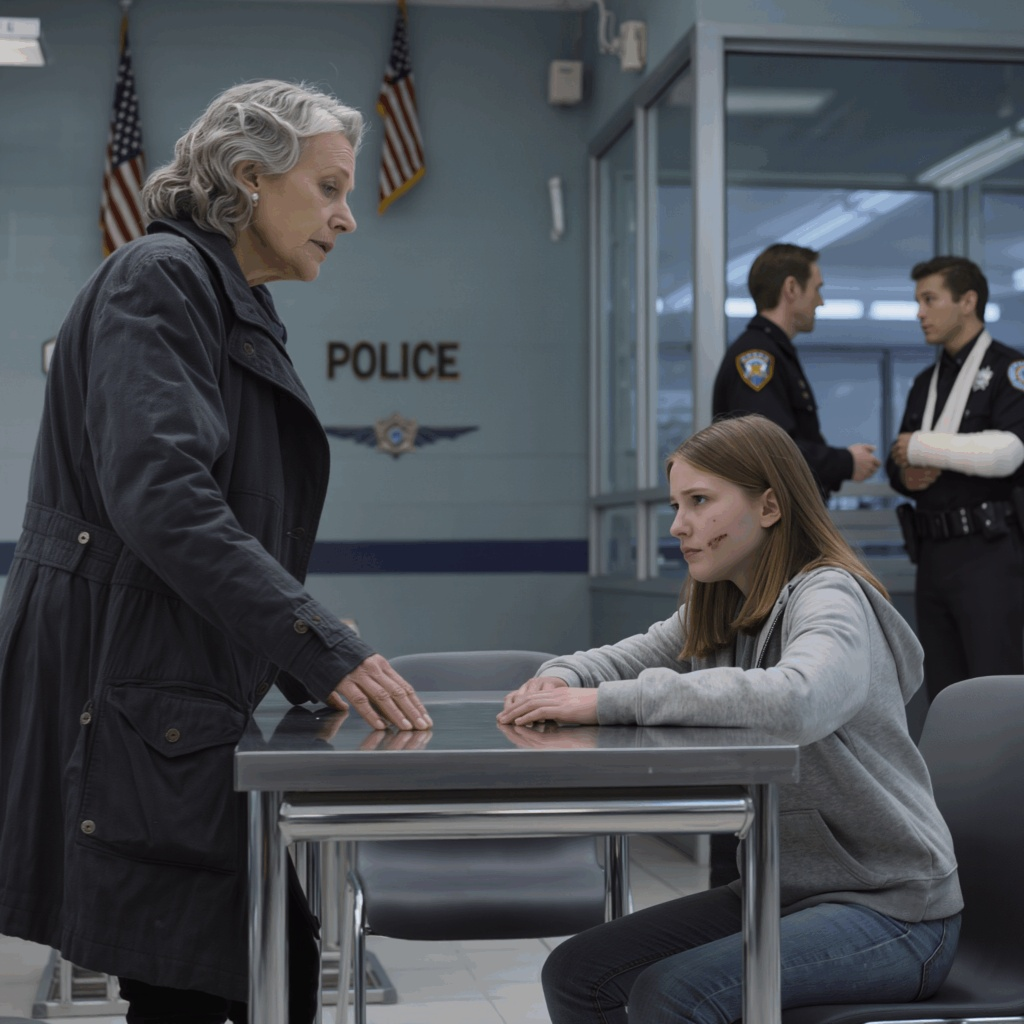
When I stepped into the police station, the fluorescent lights overhead felt too harsh, the air too stiff and indifferent. Two officers stood behind the front desk, their expressions unreadable, eyes tired from dealing with the endless stream of nighttime chaos. I told them who I was and who I was here for. One exchanged a look with the other — not cruel, not mocking, but something like restrained annoyance mixed with unease. “Your granddaughter is in the interview room,” the first officer said. “We’ve been trying to get a clear statement, but… well… she insists on something improbable.”
The word “improbable” stabbed at me. They weren’t saying she was lying. They weren’t saying she was guilty of anything. They were saying she was scared and confused and alone — and no one here cared enough to understand why. I demanded to see her. They hesitated, of course, with their procedures and their rules and their structured ways of handling frightened teenagers, but something in my expression must have told them I wasn’t leaving without her. They led me through a hallway that smelled faintly of burnt coffee and paperwork. And when they opened the door to the room, I saw her — my Lily — curled in the metal chair, arms wrapped around herself, eyes swollen from crying.
She looked up the moment she sensed me, and her face crumpled with relief as she ran into my arms. I held her tight, tighter than I had held anyone in years, feeling her shaking against me. “Grandma,” she whispered against my shoulder, her breath trembling. “I didn’t do anything. I swear I didn’t. But they won’t believe what I told them.”
I guided her back to the chair gently, sitting beside her, hand in hers. I told her to speak slowly, to tell me everything from the beginning. The officer stepped back, arms crossed, waiting to hear the same “improbable” story he’d already dismissed. But Lily’s voice was steadying now, strengthened by my presence, anchored by my hand holding hers. She explained that she had been walking home from her friend’s house — a place she had been countless times — when she saw a man standing near the alley. At first, she thought he was just waiting for someone. But when she walked past him, he whispered her name. Not “hey” or “excuse me” — he whispered her name.
She turned around, confused, thinking she recognized him. But she didn’t. He was a stranger. A stranger who somehow knew her name.
She panicked and tried to run, but he stepped toward her and said something that sent a bolt of terror through her body: “I’ve been waiting for you.”
That was when she froze. She didn’t scream, didn’t fight — fear locked her in place. But before anything else happened, a car drove by and the stranger backed away into the shadows. Lily ran to the nearest open business — a late-night diner — where the staff helped her call the police. But when the officers arrived and questioned her, the story sounded too “strange,” too “unlikely.” They assumed it was anxiety, or confusion, or fear exaggerating details. No one believed that a random man whispering her name could be real. No one believed the danger she felt.
But I did. I believed her immediately.
I asked the officers why they didn’t check the area or look for cameras. They said they did — briefly — but found nothing suspicious. They assumed she was shaken from walking alone at night. They said she was safe now. They said she should calm down. They said she might have misheard the stranger. They said too many things that didn’t matter.
I looked at my granddaughter’s trembling hands and knew something deeper was wrong — not just with the situation, but with the way they dismissed her fear. I told them we were leaving. They didn’t stop us.
In the car, Lily stayed quiet for the first few minutes, staring out the window as the streetlights blurred past. When she finally spoke, her voice barely filled the space between us. “Grandma… I know what I heard. He said my name.”
I reached over, squeezing her hand. “I believe you. And we’re going to figure out who he is.”
That night, I didn’t let her sleep in her room. She stayed with me, curled under the blankets like she used to as a child when thunderstorms frightened her. I sat awake long after she drifted into uneasy sleep, my mind racing through the strange pieces of the story. A man waiting in an alley. Whispering her name. Saying he’d been waiting for her. Too specific to be random. Too personal to be coincidence.
I called her parents — my son and daughter-in-law — but they were out of the country on a work trip. They were hours away from even hearing my voicemail. So it was up to me. I checked the locks twice, then three times. I peered through the blinds at the empty street. The unease was building inside me like a tightening knot. Something wasn’t right. Something was circling us in the dark, unseen but very real.
The next morning, while Lily slept, I sat at the kitchen table with my old laptop, digging through anything I could find — recent reports, local incidents, strange activity. And that’s when I found the first piece. A woman, only two neighborhoods away, had reported something eerily similar two weeks earlier: a stranger whispering her name from the shadows outside her home, retreating before help arrived. The police dismissed it as anxiety due to lighting and shadows. No investigation followed.
I found another report. And another.
Three women. Three different streets. Three strangers whispering their names. All dismissed.
A chill crawled up my spine. This wasn’t Lily’s imagination. This wasn’t coincidence. This was deliberate. And whoever he was… he had been watching more than one girl. He wasn’t new. He wasn’t random. He wasn’t done.
I printed everything I found, marched back to the police station, and slammed it all onto the counter. The same officer from the night before looked at me like he couldn’t believe I dared return. But he read the pages. His jaw tightened. His expression shifted from annoyance to unease. They called a detective. They opened a case. They realized — far too late — that a predator had been lurking under their noses, watching the girls in this town.
But none of that mattered compared to the moment Lily looked at me that afternoon and said, “Grandma… thank you for believing me.”
Those words sank deeper into me than anything else that had happened. Because I realized something painfully clear — sometimes the difference between being safe and being lost is the one person who refuses to doubt you when everyone else does.
And that night, as I stood at my window watching the quiet street outside, I felt the truth settle into my bones like a warning:
This wasn’t over.
He was still out there.
And he had spoken her name for a reason.