I was 64 years old when the first crack appeared — not in the walls of my home, not in the weathered wood of the tasting room, not in the roots of the old syrah vines I’d nurtured since I was a quiet-dreaming young woman — but in a stack of papers bearing my signature in ink I had never applied. I had believed, for a long time, that love could bloom in the late chapters of life, that laughter and shared sunsets over rows of grapevines could be the soft cadence of a late-bloom romance. So when I married Gabriel, the handsome man with salt-and-pepper hair and a calm voice that made me feel lighter than I had in years, I let myself believe it could be that story — the gentle one, the hopeful one, the story of “second chances.” After three decades of running Elizabeth Vale Vineyard and Winery — building it from a borrowed tractor and one acre of old fields into a celebrated estate known from Sonoma to Seattle — I’d learned a thing or two about soil, seasons, patience, and what it takes to shape something meaningful. I thought I knew what hard work looked like. I thought I knew what trust looked like. I hadn’t fully learned yet what deception looks like beneath the most pleasant smile.
It began with small things that felt almost imperceptible at first: the way Gabriel started joining me on business calls uninvited, the way he casually suggested “improvements” to accounting practices in tones that sounded more like commands than ideas, the way he lingered over my business plans with an intensity that felt less like curiosity and more like ownership. I brushed these observations away for a long time — out of love, out of hope, out of sheer disbelief that someone I opened my life to could have anything but genuine affection for me and my work. I thought this time would be different — that age brings wisdom, and wisdom brings discernment — but sometimes even the most seasoned discernment is blind to the subtleties of deliberate design.
Then came the day I opened my mail and found an envelope thicker than usual, addressed to me in a professional font I recognized immediately — legal documents. Papers I was supposed to sign to finalize changes to the company’s operating agreement, to relinquish managing control, to add a new partner with the power to make unilateral decisions about finances, assets, and the very identity of Elizabeth Vale. My heart didn’t skip so much as stopped when I saw the language. My name was on every page — not just signed, but forged in an elegant, practiced hand. I felt that first, dull thrum of real fear — not the fear of losing a person, but the fear of losing the life I had built, the legacy I had poured decades into, the vineyard rows that had been my morning horizon longer than some marriages last. I read the words again and again, not believing that such documents could exist with my name if I hadn’t signed them. A cold knot formed in my chest, and suddenly all those small disturbances — the calls, the suggestions, the unsolicited decisions — aligned themselves in an unsettling clarity.
I didn’t open the front door for anyone that day. I just stood in the foyer of our Victorian farm house, sunlight broken through the vines outside casting long lines across the hardwood floor, and felt something inside of me shatter like glass struck too hard. I felt betrayal not only from his actions but from the quiet, gnawing awareness that I had ignored my instincts because I wanted love to be true. I had wanted a partner to share the harvests with, not someone who wanted to take from what I had nurtured.
I called my attorney without hesitation. The calm voice on the other end of the line — someone who had helped me draft those original business agreements thirty years ago — didn’t gasp or judge. She simply said, “We will need the originals, and we will file a motion to void the forgeries as soon as possible.” There was reassurance in her tone, not pity, just clarity and expertise. I felt a spark of myself return then — the part of me that had never depended on others to make things right.
When I told Gabriel I was seeking legal counsel, his face didn’t show remorse. It didn’t show shame. It showed annoyance. He said, with far too casual a tone for someone accused of forgery, “It was just paperwork. We could have talked about it.” Those words, uttered in that gentle voice I had once trusted, were like nails on vitrine glass. There was no remorse. No apology. No sense of wrongdoing. Just assumption of entitlement — as though my business, my reputation, and my autonomy were just another asset to be rearranged for convenience.
The legal battle that followed was not quick. It was not dramatic in the way courtroom shows make conflicts appear. It was meticulous. It was hours of document examination, expert testimony, signatures verified against records, handwriting analysts, motions filed, hearings scheduled, and more than once I left the court chambers feeling worn out but still resolute. I learned the texture of legal language intimately; I memorized clauses about powers of attorney and fiduciary duties; I understood, with clinical precision, how forgery works and how it is defined within the law. I was no longer the hopeful partner in love. I was a plaintiff, a business owner asserting her rights, a woman who refused to let her legacy be hijacked because someone misunderstood her generosity for weakness.
But the deepest transformation wasn’t legal. It wasn’t financial. It was emotional.
In the quiet moments between hearings, I walked the vineyard rows alone at dawn — the way I used to with my husband, before profit margins and legalities ever entered my mind — and felt the raw, undiluted life force of those vines beneath my feet. I watched as the sunlight broke over the hills, illuminating fields of merlot grapes heavy with promise, and I felt something I hadn’t allowed myself in years: peace and clarity coexisting not in contradiction, but in harmony.
I realized then that the woman who built Elizabeth Vale was not weak. She was not naive. She was dedicated. She was perceptive. And she was strong enough to stand firm when deceit appeared like a friendly shadow rather than a clear threat. My attorney eventually secured an injunction to nullify the forged documents, and the court affirmed that the vineyard and winery remained fully in my name and control. Gabriel was ordered to relinquish any claim, and his access to financial accounts and business operations was permanently revoked. It was a legal victory, yes — but the true victory was the reclamation of my agency.
When the final ruling came down, I didn’t throw a party. I didn’t make a toast with fine wine. I walked out onto the vineyard terrace with a glass of my own 2015 estate pinot noir in hand, the fog lifting from the hills like it was releasing a breath it had been holding too long, and I let the significance of the moment wash over me. Not as vindication, not as triumph over someone who betrayed me, but as an affirmation that I am the steward of my own life and legacy.
And then something unexpected and beautiful happened.
One of my managers — a woman named Rosa who had worked with me for over two decades and understood the soul of Elizabeth Vale as intimately as I did — raised her glass toward me and said gently, “You didn’t just save the vineyard. You taught all of us what strength looks like when it isn’t loud — when it is quiet and rooted.”
That sentence — quiet and sincere, steeped in loyalty and respect rather than applause — was more meaningful than any court ruling ever could be. It affirmed not just the survival of a business, but the persistence of human dignity.
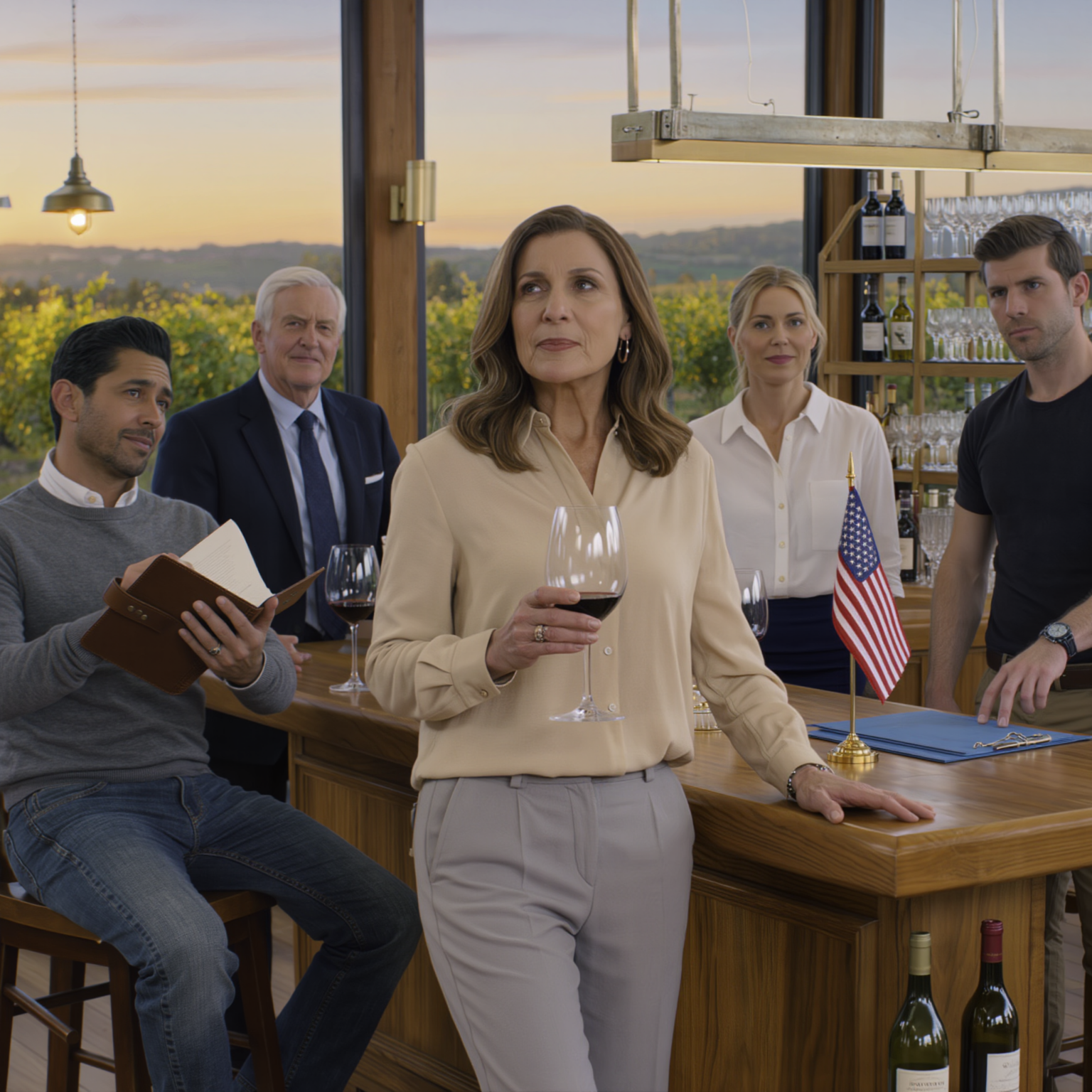
I spent that night in the tasting room with friends and staff who had become family over the years. We talked about harvests past and plans future. We laughed about the quirks of old oak barrels. We toasted life, loss, love, and lessons learned. I didn’t speak about betrayal. I didn’t talk about pain. I simply spoke about possibility — about how even when life offers us moments that feel like turning points of despair, we have the capacity to rise not with bitterness, but with resolve, self-respect, and clarity.
Looking back now, I see something I wasn’t able to see in the fog of that early betrayal: love is not the absence of discernment. Trust does not mean abandoning vigilance. And generosity should never be mistaken for surrender.
I was 64 when I understood that my second marriage was not a love story. It was an attempted takeover of something I had spent my life building — vineyard rows that spiral down the hills like ribbons of promise, barrels aging quietly in cellars, bottles filled with sun and patience and hope. But in the realization of that truth, I also found a deeper truth:
I didn’t lose love.
I gained myself again.
And that — more than any vineyard, any winery, any legacy in the external world —
is the part of my story I cherish most.