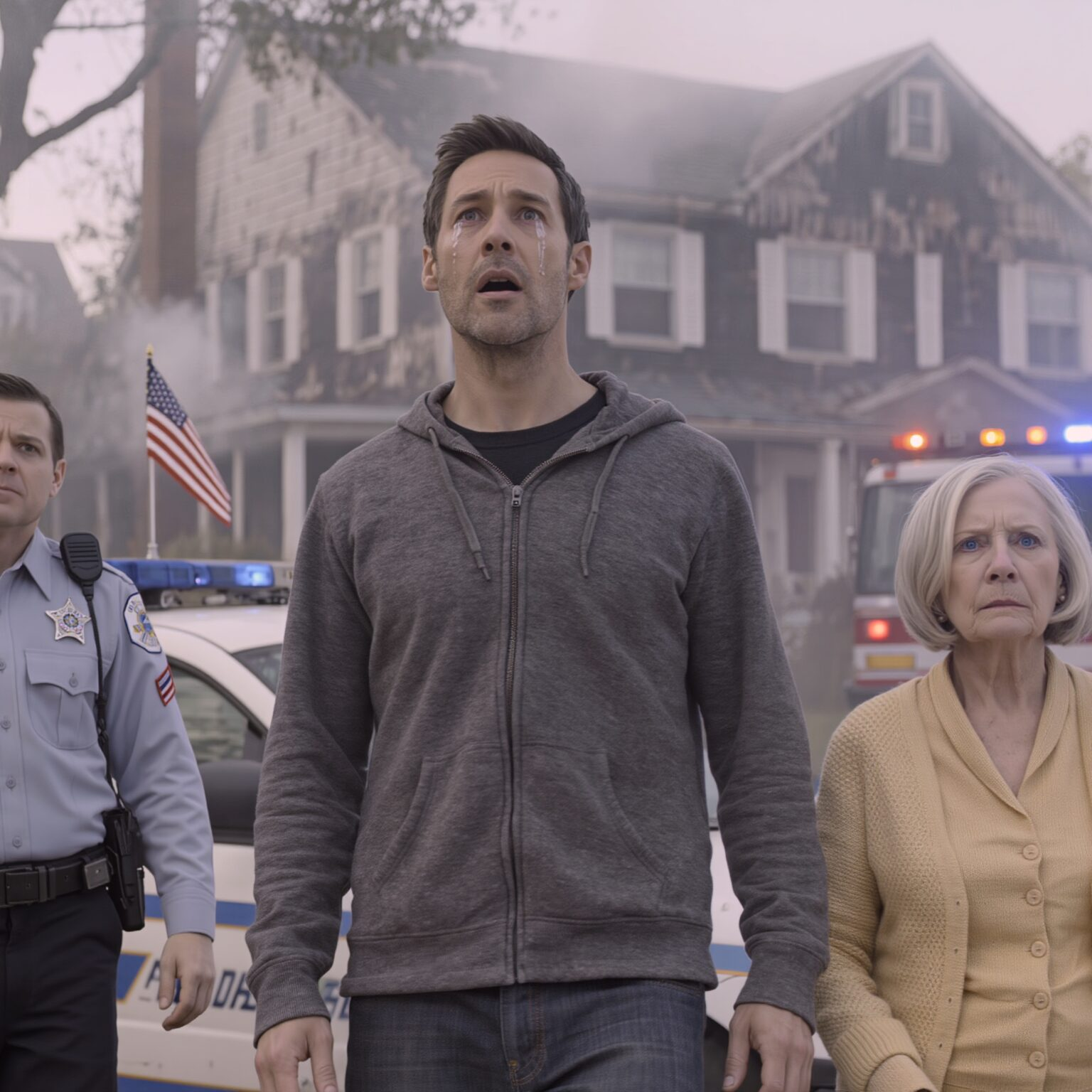
Smoke roared through the windows, thick and bitter, the kind that burns lungs before you even realize the pain’s coming. The heat pushed at my skin, the flames dancing across the walls like hungry ghosts. I barely had time to think — the living room exploded into orange light, the roof groaned, windows shattered. My son, Mark, screamed my name once, then cursed and ran toward the door. Chaos swallowed everything I’d built.
I stumbled backward, grabbing at whatever I could — a coat rack, the edge of a bookshelf — as the fire raced through the house. My heart hammered. My lungs burned. I thought of the garden we planted, the laughter in the kitchen, the pictures on the walls. I thought: this is it. The end.
But I remembered the garage door. The heavy manual latch I had added last summer. A silly precaution I made for storms, little did I know I’d need it for something much worse. Summoning the last of my strength, I wrenched the latch free, crawled through the darkness into the garage, closed the door behind me. The world outside — the fire, the flames, the screams — became muffled. I sank against the cold concrete, gasping for breath, one hand pressed to my chest, the other on the dusty floor.
Smoke seeped in through a crack, but the walls held firm. The flames raged outside. The house collapsed with a final, deafening crash. I curled into a ball, tears streaming down my soot-streaked face, the heat still roaring above, my ears ringing. Somewhere in the distance I heard sirens. Firefighters. Neighbors yelling. Then silence.
When I finally dared step out, the night was cool. Ash floated through streetlight beams. The house — my home — was gone. Charcoal shells marked where walls once stood. My heart felt hollow. And yet I was alive. Alive.
The next day, word spread quickly. The house fire made local news. The shock. The tragedy. Sympathy. And beside it all, the insurance claim. Mark called me — or so I later learned — and announced that the insurance payout would go to him: he said I hadn’t made it out in time. He said I was gone. He said I didn’t survive.
He had reported me dead. Legally — dead. My name erased from the ledger. The house and payout signed over to him. The house we built together.
I sat quietly in the battered garage, clutching a small bag with a few clothes and a photo of my husband and me. Outside, the world moved on. Strangers knocked at the burnt lot. Agents measuring debris. Police asking questions — but no one asked me, because as far as the paperwork said, I didn’t exist anymore.
Days passed. I stayed hidden, too stunned to think, too betrayed to act. How could my own son — my flesh and blood — believe I died just to pocket the money from something I helped build? I felt anger, sorrow, disbelief. I felt broken. But I also felt a slow stirring of something else. A determination. A refusal to disappear.
I began collecting copies of paperwork from neighbors, from news broadcasts — anything referencing the fire, the claim, and “my death.” I made notes. I hid these inside a dust-covered toolbox in the garage. I kept the photo of my husband pressed between the bag’s thin fabric. And I waited — until the public interest in the fire faded, until insurance adjusters returned to their desks, until Mark started spending the money.
One crisp afternoon, I walked — quietly, without announcing myself — to the ruined foundation of what had been my home. I traced the ash with gloved fingers, remembering walls, doorways, the sound of laughter. I closed my eyes and whispered goodbye. Then I walked away. No pity. No fear. Just the quiet acceptance that I was done being erased.
I rented a small flat in a quiet neighborhood. I found work at the local diner — early mornings, late nights, honest wages. I did not ask for handouts. I did not expect kindness. I just wanted to exist — truly exist — on my own terms. My days were simple: a bowl of oatmeal, a walk to the diner, scrubbing dishes, serving coffee. My nights were quiet. The flat smelled of cheap paint and hot water, but it was mine. My survival.
I kept the toolbox hidden under the bed. Inside: the documents, the photo, the memory of betrayal. I never forgave Mark. I never called him. But I knew one day I would come for what was stolen. Not for money. Not for revenge. For dignity.
Month after month, I built a new life. I saved money. I made friends — kind strangers, fellow workers, people who didn’t know my past. I drank coffee when the dawn was pale. I tasted hope in the silence of early mornings.
Then, one evening, I walked past a worn-out parked car near the diner. I caught a glimpse of the license plate — the same one Mark’s friend used when he first drove us to that house so many years ago. My fingers tightened on the handle of my coat. I took a breath. My heart sped. I followed the car at a distance. I watched the friend enter a modest house. I waited until the lights inside went off. Then I knocked.
He answered. Surprised. Fear flickered in his eyes. I didn’t announce myself. I showed him the photo of the burnt house, the newspaper clipping, a small frame of the foundation — proof the past exists. He stumbled, stepped back. I spoke calmly. “I know everything.”
He tried to lie. But I had documents. I had memory. I had survival. I had truth. I told him I was willing to keep quiet — for a price. The truth had a cost. And now I was ready to collect it.
I didn’t need police. I didn’t need pity. I only needed justice. And I knew — from the wreckage and ash — that justice was something I could rebuild, one quiet step at a time.