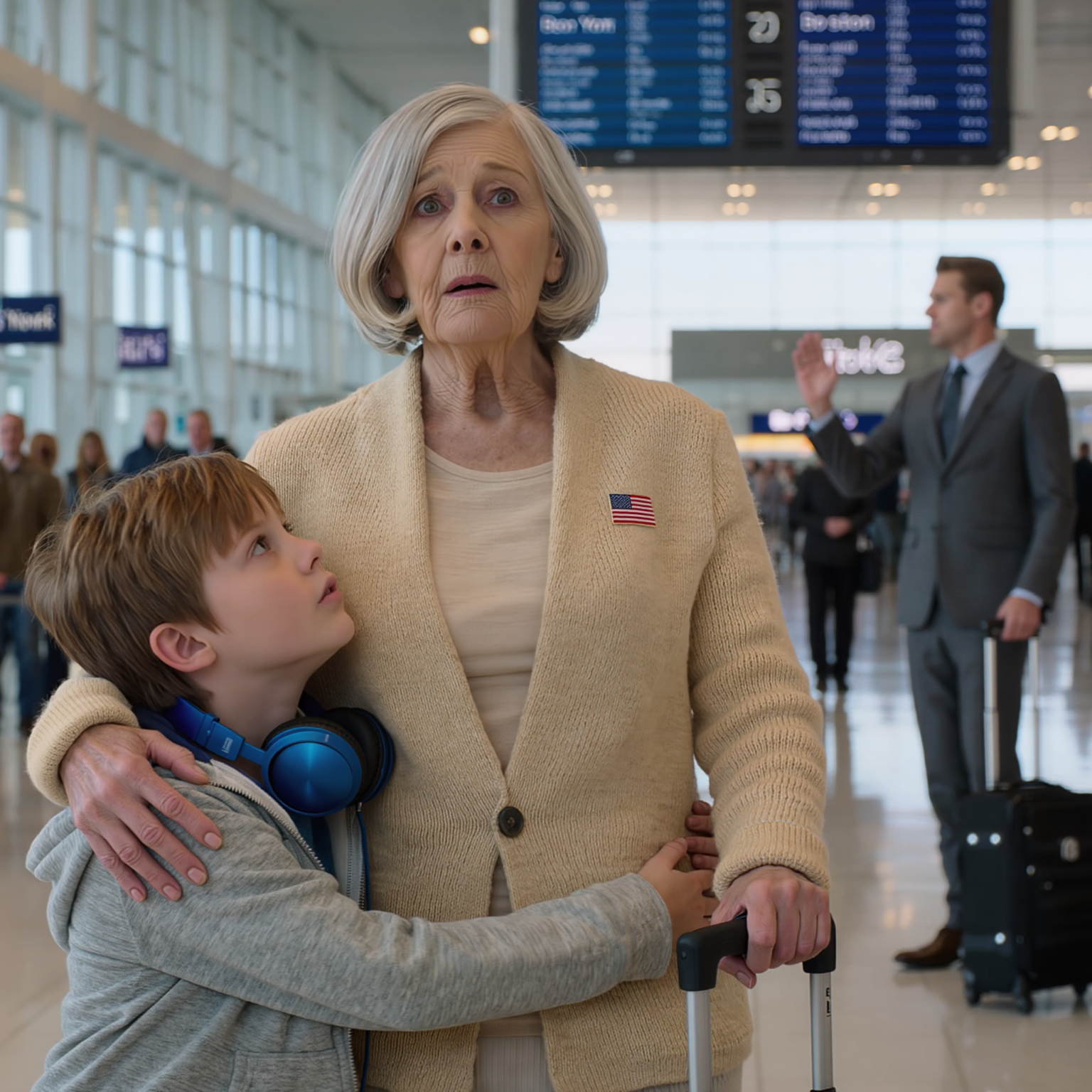
I remember the lights first. Not the sound, not the panic, not the shouting of gate agents or watches vibrating with delay alerts or boarding group changes scrolling across screens. Just the lights in São Paulo’s international airport, fluorescent, aggressive, humming with that sterile brightness that always pushes Mateo too far too fast. I knew before Daniel did that this trip was already lost to overstimulation, to crowds, to a world that refuses to dim itself for children who need darkness to breathe. Mateo sat beside me with his knees tucked up, fingertips tapping against his shoelaces, rhythm precisely the same as it always was when he began to fold inward. He looked seven, maybe eight to strangers, though he was eleven. Small for his age but emotionally enormous to carry. I understood his silence. Daniel did not. He understood the world by doing, fixing, pushing, striving. Mateo understood it only by pattern. When pattern breaks, Mateo breaks. When Mateo breaks, Daniel breaks. And when Daniel breaks, the whole world collapses behind him like an unlatched suitcase spilling onto polished airport floors. The announcement came at 2:11 p.m., clear, accented, and merciless: six-hour delay, gate change, new terminal, expect crowding. Daniel winced as if someone had physically struck him. I saw the exact second the rope inside his spine snapped. He had been holding everything too tightly for too long: single father, full-time job, therapy schedules, sensory routines, teachers calling, forms and evaluations and meetings and judgments. The invisible punishment of parenting a child the world insists must be “corrected” instead of accepted. He lifted Mateo’s bag, then set it down, then lifted it again. His breathing wasn’t angry, just collapsed, thin, fraying. “Mom,” he said, voice stripped of armor, “I can’t do this anymore.” It wasn’t abandonment. It wasn’t cruelty. It was a drowning man’s final inhale before slipping underwater. He took three steps back, then five, suitcase wheels rattling. Mateo didn’t scream. He didn’t run after him. He didn’t panic. He simply leaned into me, head against my shoulder, eyes wide open but no tears. Just sensory shutdown. His fingers pressed into my sleeve like he was pinning himself to Earth before floating away. Daniel disappeared into the clamor of passport lines and perfume-clouded duty-free aisles, swallowed by movement, needing to not exist for one hour, possibly for one lifetime. I held Mateo while announcements pounded against us in three languages. Passengers rolled suitcases past our feet, annoyed, impatient, whispering about the boy rocking gently against my arm. They always whisper. They always assume noise means misbehavior, stillness means obedience, difference means danger. Mateo wasn’t dangerous. He was overwhelmed. This wasn’t tantrum, this was overflow. I slipped the noise-canceling headphones over his ears. Instantly, his shoulders softened. His breathing lengthened. He sank into a quieter universe built only for him. We sat on the floor beneath gate signs flickering like failing stars. I do not know how long we remained there, but time inside airports is not linear. It is a ceilingless waiting room between worlds, where days compress into minutes and panic stretches into eternity. A security officer approached, but without suspicion. “There is a sensory room now,” he said gently, “for situations like this. Families use it all the time.” I nodded, grateful, lifting Mateo carefully. He clung to my arm but walked, trusting my steps more than the ground beneath him. The sensory room was tucked behind frosted glass, an oasis of dimness, with padded corners, fiber-optic tubes, soft mats, and slow-changing colors that moved like the sea at dawn. Peace in architecture form. Mateo sat before the glowing strands, his fingertips brushing them like one might touch sunlight if sunlight could be held. His rocking slowed until his body became still as a waiting photograph. I could finally breathe. Two hours later—I counted only because my watch vibrated—Daniel returned. But not the Daniel who left in panic, jaw clenched, eyes foggy with failure. This Daniel had cried somewhere private, where men are still taught to unravel only in isolation. His shoulders shook. His suitcase handle quivered in his hand. He knelt before his son, not apologizing with words but offering presence, which is heavier and more sacred than any spoken regret. Mateo looked at him and extended one headphone, pressing it against Daniel’s ear. It was the highest form of communication Mateo could give: you need quiet too. You need softness too. You are allowed to feel everything you cannot say. Daniel cried then—not out of shame but out of release, the kind that comes when someone finally learns they can fall apart without losing the people who love them. I rested a hand on his back. “You didn’t abandon him,” I whispered. “You broke. There is a difference.” He lowered his head into his palms. “Everyone thinks I should be stronger.” “No,” I said. “Everyone should help you carry it.” We forget that parents, especially those who raise neurodivergent children, aren’t built from steel. They are built from sleepless nights, guilt, hope, fear, paperwork, therapy appointments, confused stares from strangers, and love so dense it compresses the lungs. In that room, none of us were teacher or savior or disappointment. We were simply three humans trying to redistribute weight before someone shattered permanently. Mateo reached for Daniel’s hand, anchoring him back to Earth. There was no resentment in his touch, no memory of the moment Daniel disappeared into the crowd. Mateo does not store time the way we do; he stores energy, tone, vibration. His father returned without anger, without threat, so Mateo accepted return as the only truth that mattered. When boarding finally reopened, there was no rush. The sensory room had reset all three of us, like hearts syncing after a storm. We walked toward the gate, Daniel holding Mateo’s backpack, Mateo holding my wrist, and me holding both of them with the invisible web of love that has always kept us from splitting apart. At the gate, Mateo hummed softly—one of his rare comforts—an old lullaby Daniel used to play on the car radio when Mateo was younger and storms in his mind were louder. Daniel’s eyes welled again, not from panic, but from recognition: his son was not slipping away, not disappearing into his condition. He was here, present, humming, existing in a world too loud but finding ways to filter it. As we boarded, a woman who had passed us earlier stopped me. “Your grandson,” she said, “he handled it so quietly. So beautifully.” I smiled faintly. People mistake silence for calm. They do not see the earthquakes that happen beneath stillness. On the plane, Mateo curled against Daniel, headphones on, breathing even. Daniel remained awake, staring ahead, not in dread but reflection. “Mom,” he said quietly, “I didn’t mean to go. I just—” “I know,” I answered. “Even machines have emergency switches. Humans should too.” He leaned back, closing his eyes, releasing a lifetime of expectation that he must be perfect, must never buckle, must never need rescue. The air between us shifted into something gentler. Not forgiveness, because nothing needed forgiving—only understanding. When we landed many hours later, Mateo signed thank you into Daniel’s palm, a gesture his therapist taught him months ago. He rarely used it unless the moment carried real weight. Daniel kissed his son’s forehead. “I love you too,” he whispered, the translation Mateo never needed spoken aloud. The world will never make itself quiet enough for boys like Mateo, or forgiving enough for fathers like Daniel, but sometimes a single room—a sensory sanctuary hidden behind glass—can hold three lives long enough for each to remember they are not required to survive alone. That day in São Paulo, in a collapsing airport of impatience and fluorescent chaos, the breaking was the healing. The leaving was the breathing. The silence was the language. And the mother, the father, and the boy walked out not cured, not changed, but synchronized, finally, to the same rhythm of love that has no volume and no translation.
The Airport Breakdown That Changed Everything