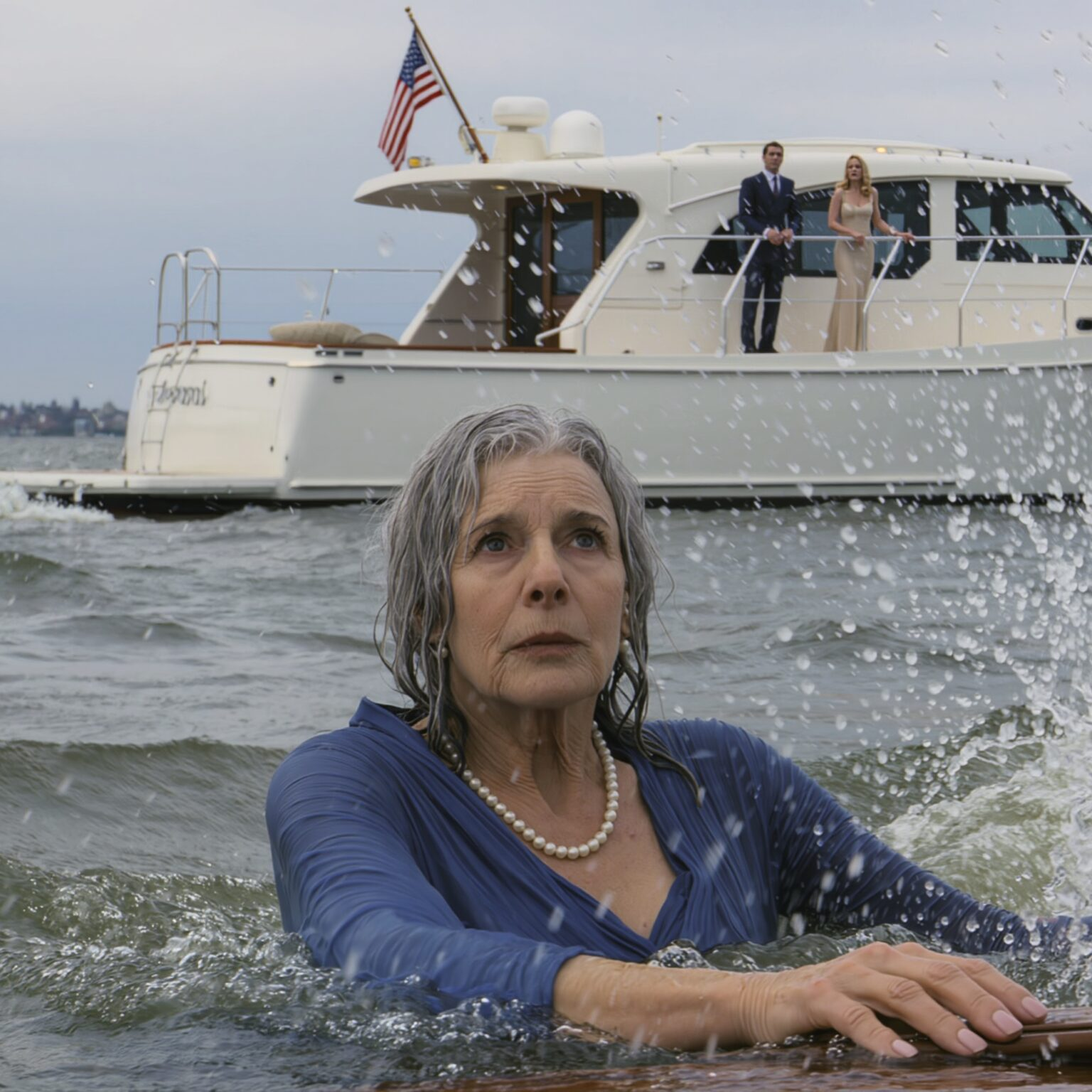
I knew something was wrong the moment I stepped on the yacht. Not because the sky was gray or the waves aggressive—they were calm, too calm, like the world had staged a false peace. What felt wrong was their faces. My son and his wife wore expressions that were too smooth, too polished, like actors who had been practicing lines for weeks. Their smiles were stretched wide, and their eyes were glassy with anticipation, hunger, calculation. They ushered me aboard with dramatic gestures and exaggerated warmth, insisting I relax, sit, enjoy the sea air, breathe in the luxury. They said it was a gift, a symbolic moment, a celebration of “all I had done for them,” yet the way they kept watching me made the words feel like traps wrapped in silk.
Champagne appeared within seconds. Not poured—presented, flaunted, drenched in ice and status. My daughter-in-law lifted her glass with her glittering nails and said, with voice syrupy enough to choke, “To a beautiful new chapter for the family.” My son echoed her, adding, “And to a mother who knows how to let go gracefully.” The word let carried weight, not spoken like ease but like command. I told myself to ignore the undertone, to believe in celebration, to believe that perhaps they were finally honoring me after years of financial support, emotional labor, endless stepping aside so their dreams could fill center stage while mine shrank like neglected plants.
The yacht drifted from shore quickly, faster than necessary. I noticed because land thinned, shrank, dissolved. My son directed the captain with swift gestures, confident as if he owned the sea, the crew, the horizon. Then came the envelope. Not wrapped in gold, not disguised in ribbon, but thick, blunt, heavy with legal ink. I opened it with hands suddenly colder than the wind. Documents stared back at me like verdicts: asset transfer, account authorization, estate control, liquidation access. My name appeared on every page, not honored or praised but positioned as an obstacle to be erased quietly and efficiently.
My son leaned back as if settling into a throne. His smile didn’t waver, but something behind it sharpened. “Mom,” he began, voice gentle but stripped of affection, “there’s no need to complicate life with lawyers or old-fashioned legal delays. You’ve lived your life. Now let us live ours.” The phrasing was surgical. It did not ask for kindness. It assumed entitlement. His wife chimed in, eyes gleaming like the surface of a diamond cut too perfectly, “You don’t need the apartments, the investments, the vacation property, the accounts. You’re comfortable. You have retirement. We’re just… accelerating the natural timeline.”
Accelerating. Meaning: taking before death to avoid waiting. Meaning: smiling while engineering extraction. Meaning: calling theft efficiency. They weren’t ashamed. If anything, they were proud of the precision. The yacht, the champagne, the ocean—every aesthetic detail curated to make coercion feel like luxury. They believed setting the stage made the act cleaner, more civilized, less monstrous, as if betrayal loses venom when served with oysters and salt air.
I refused quietly. Not dramatically. Not angrily. I simply said, “No.” That single syllable shattered their script. I saw the truth snap beneath their skin like wire pulled past tension. My son’s face tightened—not with sorrow but with irritation, as if he couldn’t understand why I would interrupt a business plan with humanity. His wife’s voice dropped its sweetness violently. “Don’t be selfish,” she hissed, tone no longer dripping with charm but stripped to its metallic core. “You raised him to be successful. Now let him succeed.”
Succeed by taking everything I built. Succeed by leaving me with scraps. Succeed by turning motherhood into an exploitable asset rather than a memory of sleepless nights, sacrifices, years of bending until I nearly broke. When I refused again, they didn’t negotiate. They didn’t reason. They simply executed phase two. My son signaled the captain. Without drama, without cinematic cruelty, I was escorted by two crew members—faces blank, trained, emotionless—to the lower deck where a small auxiliary vessel waited.
They didn’t push me. They didn’t scream. They simply removed me like an inconvenient suitcase. My son kissed my cheek with chilling efficiency and said, “When you’re ready to sign, call us.” The yacht moved away, not rushed, not panicked, just confidently slicing through water with the arrogance of people who believe they own outcomes. I sat alone, floating, the sea stretching endlessly beneath me like a truth too enormous to deny: they never wanted celebration, closure, connection, gratitude. They wanted liquidation.
Time on open water is not real time. Hours feel like decades. The sun burns slower, the wind grows teeth, and the brain begins to unravel precise betrayals in terrifying clarity. Every childhood memory of him resurfaced—not the cute ones, not the first steps, first drawings, birthday candles. What replayed were the moments I had ignored: the entitlement at sixteen, the callousness at twenty, the transactional nature of his affection at thirty. I had believed growth would soften him, maturity would humble him, marriage would humanize him, but all those things only sharpened what was already there: appetite without empathy.
When the fishing crew found me, half-drenched in fear and salt, they didn’t ask about documents or assets or inheritances. They asked if I needed tea, blankets, calm. Their boat was small, paint chipped, engine loud, but the humanity on it was wider than any yacht. As I told them the story, not as a wealthy matriarch betrayed by heirs but as a mother stripped of her final illusion, they didn’t look shocked—they looked unsurprised. One of them, wrinkled and sunworn, said, “The sea has two types of passengers: those who want to control it and those who respect it. Yours didn’t respect anything—not even you.”
Back on land, the world moved quickly. Lawyers, banks, digital trails. My son and his wife had recorded everything—not because they were stupid but because arrogance blinds itself. Their own phones, yacht surveillance, crew testimony. Their confidence became their undoing. They tried to frame abandonment as cooling-off strategy, coercion as inheritance planning. But the law reads intention differently than social media captions. Their accounts froze before they could enjoy what they attempted to harvest. Their names now sit in legal databases not as heirs but as manipulators flagged for financial predation.
The ocean did not drown me. Betrayal did not unmake me. If anything, the salt, the solitude, the abandonment burned something clean inside me: the permission to stop parenting adults who only see parents as wallets. I no longer mourn the version of my son I invented to survive his greed. I do not wait for apologies, redemption arcs, poetic reconciliation. I sit now in a harbor apartment where gulls cry and boats pass, and I breathe not like a mother clinging to legacy but like a woman finally released from obligation. There is life after disillusionment. There is quiet after storming inheritance wars. There is dignity in choosing self over children who have long chosen assets over blood.
They wanted me to sign my future away on the water. Instead, the water signed theirs.