The rain hammered against the train station roof so violently that every conversation, every complaint, every irritated sigh felt drowned under the weight of thunder. People were angry, restless, late, wet, and loudly reminding the universe that they deserved better timing. Suitcases slammed, toddlers cried, old men cursed the weather, the delay announcements repeated like a broken machine: “All trains are currently delayed. We apologize—” but clearly, no one in that station was in the mood for apologies. I stood there, clutching my ticket, soaked from the storm, exhausted from a workweek that felt like a year. Nobody cared about anyone else; they only wanted out, home, done. Then, slicing through all that noise, came the smallest, thinnest voice I had ever heard: “Sir… my mom is crying in the bathroom.” It shifted the air. Not a scream, not a tantrum, not dramatic—just a terrified whisper from a boy who couldn’t have been more than seven. People heard it. I know they did. They just chose not to care. They glanced, rolled eyes, returned to phones. Delay misery > a child’s panic. That’s modern humanity.
But one man looked up.
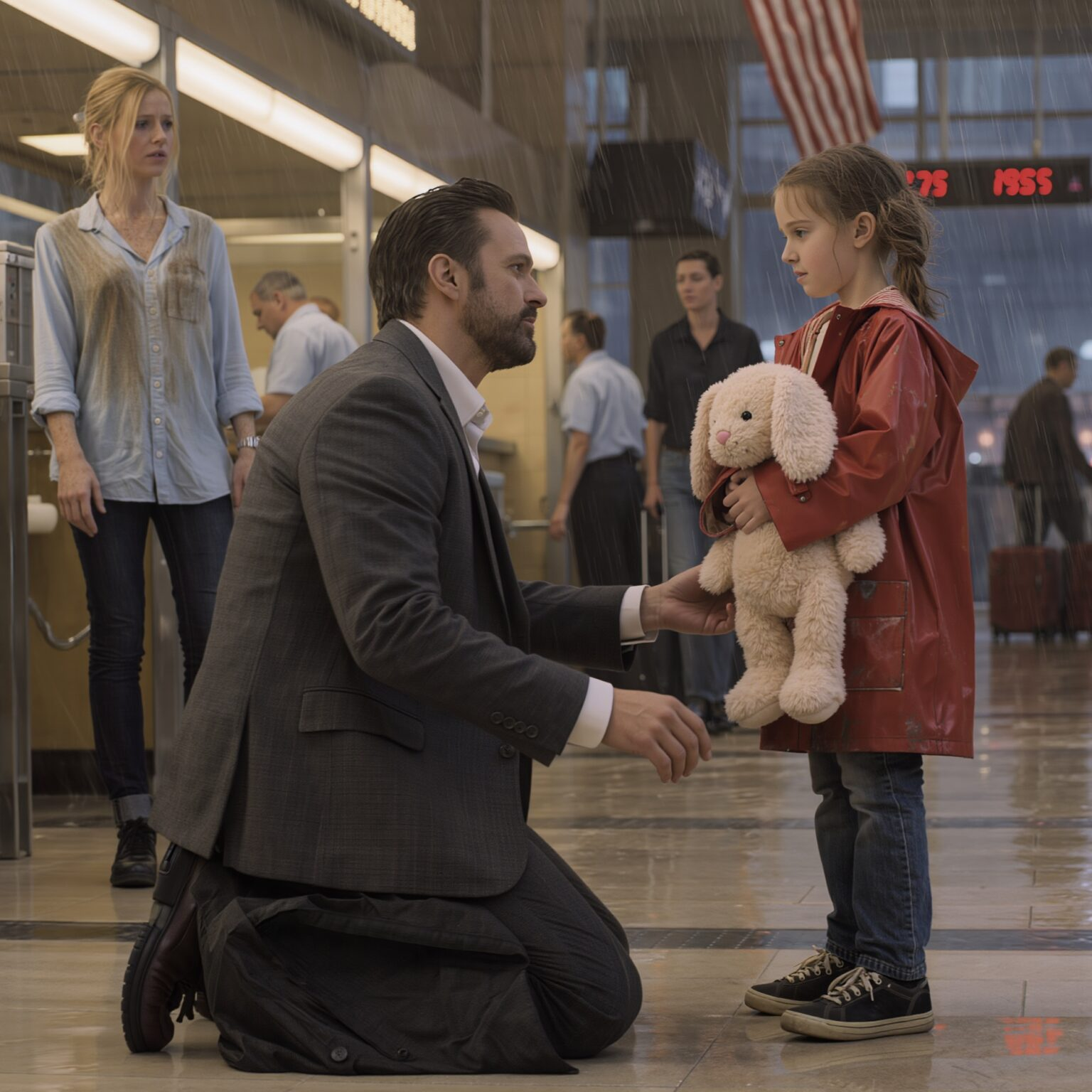
He was tall, sharply dressed in an expensive black coat, crisp suit beneath, shoes polished enough that even the murky station lights caught reflection. His posture screamed control. Power. Money. Status. But his eyes—his eyes cut through the noise with something rarer: attention. He didn’t shush the boy, didn’t tell him to calm down, didn’t ask where security was. He simply stepped forward, lowering himself to the boy’s level, voice steady, “Tell me what happened.” The boy’s fingers clenched his backpack straps so tight his knuckles paled. “She… she went into the bathroom after talking to Grandma… and she won’t come out. She’s not okay. She won’t answer me. I’m scared.” Something in the man’s expression changed—not pity, not annoyance, but recognition. He stood and said, with quiet authority, “Show me.” No hesitation. No waiting for staff. No asking permission. He followed the boy, and for reasons I don’t fully understand even now, I followed too. The corridor towards the bathrooms was dim, echoing with the station’s haunting mix of thunder and fluorescent hum. The boy stopped at the last stall, knocking shakily. “Mommy… I brought help… please talk to me…” Silence. Then a broken, shattered sob from behind the door. Not attention-seeking, not dramatic—just a human soul collapsing.
The man nodded to a station attendant who had hurried after us, and with swift, careful precision, the door was unlocked. She sat there on the floor of the stall, knees held tight, hands shaking so badly she couldn’t even wipe her tears. Phone face-down beside her, showing dozens of missed calls. Her breathing came in sharp, painful gasps. Her son rushed to her, hugging her waist. “Mommy, please don’t cry…” She tried to speak but could only whisper apologies—apologies for existing, for crying, for frightening her own child. “I’m sorry… I just… I can’t anymore…” she choked out. The CEO—not yet known to us as one—didn’t recoil, didn’t lecture, didn’t perform compassion for cameras. He simply said, calmly, “You are exhausted. Not failing.” It was like the words pulled a string and her posture collapsed even further—not because they hurt, but because she had finally been seen. She sobbed harder, shaking, “Everyone needs me. Everyone calls me. Everyone depends on me. But no one asks if I’m okay. They just… take. And keep taking. And I’m invisible even when I scream—” she broke off, voice strangled with humiliation.
He knelt beside her, coat brushing the wet floor, not caring. “You don’t need to explain. You need to breathe.” No condescension. No judgment. Just presence. That rare, ancient form of empathy: witnessing. He helped her stand, wrapped his coat around her shoulders, guided her gently out into the waiting area where chaos had strangely softened. The crowd that had ignored her son now stared, shame flickering across faces. She explained—in trembling fragments—how she worked full-time, cared for her son alone, sent money to her ill mother, handled every crisis, every bill, every sleepless night while her husband traveled, called occasionally, but never asked the most basic human question: Are you okay? She hadn’t broken because of a phone call. She had broken because endurance runs out when nobody sees the person holding the world.
The CEO made one call. One. Within fifteen minutes, an assistant arrived carrying towels, food, blankets, even dry clothes for the child. The efficiency was chilling—and comforting. He had not helped; he had rescued. She shook her head in disbelief. “I can’t accept this. You don’t even know me,” she whispered, shaking. He met her gaze without blinking. “I know what collapse looks like. I lived it. And I didn’t save someone when I could have. I won’t repeat that mistake.” The words hit harder than thunder. He turned to her son, gently brushing rain from the boy’s hair. “You did the right thing. You protected her. That makes you brave.” The boy’s chest rose with new pride, replacing fear.
Then the man said something that stunned everyone: “I booked you a hotel—food, rest, silence. Tonight you only sleep.” She burst into tears again—not from pain, but from the shock of being offered rest instead of expectation. “No one has ever… given me space to stop,” she whispered. “They only ask me to continue.” He nodded. “The strongest ones are always the ones drowning silently. Tonight, you float.” They turned to leave, but before stepping into the rain, he said, softly but clearly, “My wife carried everything alone until she couldn’t anymore. I didn’t see her breaking. Don’t apologize for being human. Apologize only if you stop being one.”
With that, he placed his umbrella over her and led them through the storm. No cameras. No applause. Just three souls disappearing from a station that suddenly felt less mechanical, less selfish, less numb. When they were gone, silence replaced complaints. Suddenly delayed trains were not the crisis. The crisis was how many mothers, wives, caregivers, and silent warriors collapse in bathroom stalls while the world shouts for them to continue. We have forgotten tenderness. He hadn’t. And for a moment, that entire station remembered how to be human again.