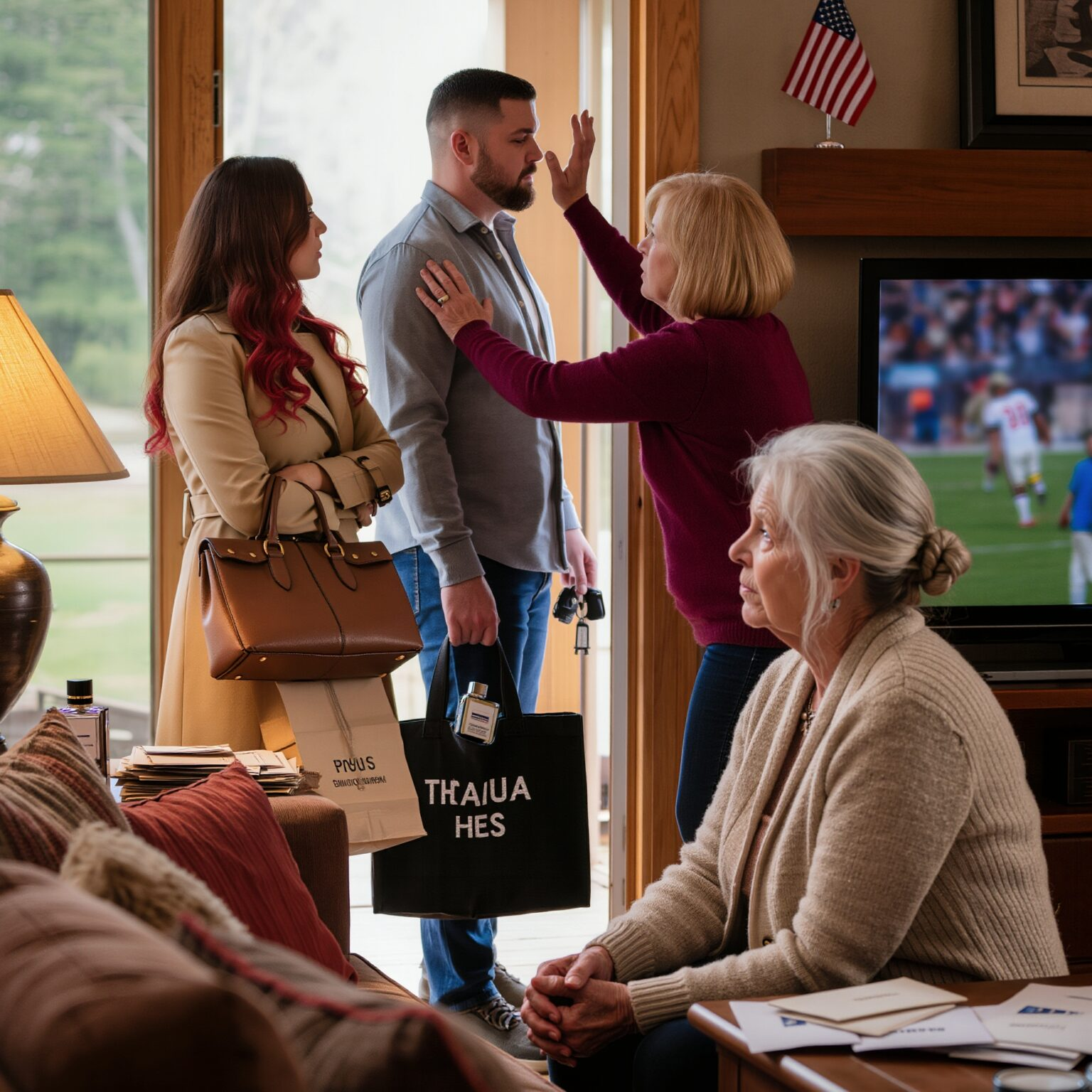
I never expected New Year’s Eve to arrive like a storm that drenches everything in its path. I had spent weeks preparing the house in Texas, arranging tables, ordering flowers, polishing crystal, and hanging the fairy lights that glowed with soft gold over the living room. The smell of roasted turkey and cinnamon-spiced desserts floated in every corner, and the children had giggled for hours, decorating the tree and placing little gift boxes under it with notes that said, “To Grandma, With Love.” Everything was perfect—or so I thought.
We arrived early, all of us dressed in our holiday best, a family that smiled for the cameras even though, deep inside, tension had always simmered. My husband carried our youngest, laughing at his jokes and tying his tie with that same nervous precision he had always had when hosting relatives. My mother-in-law had arrived last, her silver hair perfectly coiffed, pearls gleaming around her neck. She carried herself like someone who had been used to authority, and tonight, like every night, she expected the respect she believed she had earned.
I had invited everyone: children, grandchildren, cousins who traveled from other states, neighbors, and even a few old friends who always loved a dramatic toast. The house was alive, every corner buzzing with laughter and conversation. I was proud. Proud of the home I had built, proud of the party I had organized, proud that my husband and I could make everyone feel welcome, even when certain tensions simmered under polite smiles.
Then it happened.
My daughter, the one with the fiery streak and a stubbornness that matched her late grandfather’s, grabbed my hand in the middle of the crowd, tugging me toward the center of the living room. She was holding something shiny—a small, golden crown. My heart started to race. I glanced around, confused, thinking it was part of a children’s game. But the look in her eyes told me this was something entirely different.
“Mom!” she shouted, her voice cutting through the chatter like a knife. “The new matriarch of this family!”
Before anyone could react, she stepped forward and placed the crown firmly on my mother-in-law’s head. The room fell silent, and every eye in the house turned toward us. My mother-in-law froze, the pearls around her neck shimmering in the candlelight, her face a mask of shock and indignation. I could see the color drain from her cheeks. I could hear the whispers start to ripple like waves.
I opened my mouth to say something, anything, but my daughter raised her hand, silencing me. She turned to the crowd and announced, “From this moment, Grandma may have the title, but she no longer controls the family. We are changing things. This family belongs to all of us, and we will no longer live under fear or intimidation!”
Gasps filled the room. The children stared wide-eyed, the adults murmured behind their hands, and my mother-in-law’s lips parted, but no words came out. She tried to remove the crown, but my daughter held it firmly, insisting that this symbolic act was now permanent for the night. For the first time in decades, she looked powerless. The room, which had been warm and inviting moments before, now felt like a courtroom.
I wanted to intervene, to smooth things over, to explain that my daughter didn’t mean disrespect. But then I looked at the crown on my mother-in-law’s head and realized it didn’t diminish her. It illuminated a change. It represented a shift in the family dynamic that had been brewing for years. The control, the silent demands, the constant criticism—all of it had to be balanced. And tonight, balance had been restored, not by force, but by a bold, determined child who refused to let fear dictate the family’s story.
The night continued with tension, laughter that felt strained, and conversations that had previously been avoided now forced into the open. My daughter’s act had cracked the facade. Secrets were whispered. Old grievances surfaced. Long-standing grudges were examined under the flickering candlelight. And I realized that this act, audacious as it was, had opened a door that could never be closed.
By midnight, the crown still rested on my mother-in-law’s head. The clock chimed twelve times, each chime echoing not just the start of a new year but the dawn of a new era in our family. I felt a strange mix of relief and anxiety. Relief that finally the children’s voices mattered. Anxiety because the next days, weeks, and months would bring change—resistance, negotiations, perhaps even more rebellion. But for this single night, the house felt alive with honesty, courage, and a new kind of respect.
Looking around, I saw my other children smiling at my daughter with pride. I saw my husband’s eyebrows lift in surprise, and then he nodded slowly, recognizing that control does not always come with authority, but with the ability to act decisively when it matters most. I approached my mother-in-law, kneeling slightly to speak in her ear.
“This isn’t about disrespect,” I whispered softly. “It’s about our family being equal, for everyone to feel seen. You have been the matriarch for years, but tonight, we all take part in shaping this family.”
Her eyes glistened with tears, but I couldn’t tell if they were of anger, understanding, or perhaps the start of acceptance. She didn’t speak. She just nodded once, stiffly, and returned to her seat. The crown remained. My daughter sat nearby, satisfied with her achievement, while the rest of us cautiously resumed our celebrations.
By the end of the night, I realized that the New Year’s Eve party had become a pivotal moment in our family history. The crown, small and golden, was no longer just a piece of decoration. It symbolized courage, fairness, and the assertion that family hierarchy must evolve. And as the fireworks lit the Texas sky, I felt the weight of the night’s lesson: power is not inherited, it is recognized and shared, and sometimes, it takes the boldness of a child to remind the adults of what really matters.
The morning light revealed remnants of the previous night: champagne glasses, strewn napkins, the faint smell of roasted turkey, and the golden crown resting on the mantle. I knew then that nothing would ever be the same. Conversations had been sparked, attitudes questioned, and boundaries subtly redrawn. My daughter’s act would be remembered, repeated, and discussed for years to come. It was audacious, shocking, and maybe even a little rebellious, but it had shaken us awake. It had reminded us that families grow not just in love, but in courage, dialogue, and the ability to recognize fairness.
Even weeks later, the crown remained a symbol in our home. Not as a trophy, but as a reminder that respect is earned, not demanded, and that even small actions, like a child placing a golden crown on an elder’s head, can ignite transformation.