When my husband died, the world seemed to shrink into a tighter, colder version of itself. The house felt different—echoes in the hallways where laughter used to linger, an empty space on the sofa that my eyes kept drifting toward, the quiet clinking of dishes that once had conversation behind them. But nothing prepared me for the silence in the garage. That garage had been his sanctuary—a place filled with the hum of tools, soft country music on the radio, and the steady rhythm of his hands working on the car he loved more than anything except me. A 1967 Mustang Fastback, midnight blue, chrome polished like a mirror. Fifteen years he worked on it. Fifteen years of sweat, patience, learning, rebuilding, breaking down, and starting over.
I still remember the day he brought it home—rusty, dented, barely alive. “This isn’t a car,” I teased, laughing, “this is a fossil!”
He winked at me and said, “Not yet.”
We built our life around that car as much as we built it around each other. Some wives complain their husbands spend too much time in the garage; I never did. Because every hour he spent on that Mustang was another hour he wasn’t drowning in work stress or the weight of responsibilities. It kept him alive. It kept us alive.
When he died, the Mustang sat in the garage like a frozen memory—silent, perfect, and sacred.
My son, Eric, didn’t understand. He appreciated cars the way a person appreciates paintings in a museum—interesting, nice to look at, but not something he connected to. He barely stepped foot in the garage growing up. He didn’t inherit his father’s passion; he inherited his practicality.
Or… what I thought was practicality.
Three months after the funeral, the air still heavy with grief, I came home from grocery shopping to see something that made my stomach drop. The garage door stood open. And inside—nothing. The car was gone. The empty rectangular outline on the floor was a wound.
My breath caught, sharp and painful. I stumbled backwards, nearly dropping the bags in my hands. “No… no, no, no…”
I ran inside, calling for Eric. My voice shook.
“Where is the car? Eric, where is your father’s car?”
He appeared from the living room, eyes avoiding mine, jaw set in a way that told me immediately—he had done something unforgivable.
“Mom,” he said, raising his hands as if calming a wild animal, “listen, okay? You don’t need that car. It’s just sitting there. It’s not practical.”
My heart pounded so hard it felt like it might bruise my ribs. “What did you do?”
He exhaled sharply. “I sold it.”
The world tilted. My hand pressed against the wall to steady myself. The grocery bags spilled on the floor—apples rolling across the tiles.
“You… sold it?” My voice cracked on the last word.
Eric nodded, trying to sound logical, calm, reasonable—none of which mattered.
“We need to think about the future, Mom. You’re alone. You need stability. And Lucy’s been wanting a new wardrobe for a while now—she just had the baby, and—”
I held up a hand. “Wait… you sold your father’s life’s work… to buy your wife a wardrobe?”
He winced but didn’t deny it. Instead, he doubled down.
“We’re a family. We share resources. Dad’s gone. The car is just… a car.”
It wasn’t just a car. It was 15 years of love. Of identity. Of passion. It was the last physical piece of my husband’s soul. And my son had sold it like it was an old couch on the curb.
I couldn’t even cry. The shock was too big, too heavy. “Get out,” I whispered.
“Mom…”
“Get out.”
I didn’t scream. I didn’t break anything. My voice was quiet, but the kind of quiet that ends empires. Eric left without arguing—maybe because he knew he had crossed a line that might never be uncrossed.
That night, I sat in the empty garage, running my hands along the cool concrete where the Mustang once stood. I would have sat there forever if the phone hadn’t rung. The caller ID showed an unknown number. Normally, I never answered those. But something made me pick up.
“Hello?”
A man’s voice answered, warm, polite, hesitant.
“Ma’am… my name is Daniel. I’m the one who bought the Mustang today.”
My throat tightened. “I see.”
There was a pause. Then he said the sentence that changed everything:
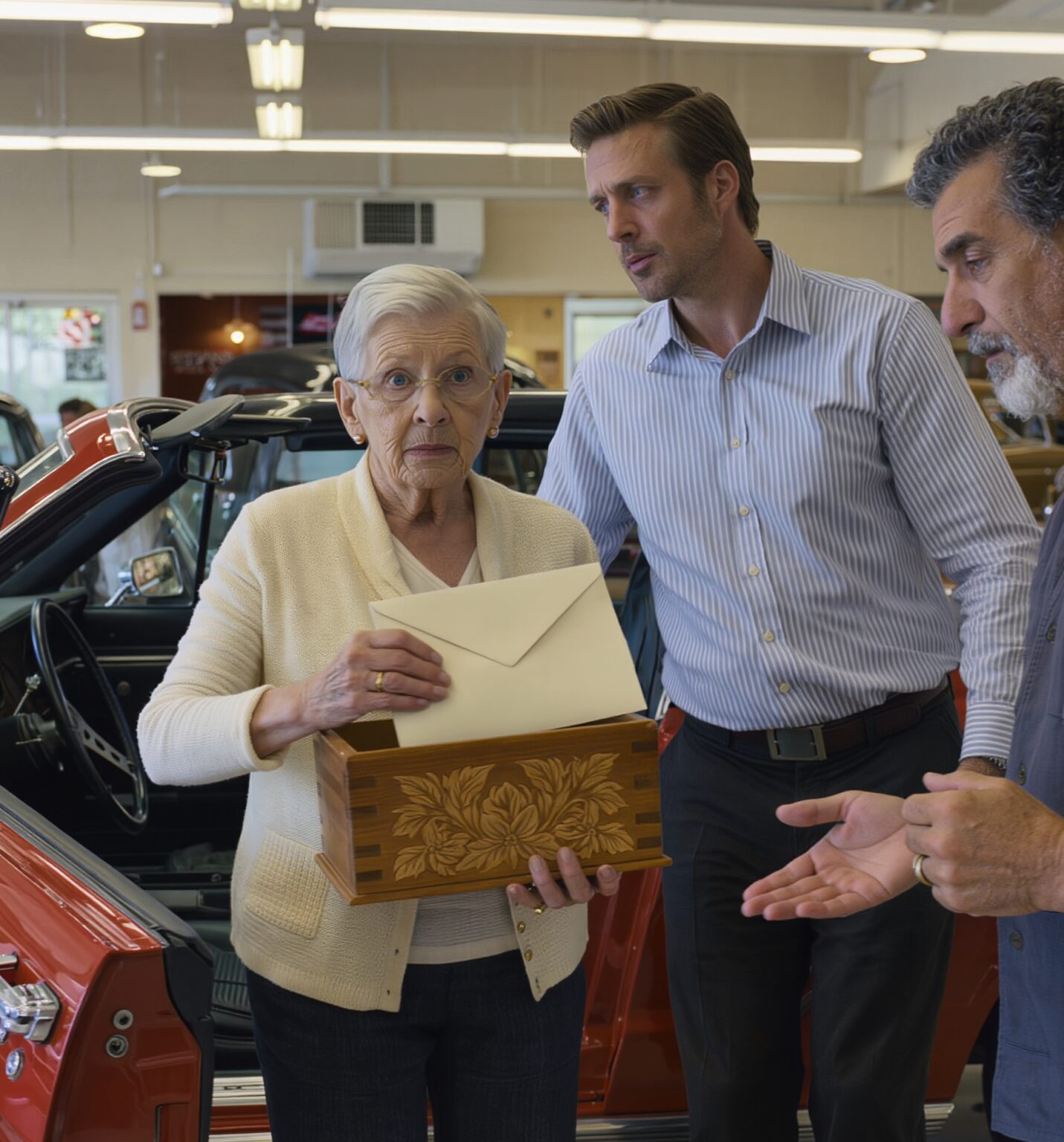
“Ma’am… your husband left a sealed letter in the glove box with your name on it.”
For a moment, I forgot how to breathe. A letter. From him. My husband. A message he had written before he died, hidden in the car like a bottled message thrown into the sea of time.
“I didn’t open it,” the man continued softly. “But based on the way your son acted… I have a feeling this car wasn’t his to sell.”
Tears flooded my eyes. I wiped them quickly. “No. It wasn’t.”
“Ma’am,” he said after a moment, “I don’t feel right keeping this car. Not after hearing your voice. Not after seeing that letter.”
I swallowed hard. “I… I don’t know what to say.”
“You don’t have to say anything,” he replied kindly. “I’m bringing the car back. Tonight.”
Two hours later, the Mustang rolled back into the driveway, engine purring like a memory waking up. Daniel handed me the letter and the keys. He refused the money. I tried insisting—he wouldn’t take a cent. “Some things,” he said, “aren’t meant to be bought.”
When he left, I sat in the driver’s seat, my hands trembling as I held the envelope. My husband’s handwriting staring back at me sent a wave of grief so strong it nearly knocked me breathless.
I finally opened it.
Inside, in neat handwriting, he had written:
“If you’re reading this, my love, it means I didn’t get the chance to finish what I started. This car is more than metal and paint—it’s us. Every bolt has a memory. Every scratch has a story. When I’m gone, I want you to keep it. Not to sell it. Not to give it away. Keep it. Because as long as this car is alive, a part of me will always ride beside you.”
I sobbed until my chest ached.
The next morning, Eric came by, guilt written all over his face. He asked where the car went. I told him it came back. He looked stunned. “Why would someone return a car?”
I handed him the letter.
He read it slowly.
Then he cried.
Really cried—like a child who finally understood the weight of what he had broken.
He apologized, dropped to his knees, begged for forgiveness.
I forgave him.
But I did not forget.
Some lessons in life must scar deeply enough to be remembered forever.
Over the next months, Eric changed. Truly changed. He visited more. Helped more. Listened more. He stopped obsessing over money and started cherishing memories. The Mustang became a symbol—not of conflict, but of understanding. Of legacy. Of a father’s love that reached beyond the grave to guide his family.
Today, that car sits safely in the garage again. I start it up once a week, just to hear the engine. Just to feel him near me.
And every time the engine rumbles, every time the chrome gleams under the light…
I whisper, “I kept it. Just like you wanted.”
Because love—true love—doesn’t leave with death.
It lingers.
In letters.
In memories.
In the engine of a midnight blue Mustang that carries a lifetime within its steel.