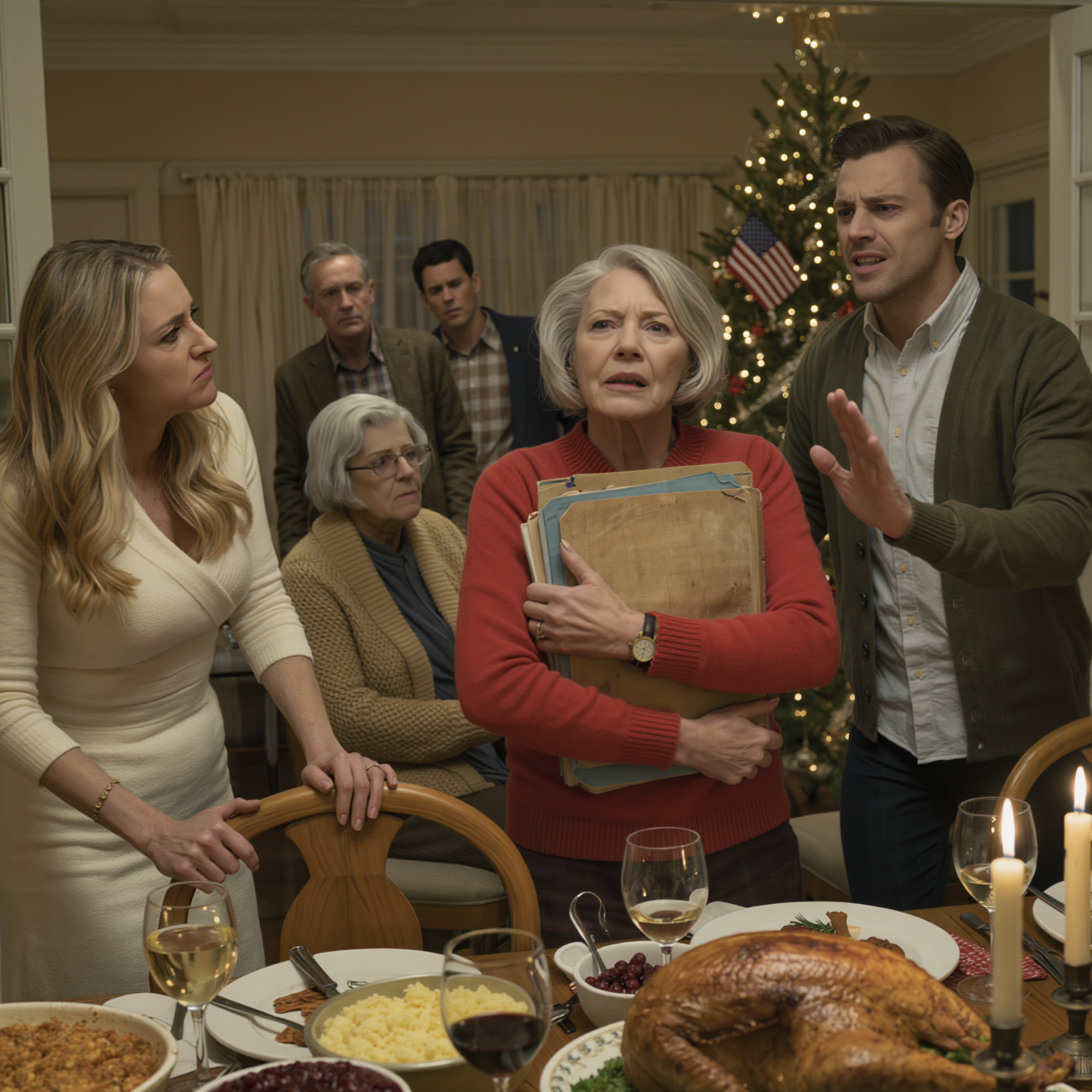
The snow had only just begun to fall that Christmas Eve, tiny crystals drifting like delicate feathers against the soft glow of streetlights, when my son stood up during dinner with that strange, serious expression on his face that made my heart skip. We were gathered around the table—my husband, my two daughters, and my son, Thomas—plates full of roast turkey, mashed potatoes steaming, our voices warm with holiday laughter. I remember the moment so clearly because it was the instant our quiet, cozy world shifted into uncertainty. My husband passed the gravy, and as he did, Thomas cleared his throat and said, “We want to tell you something.” I smiled at first, assuming an engagement announcement or some exciting surprise. Instead, my son said, “Emily’s moving in with us. She’ll be staying here. Full-time.”
The room went quiet. Christmas lights blinked softly from the corner, and I could feel the weight of each heartbeat like a slow drum in my chest. My husband blinked, mid-pour, gravy sloshing slightly over the edge of the boat. My daughters exchanged awkward glances. I smiled—because that’s what I always did when I didn’t know what else to do—but inside, a small, uncomfortable knot tightened around my ribs. “Get used to it,” Thomas said, almost cheerfully, like he herself had popped out of the oven somewhere, dusted with powdered sugar. “I always get what I want.”
I picked up my fork and took a bite, as though normalcy would return if I just ate hard enough. But the texture of the mashed potatoes suddenly felt foreign in my mouth. My husband cleared his throat, trying to bridge the silence, but Thomas added gently, “She’s having a rough patch. Emily needs a place right now. And she’s asked to stay here with us for a while.” And that was when I looked at my husband, really looked at him—a man who had grown quiet in recent years, like he was conserving strength for something we weren’t fully aware of yet. His eyes were soft, but there was a tension there I didn’t quite recognize.
We finished that dinner without much more said about it. But the rest of Christmas Eve (and Christmas Day) felt like walking on cold tiles in socks—soundless, uncomfortable, painfully cautious. We all smiled when relatives called and asked about the holidays, but each of us felt the shift beneath our feet like frost creeping up the window.
That night, I made extra cookies—pecan, the kind my mother used to make—and set them on the old cookie plate near the fireplace. The fire crackled, shadows danced along the walls, and the wind howled outside like old ghosts whispering through the trees. Under that glow of flickering flame, I tried to convince myself that a live-in fiancée was not the end of anything. Maybe it was just a new beginning. But in the silent hum of that night, I couldn’t escape the way the walls seemed to draw closer in our home, as though they sensed the tension seeping into every corner.
The next morning, I woke to the sound of footsteps in the hallway. I wrapped my robe around me and made my way to the kitchen, where I found plates on the counter and the beginnings of breakfast already underway. And there she was—Emily—my soon-to-be daughter-in-law, in a bright sweater and her hair in soft waves, humming along with the radio like she already belonged here. I offered a polite smile and a slice of toast, and she replied with a warm, overly cheerful “Good morning!” that made my skin prickle, not with annoyance, but with the faintest tremor of unease I couldn’t quite place.
Over the course of the next week, holiday decor started to feel like obstacles — rugs that couldn’t lie flat, garlands that blocked sightlines, twinkling lights that suddenly felt like tiny flashes of warning. Emily was cheerful and helpful at first, offering to cook, tidy up, fetch things—acting as though she had memorized the script of every perfect daughter-in-law trope in existence. But as the days passed, that cheerfulness began to feel practiced, like an actor who memorized all the happy lines without learning the deeper ones.
I observed quietly. I didn’t accuse. I didn’t raise my voice. I simply watched.
My husband, ever the peacemaker, treated her with gentle courtesy — offering coffee refills, asking about her favorite holiday traditions, even suggesting she help pick out ornaments for the tree. But just once, I saw him pause mid-smile, as though he was trying to remember something important he had forgotten. My daughters, polite but reserved, kept their conversations short, laughing at jokes gently, eyes flicking toward me as though checking whether I was okay with this arrangement. And Thomas? Thomas was just happy. Elated, even. He greeted every word Emily said like it was sunshine breaking dawn, and that alone was unsettling — not for any reason of malice, but because I hadn’t known him to be so easily swayed before.
Days passed, and the house, once warm and familiar and filled with echoes of Christmases past, felt like it was wearing a different shape. Emily rearranged small things — pillows, placemats, even the position of the salt and pepper shakers — in ways that seemed minor but reverberated with subtle implications: I belong here now. I watched each placement with measured calm, not because it angered me, but because every gesture felt like a claim. I thought about my role in this home—my routines, my memories, my small movements through each room—and wondered, not for the first time, how much space someone is allowed to occupy before belonging becomes overshadowing.
Then, one morning, I found one of my favorite mugs—a chipped blue one that my son had given me years ago—tucked away in the cupboard behind other plates. Not broken, just hidden. When I asked about it, Emily smiled and said she was “just making room for new things,” as though that explained away every unspoken shift without apology or acknowledgment. The ease with which she answered told me she believed she hadn’t done anything wrong. And that was the moment I decided I would not argue. I would not raise my voice. I would not make a scene. Instead, I would observe. I would listen. I would quietly understand the dynamics of this new arrangement before I made any judgments.
And so I watched Emily interact with every corner of our life: how she spoke to the girls; how Thomas responded to her suggestions; how my husband, who rarely raised his voice even on good days, seemed unusually buoyant when she was near. I observed how she placed her hand on Thomas’s arm when she spoke, how she adjusted curtains, how she smiled at reflections of herself in mirrors as though practicing perfection. It struck me then that I wasn’t just witnessing a new presence in the home — I was witnessing an intention, deliberate and meticulous.
One night, after a long day of quiet observation and polite exchanges, I went to bed earlier than usual. In the stillness of the dark room, I felt restless, as though something unspoken vibrated beneath my skin. And in that restlessness, I realized I hadn’t spoken to Thomas one-on-one in more than a week. Not really spoke — not about his life, his hopes, his worries — only small talk. I missed the depth of our conversations. I missed his grounded voice. I missed the honesty of his presence before Emily moved in.
The next morning, I made pancakes — the way Thomas’s father had always made them, fluffy and golden — and called everyone to the table. We sat together in that fragile glowing light of mid-morning, and for the first time in days, I made eye contact with my son that didn’t include the ghost of tension. I asked him how he felt about the coming year, his hopes, his work, his life beyond the holidays. He spoke with enthusiasm — but not depth. Where once his words carried substance, now they seemed surface-level and rehearsed, like the reflections on a still pond that don’t reach the depth beneath.
It was then I realized that Emily’s presence — for all her warmth and good intentions — wasn’t just settling into our home. It was gently steering my son’s heart away from the depth we once shared, like a slow tide pulling him out to sea. And while I didn’t want to push her away — she had done nothing wrong that merited confrontation — I knew I needed clarity, not conflict.
That evening, I invited Emily to help me decorate the tree — just the two of us — and as we worked in the quiet glow of fairy lights and tinsel, I asked her about her life, her dreams, her fears, not as a daughter-in-law but as a woman. And she surprised me — not because of what she said, but because of what she hid. Her voice trembled slightly when she spoke about family, her eyes flickering with something unspoken, like a shadow tucked just out of view. I didn’t press her. Instead, I listened — truly listened — and discovered beneath her cheerful surface a deep insecurity, a longing to belong, a fear of rejection that seemed to fuel her need to be “perfect” in every small gesture she made. She didn’t want to take over. She wanted acceptance. She didn’t want control. She wanted love. And just like that, the tension that had draped itself between us thinned.
Over the next few days, our interactions shifted — not with dramatic confrontation, but with simple honesty. We cooked together, we talked about Christmas traditions, we even laughed at mismatched ornaments I had made decades ago. The atmosphere lightened. My husband relaxed more when she was in the room. My daughters, once tense around her, began offering genuine smiles. And Thomas… Thomas returned to that familiar depth in his voice when he spoke to me, like a tide returning to the shore after wandering too far out to sea.
Christmas Morning arrived with a soft snowfall and the sound of laughter echoing through the halls. The tension that once lay in invisible cracks had dissipated, replaced by something warm and human — a fragile, evolving harmony built not on forced belonging, but mutual understanding.
That night, as the candles flickered and we sat together around the fireplace, I realized something profound: family isn’t about territory, or “getting what you want,” or snugly fitting into roles that look perfect on paper. Family is about honesty, empathy, and the willingness to understand someone beneath the surface of first impressions. It’s about choosing each other — even when it’s hard — and finding connection in the quiet places we least expect.
And as the snow continued to fall outside, layering the world in bright white silence, our home finally felt complete — not because someone moved in, but because we opened our hearts wide enough to truly see one another.