I stood in front of the full-length mirror one last time, smoothing out the small crease near the lapel of my jacket and adjusting the tie that my husband had given me on our anniversary years before. The reflection staring back at me was calm, poised, and dignified — a version of myself that refused to shrink in the face of rejection. Today was supposed to be my son’s wedding — a day I had imagined for years — but instead of joy, it had become the center of a family conflict I never saw coming. My son and daughter-in-law had crossed my name off the guest list, sending me an invitation with only the politeest of words: “Hope you understand.” I did understand — but I chose not to let their decision shrink me. I brushed a strand of silver hair behind my ear, took a slow breath, and stepped out of the house wearing dignity like armor.
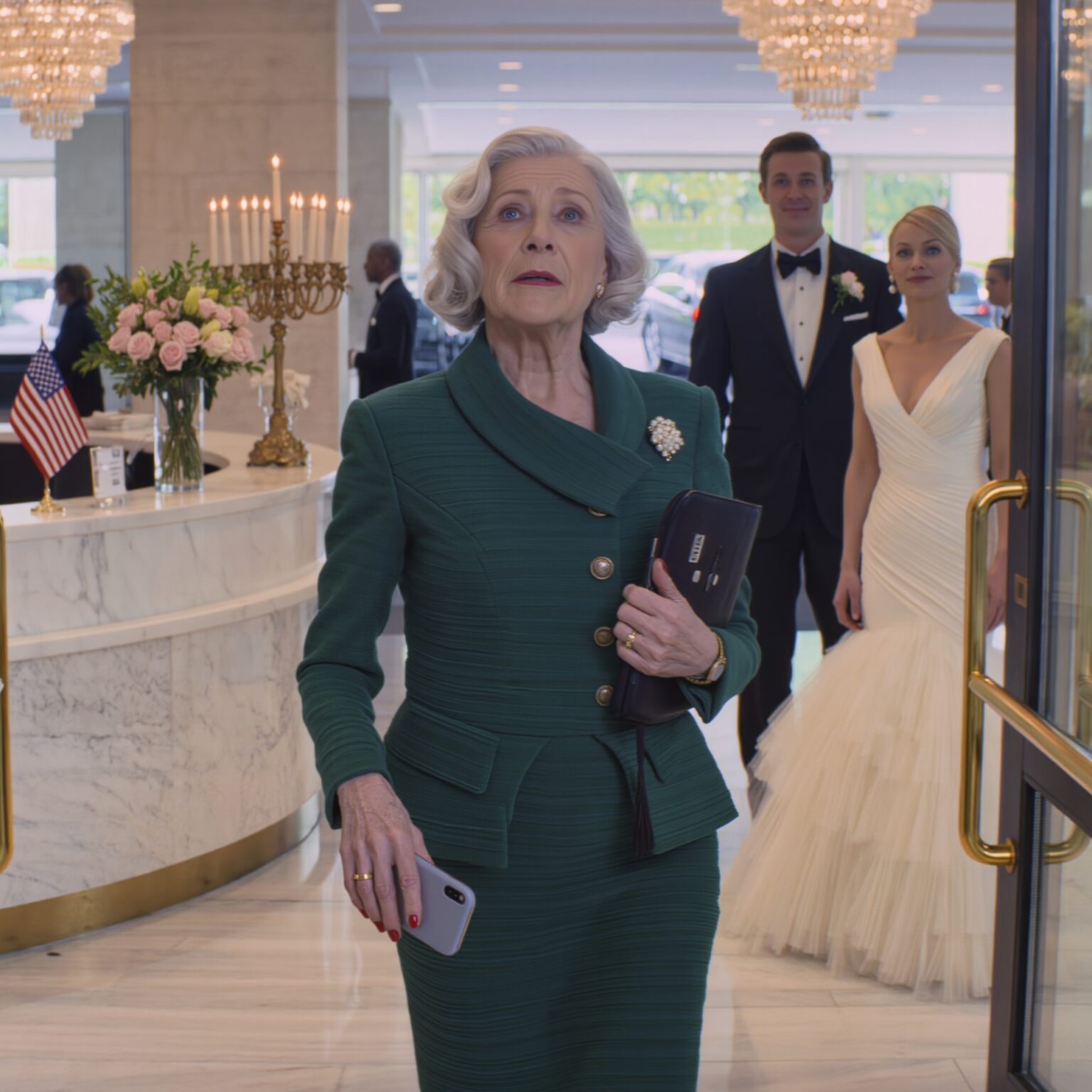
The walk up to the reception desk was surreal. Bright flowers draped the archway. Soft music drifted across the pathway. Guests in fine suits and delicate dresses chatted and laughed. Everywhere, I saw glimpses of happy couples and friendly faces. But none of them knew the truth of why I was there today. None of them knew the weight of the painful text message I received three weeks ago that told me I was no longer included. They didn’t know about the late nights I stayed up making sure every one of my son’s childhood memories was preserved in albums, boxes, and frames. They didn’t know about the tiny details I had tucked into the wedding plan months before — the special table setting for my son’s late father, the heartfelt toast I had written but never delivered. They didn’t know any of that. All they saw was a woman in a tailored suit walking toward a desk like she belonged.
I didn’t hesitate. I didn’t question myself. I simply approached the receptionist with a calm smile. The staff member looked up, eyes polite, ready to greet another smiling wedding guest. All I said was, “Good afternoon. My name is Linda Brantley.” The moment the name left my lips, everything shifted. The receptionist’s smile tightened, her eyes darting briefly to a clipboard with the long list of names she kept close beside her. She flipped through the pages quickly — too quickly — as though trying to find a name that shouldn’t have been missing. There it was: No “Linda Brantley.” My name was crossed off in neat red ink. Someone had gone through the list with absolute precision — no room for ambiguity.
The receptionist looked up at me, her face professionally neutral but her eyes betraying recognition. “I’m sorry, Mrs. Brantley,” she said softly, “but our list doesn’t include your name.” Her lips were polite, her posture correct. But in her eyes, I saw the small flicker of unease — the tiny crack in the rehearsed facade.
I didn’t get angry. I didn’t raise my voice. I just smiled — the same poised smile I wore when I walked out of the house that morning. “I understand,” I said gently. “But I’m here anyway.” The words were simple, but the calmness beneath them carried a quiet power. I stepped past the desk and walked into the reception hall.
There was a collective stillness that seemed to fall across the room — a sudden hush that radiated toward me like ripples in a pond. Forks paused mid-air. Conversations flickered out like candles snuffed by a breath. The band kept playing, a soft instrumental in the background, but I could feel the weight of every gaze drifting toward me. And yet, I didn’t avert my eyes. I didn’t apologize. I simply walked, dignified, straight to the far side of the room where an empty seat rested beneath a small sign that read Reserved. I sat, hands folded in my lap, and waited.
Time passed slowly. A few guests murmured behind cupped hands. Some whispered. Others tried to pretend nothing unusual was happening at all. And then I saw him — my son — standing near the head table, smiling awkwardly, laughing at a joke someone made that wasn’t funny. His eyes caught mine for a moment — a small, fleeting flicker — and then he looked away. I could feel the tremor of regret on his face, like a gust of wind brushing across a fragile leaf. But even in that moment, he didn’t come toward me. He didn’t approach. He just watched from a careful distance, as though afraid I would vanish if he got too close.
I didn’t move. I didn’t look down. I simply waited, maintaining my posture, my calmness, my presence.
Minutes later, my daughter-in-law appeared beside me like a shadow emerging in silence. Her eyes were tight, her lips slightly parted, as though hesitant speech was waiting behind them. “Mom,” she said, voice soft, tentative, strained. “What are you doing here?” The question hung in the air, not accusatory — more bewildered.
I didn’t rise from my seat. I didn’t demand an explanation. I just replied gently, “I came to witness your wedding.” The tone was quiet, respectful, yet there was something in the stillness of that moment — a firmness, like a quiet anchored strength.
She looked at me like she expected me to be angry, bitter, dramatic — but I wasn’t. I wasn’t any of those things. I was just there — calm, composed, genuine. “I was uninvited,” I added, “but I’m here.”
She sighed, a small exhale weighted with things she couldn’t say. Her eyes flicked toward the head table, where my son’s gaze remained steady, drawn like a compass needle under the influence of things he hadn’t yet admitted — not even to himself. I watched her turn back to me, her shoulders tense, and rather than demand pride or force apologies, I simply reached out and placed two fingers lightly on her arm — not in confrontation, but in peace.
“Your wedding,” I said gently, “shouldn’t be a battlefield.”
For a moment, the room felt impossibly quiet, like the world had taken a breath it didn’t want to release. No one spoke. Even the music dipped softer, like a lull in the tide. Then something shifted — not dramatically, not suddenly — but quietly, like a sunrise breaking through fog. My son left the head table and walked slowly toward me, his face serious, respectful, but wary. “Mom,” he said, voice low. “I… I didn’t think — I mean — we thought — things were complicated.” His words stumbled in that gentle, awkward way people use when they are confronting truth for the first time.
I didn’t interrupt. I didn’t scold. I didn’t lash out. I just looked at him gently — the same way I always looked at him as a child when he learned to ride a bike or spoke his first words. And I said simply, “I love you. I’m here.”
Something in that moment unspooled — not like a dramatic confession, not like a sweeping apology, but like breath exhaled after holding it too long. My daughter-in-law’s eyes softened. Guests watched quietly, processing what they saw — a mother, dignified and calm, refusing bitterness; a son confronting his mistake; and two people fated to share life’s most significant milestones together, realizing that family was larger than exclusion, greater than resentment.
My son gently guided me toward the head table. Not with force, not with shame, not with awkwardness — but with respect. With intention. With a silent promise, finally spoken through his actions. When he placed a chair beside him, it wasn’t a gesture of obligation — it was a gesture of understanding. And when I sat, not defeated but composed, a shift moved through the room. Conversations resumed. Eyes glistened. The air felt warmer. The music lifted.
No speeches were dramatic that night. No tears streamed in public. But the atmosphere — everything about that space — changed. Not because of confrontation, but because of truth. Because dignity never demands validation. Because love is not a trophy to be earned; it’s a presence to be honored, even when mistakes were made.
After the reception, when the lights were dimming and guests were slipping out into the night with applause still echoing softly, my son came to stand beside me. He didn’t apologize with grand statements; he simply said, “I’m glad you’re here.” That was more than enough.
And while that wedding didn’t become a fairy tale in the way most people imagine — with perfect moments untouched by pain — it became something far greater: a story of healing, of dignity, of honesty, and of hearts choosing connection over conflict.
Because no matter what the list said — I was his mother. And love cannot be erased by omission.