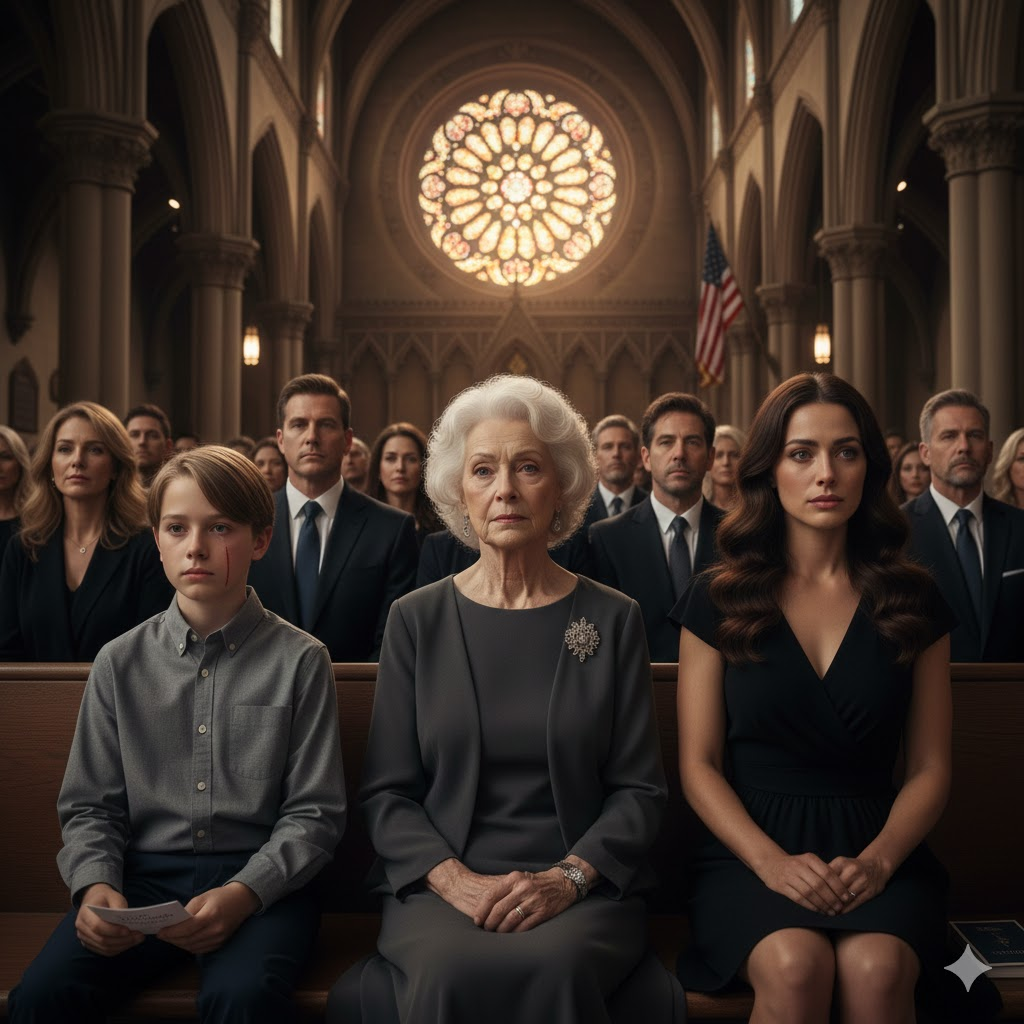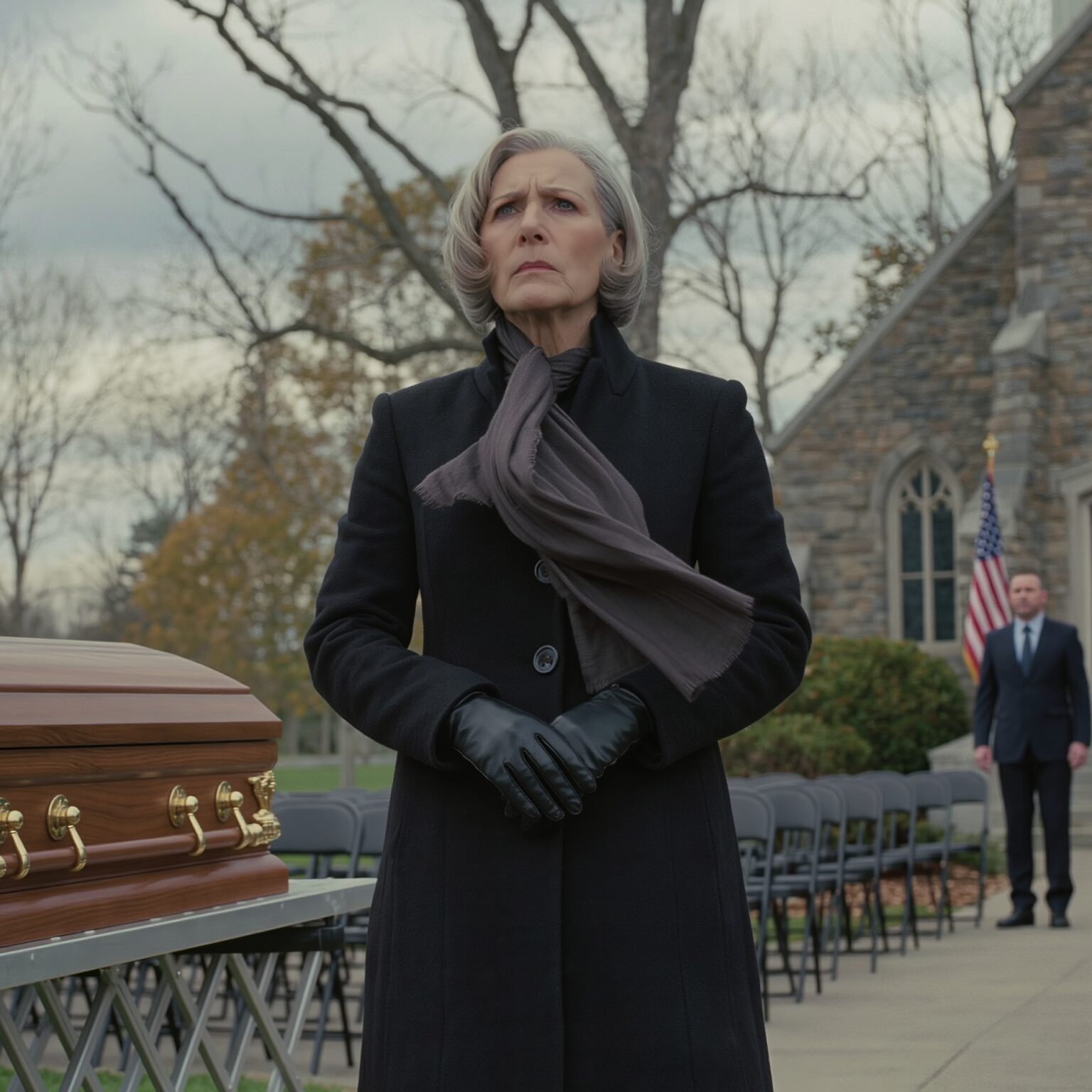
I remember the way the morning felt — strangely still, oddly quiet, as though the world knew something monumental was happening but wasn’t quite sure how to respond. My husband had been gone a little over a week, life’s gentle current turned suddenly into something sharp and abrupt the moment he slipped from this world. I had stayed beside him during the final hours, holding his hand, whispering memories into the silent spaces between us, believing — perhaps naively — that when it was time for the rest of the world to honor him, those I loved most would stand beside me. The funeral was arranged for a crisp autumn day. The sky was pale blue with soft clouds drifting like quiet whispers. Chairs were lined up in neat rows, flowers arranged with careful generosity, and a photograph of him — smiling, serene — placed at the front. But as names were called and hymnals placed in open hands, five empty chairs remained at the center of that gathering — five chairs with my children’s names on the cards, untouched and unoccupied, staring back at me like unanswered echoes.
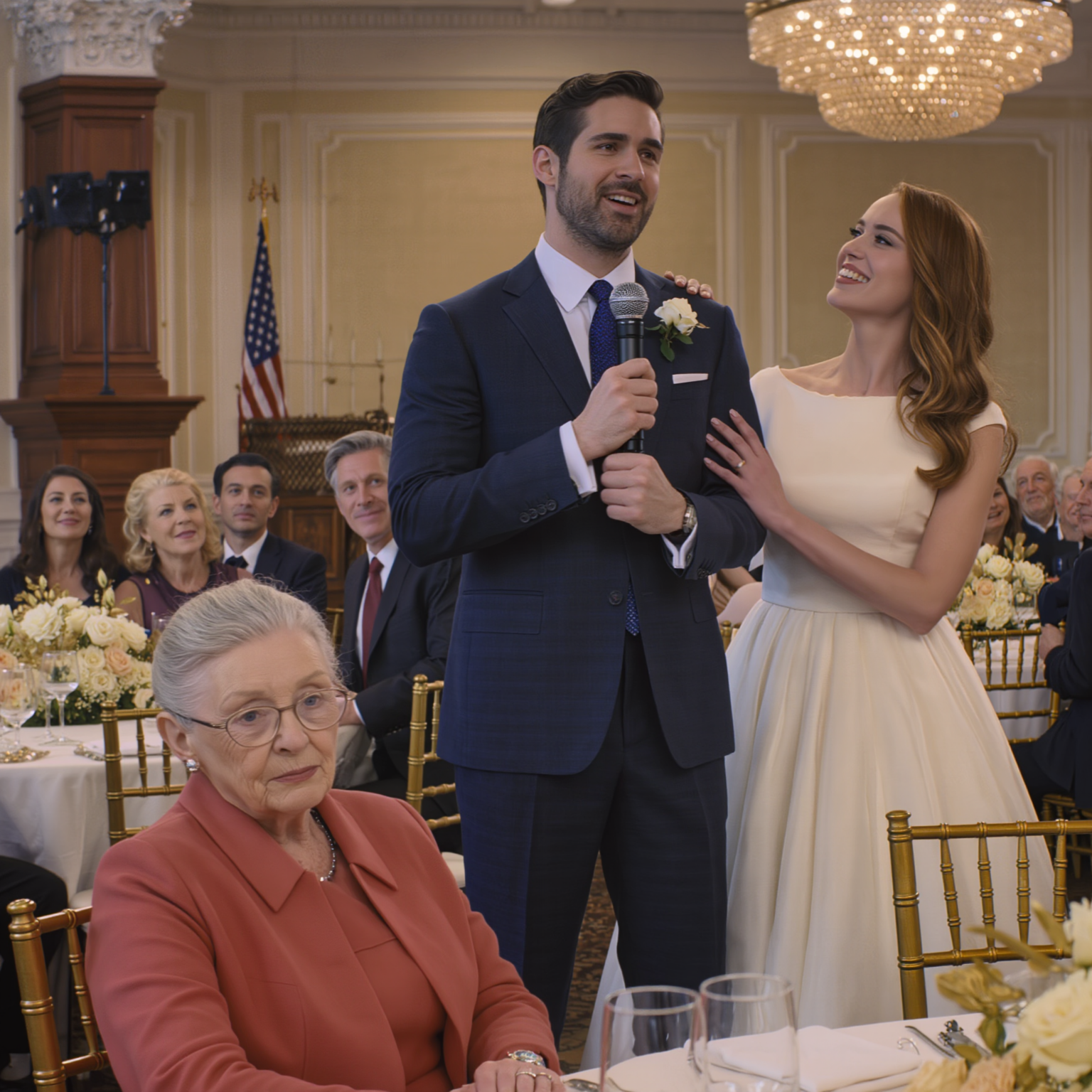
I heard the explanations later, when the awkwardness of absence had settled into the hum of polite conversations at the reception afterward. One was “too busy at a party” — a party on the night of the funeral, not some distant obligation, but a social gathering with laughter and music that seemed more important than honoring the father who had raised him. Another was “working on his golf swing” and posting about it online with giddy enthusiasm just hours after my husband’s passing. Others had “previous commitments” and “couldn’t make it” delivered in texts that felt like formalities rather than genuine regrets. Their excuses weren’t cruel in isolation, but stacked one on top of another on that clear morning, they read like a fresco of avoidance, each brushstroke revealing a different shade of indifference.
I didn’t cry when I saw the empty chairs. I didn’t wail or collapse or scream into the sky with unanswered anguish. I just sat there — calm, composed, and quiet in a way that felt strange even to me. Some people might think that if the absence of those you love most cuts deep, it should leave you raw and trembling. But the truth is, pain doesn’t always wear tears. Sometimes pain sits in steady silence, acknowledges itself with dignity, and watches the world without demanding applause.
When the service concluded and the final verses drifted into gentle stillness, I stood and walked down the row of chairs where my children should have been. The name cards fluttered faintly in the breeze from the open windows, untouched — like letters never delivered, like voices waiting to be heard but never raised. I didn’t remove the cards. I didn’t speak their names aloud. I simply acknowledged them with a subtle nod of recognition — not in bitterness, but in clarity.
Afterward, at the reception hall where trays of finger foods and modest desserts were set out, the conversation hovered around ordinary topics: the weather, updates from distant relatives, memories of my husband from friends who truly knew him. People shared stories of his generosity, his dry humor, the way he always made room at the table for others. And while they spoke, a quiet truth unfolded inside me — my husband’s legacy was not built on empty promises or social calendars. It was built on presence, on memory, on the way he showed up for others long before life asked him to.
I greeted people with soft smiles and gentle thank-yous, listening to anecdotes that made me laugh, slightly smile, or quietly nod in remembrance. And somewhere between stories of late-night fishing trips and the time he fixed the neighbor’s fence with only a hammer and determination, I realized that absence didn’t diminish love — it revealed it.
Later that evening, when the guests began to disperse, my phone finally lit up with messages that were as clumsy as they were revealing: “Sorry I couldn’t be there, Mom.” “Dad would have wanted us to be having fun.” “I thought you’d understand.” Each text landed with a strange echo that felt half-apology, half-excuse — like expressions of social courtesy that never quite met the depth of the moment they were meant to honor.
I didn’t respond right away. I didn’t condemn. I didn’t unleash a litany of the sadness I had carried quietly all day. Instead, I thought about each child — their laughter when they were small, their tears over scraped knees, their whispered confessions on late nights, their first days of school — memories woven like golden threads into the tapestry of a shared past. Those memories weren’t erased by absence. They were simply challenged by it.
In the following days, when my children reached out to explain, to apologize, to rationalize, I replied with calm sincerity. I didn’t neglect their words, nor did I accept excuses as emotional currency. I simply said this: I loved your father deeply. I miss him every day. You are welcome to talk about him with me anytime you choose. Nothing more. Nothing less.
Some of them responded with warmth. Some with discomfort. Some didn’t respond at all. But the thread of connection remained unbroken by anger or retaliation — because loss is not a weapon to be wielded, nor a scoreboard to be kept. It is merely a space where humanity is laid bare.
The empty chairs at that funeral table taught me something that formal mournings never could: love does not require presence to remain true. Respect is not measured by attendance, and grief does not obey schedules. Families are complicated things — woven together by decades of shared history but also by unspoken expectations, misunderstandings, and the quiet spaces between words left unsaid. Sometimes people show up. Sometimes they do not. And it is not always a reflection of love or its absence — sometimes it is simply a reflection of who they are in that moment, and where they stand in their own journey toward understanding vulnerability.
When I returned home that night, the house was still. The sun had dipped below the horizon, leaving soft amber light in the sky that seemed quietly hopeful rather than mournful. I walked into the living room where photographs of my husband and our family adorned the walls — birthdays, summer picnics, birthday candles held mid-blow, the sparkle of triumphs and the soft shadows of ordinary days. I stood there for a long time, not with regret, but with acceptance.
Loss does not make you weak.
Loss does not make you small.
Loss does not diminish the past.
It only asks you to find strength in what remains.
And what remained was not absence — not really. What remained was memory, presence in spirit, the echo of laughter, the warmth of shared years. My husband was gone, yes. But the legacy of his life — his kindness, his humor, his quiet courage — that still stood firm, not in chairs that were filled, but in hearts that remembered.
Family isn’t only who shows up.
Family is who carries you forward —
in thought, in love, in memory,
even when their seats are empty.