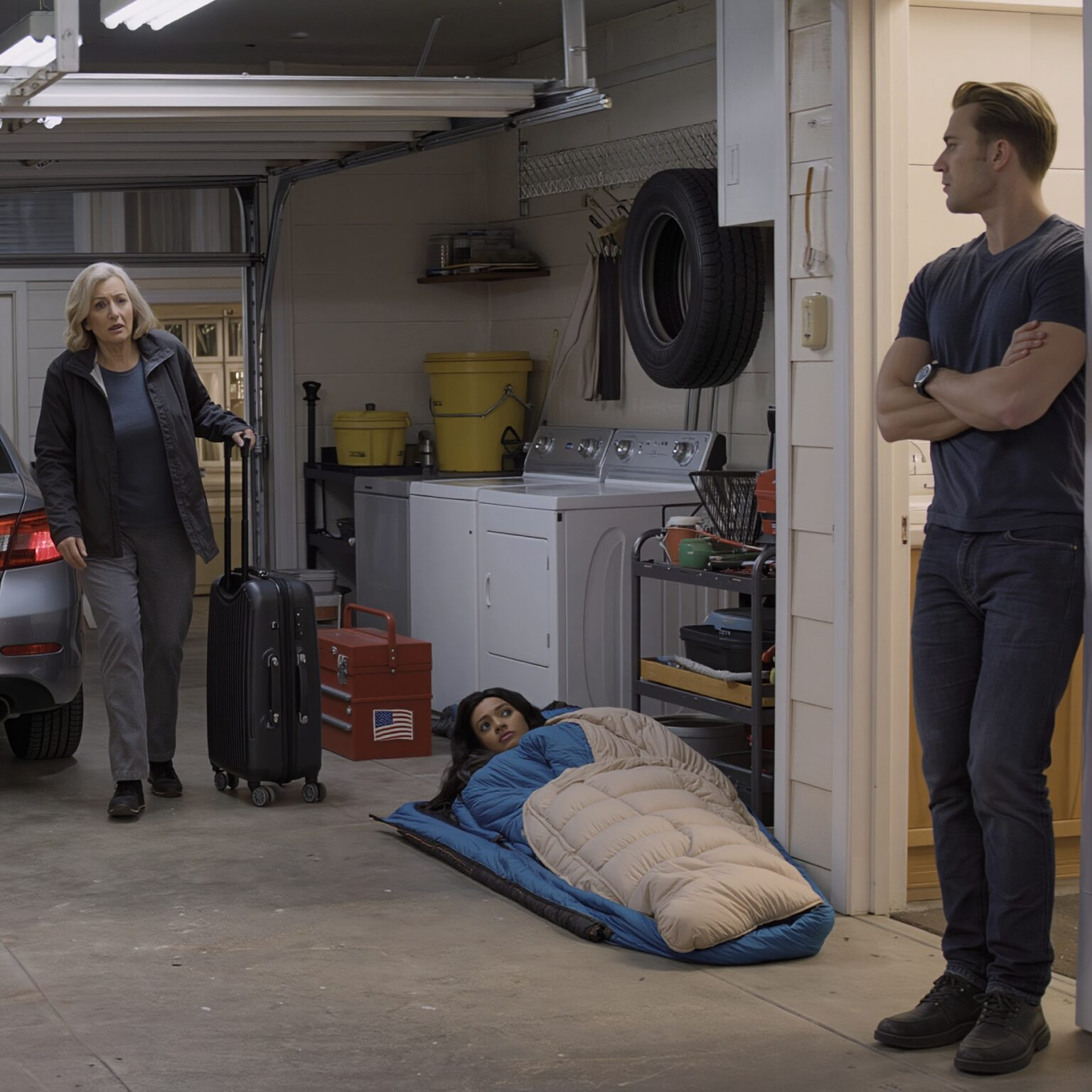
I came home from my trip later than expected, my suitcase wheels rattling softly across the driveway as the sun dipped low and painted the sky in tired shades of orange and gray. I was looking forward to my own bed, to the comfort of routine, to the simple relief of being back in my own home after days of cramped hotels and polite smiles. What I wasn’t prepared for was the sight that greeted me when I opened the side door leading into the garage — a thin blanket spread over cold concrete, a pillow clearly improvised from folded clothes, and my daughter-in-law curled up in the corner like someone who had learned to make herself small to survive.
For a moment, I stood there silently, my hand still gripping my keys, the weight of the moment pressing down on my chest so hard I had to remind myself to breathe. She stirred slightly, blinking up at me with a startled expression that quickly turned into embarrassment, then resignation. She sat up quickly and began apologizing — too quickly, too practiced — saying she hadn’t wanted to be in the way, that she was fine, that it was only temporary. Her voice held no anger, only exhaustion, and that somehow made it worse.
I asked her why she was sleeping there, even though some part of me already knew the answer. She hesitated, glanced toward the door leading into the house, and then simply said, “It’s easier this way.” Those four words carried more weight than any accusation ever could.
I walked inside without another word, my heart pounding with a mixture of disbelief and guilt. My son was in the living room, feet up on the coffee table, television playing loudly, entirely unbothered by the reality I had just witnessed a few steps away. When I asked him — calmly, though every nerve in my body was screaming — why his wife was sleeping in the garage, he didn’t even look ashamed. He shrugged and said, “She’s such a nuisance. She doesn’t deserve a room. She’s always complaining anyway.”
That was the moment something inside me finally cracked — not loudly, not dramatically, but cleanly, like a piece of ice breaking under quiet pressure. I realized that this wasn’t a sudden cruelty. It was the end result of years of small allowances, of excuses made for bad behavior, of silence chosen over confrontation because it felt easier in the moment. I had watched my son grow from a difficult teenager into a man who mistook control for authority and indifference for strength, and somewhere along the way, I had convinced myself it wasn’t my place to interfere.
Standing there, listening to him dismiss his wife’s dignity as though it were a minor inconvenience, I understood that neutrality had made me complicit.
I didn’t argue with him. I didn’t raise my voice. I simply turned off the television and told him to listen — really listen — because this was no longer a conversation he could escape with sarcasm or dismissal. I told him that no one in my house would ever be treated as disposable, especially not someone who had given up her own comfort and independence to build a life with him. I told him that sleeping in a garage wasn’t a temporary solution, it was a symptom of neglect and cruelty that had gone on far too long.
He laughed at first, a short, disbelieving sound, until he saw that I wasn’t backing down. When I told him he would be the one sleeping in the garage that night, not her, the color drained from his face. Suddenly, the idea wasn’t funny. Suddenly, boundaries felt unfair.
I walked back into the garage, helped my daughter-in-law gather her things, and showed her to the guest room — the same guest room that had been “too inconvenient” for her to use before. She tried to refuse, out of habit more than anything else, but I insisted. As she lay down on an actual bed, tears slipped silently down her face, and I sat beside her, realizing how long it had been since anyone had simply chosen her comfort without conditions.
That night, I barely slept. Not because of noise or discomfort, but because of the weight of everything I had ignored. I thought about the subtle comments I had brushed off, the times she had smiled politely while shrinking inward, the way my son had always spoken about her like she was a burden rather than a partner. Love doesn’t vanish all at once — it erodes quietly, especially when no one steps in to stop it.
The next morning, I told my son that things were going to change. Not suggestions. Not negotiations. Changes. If he wanted to stay in my home, he would treat his wife with respect, contribute equally, and seek counseling. If he didn’t, he could find somewhere else to live. For the first time in his life, he didn’t have an argument ready. He had never expected consequences to come from someone who had always protected him.
Whether their marriage survives is something I can’t control. But what I can control is the environment I allow in my home — the values I enforce, the dignity I defend, and the silence I refuse to keep anymore. My daughter-in-law didn’t ask me to choose sides. She never asked for rescue. She simply needed someone to notice.
Sometimes the most painful realization isn’t discovering someone’s cruelty — it’s recognizing how long you tolerated it because it was easier than standing up.
And that night, when I closed the garage door and turned off the light, I promised myself that no one under my roof would ever be made to feel like they belonged on the cold concrete again.