I didn’t go into that dining room gasping for confrontation or seeking drama. I invited the whole family over for dinner with a clear intention: to speak honestly about my inheritance — not to dictate decisions, not to accuse anyone of secrecy or ambition, but simply to ensure that when the time came, everyone knew my wishes and understood why they mattered. It was a rare moment when I felt calm, prepared, and genuinely optimistic, like someone who had spent years smoothing out differences and avoiding conflict, finally choosing transparency over avoidance. The table was set, the food was simmering with aromas of roast and herbs, and the soft glow of candlelight gave the room a warmth I hoped would reflect goodwill more than tension. The kids arrived, cousins trickled in, and finally my daughter-in-law took her seat — her smile just a little too bright, her eye contact lingering slightly longer than necessary, her enthusiasm bordering on performative. I noticed it, but I didn’t overthink it. I’d spent years learning that strong personalities often showed vivid energy around sensitive topics. I took it all as nothing more than personality.
We began casually, catching up on the weather, health updates, the little happenings of everyday life. Then, over lukewarm laughter and passing the mashed potatoes, I gently steered the conversation toward the reason for the gathering. I spoke quietly but confidently, laying out my long-drafted wishes, the way I hoped assets would be managed, who I trusted with sentimental items, and — most importantly — how I hoped I wouldn’t leave a legacy of hurt or division. The room was still… until it wasn’t. My daughter-in-law’s bright smile wavered just slightly, like someone who realizes they rehearsed the wrong lines. There was a pregnant pause, an undercurrent of expectation that rippled around the table like an unspoken question no one wanted to voice, until nothingness itself seemed to ask the loudest question: What will you say when someone wants more than they ought to?
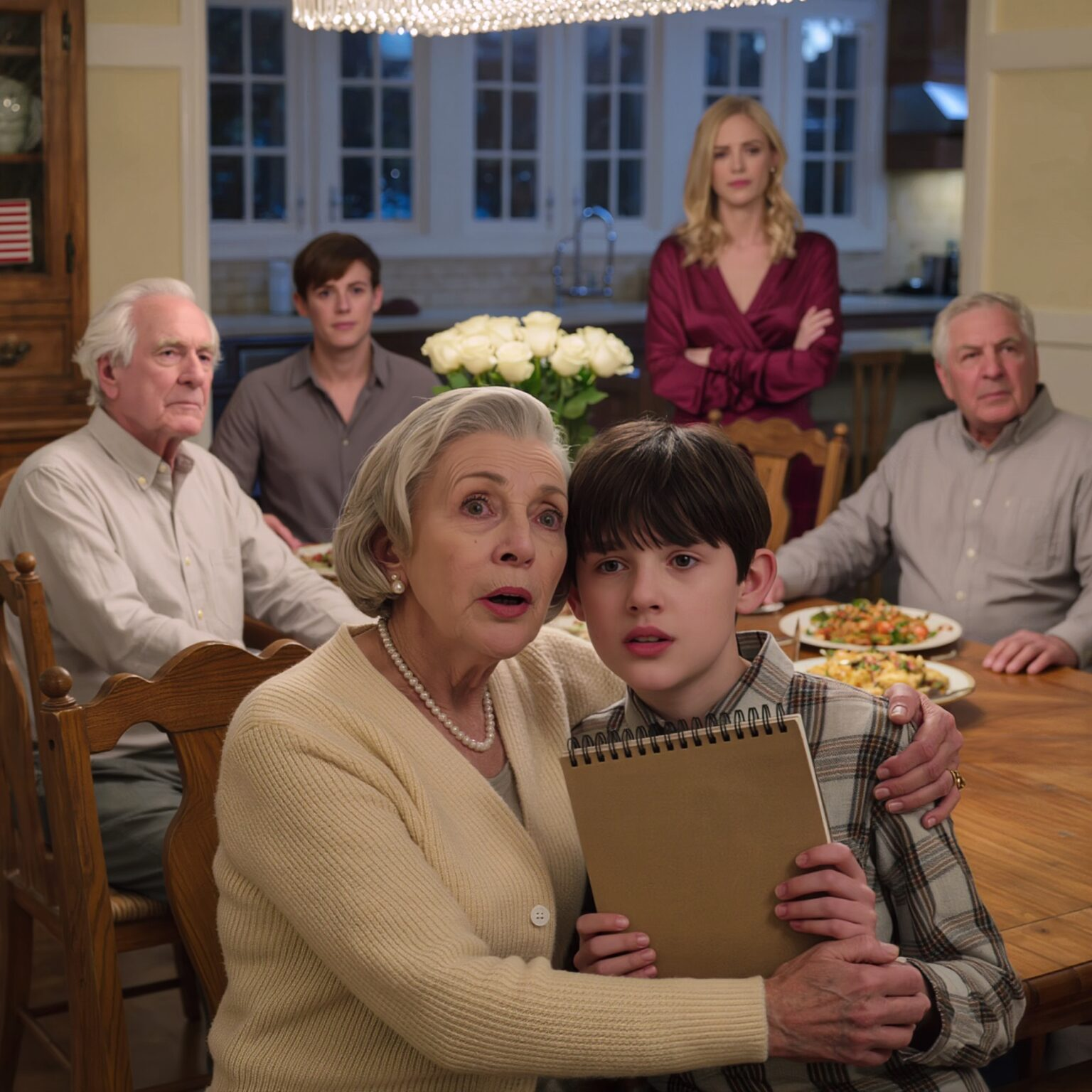
Before anyone else could respond, my young grandson — a boy of perhaps seven or eight, always lively and affectionate — shifted in his chair and then suddenly climbed off it and ran across the dining room to hug me tightly. It was spontaneous, genuine, and entirely unprompted, the kind of hug that smothers your heart with warmth when it comes unexpectedly. But what he whispered into my ear — soft, shaky, and urgent — was nothing like the innocent murmuring of a child. “Gran,” he said, his voice small and serious, “Mom said you have nothing left for me. She said you’re giving everything to Dad and the others.” The words were so quiet, so simple, that for the barest second I thought I had misunderstood. But I saw the weight in his eyes — not confusion, not fear exactly, but something deeper, like a child too young to understand greed yet old enough to sense unfairness.
I didn’t recoil. I didn’t flinch. I simply hugged him back, careful and steady, and whispered, “I told no one to say that. I told them what I want, and it has nothing to do with taking from you.” He pulled back slightly, eyes wide, and nodded — not entirely reassured, but comforted by my calm.
There was a hush around the table after that — not because silence fell, but because something true had entered the room uninvited and unsettled everyone: honesty.
My daughter-in-law’s face, once bright with a practiced smile, softened into something else — a flicker of uncertainty, maybe even guilt. She cleared her throat awkwardly and attempted to steer the conversation away from inheritance talk entirely, offering dessert soon and commenting on how lovely the lighting was. But the moment had already shifted, not dramatically like an aggressive storm, but subtly, like the wind changing direction so quietly you only notice when it brushes against your skin.
I met her eyes once, and she immediately looked down at her plate as though the air between us had suddenly carried a different meaning. That’s when I knew she hadn’t been smiling just for joy at the subject. She had been calculating — not subtle, not kind, just visible enough once the truth had been spoken by the innocent voice of a child.
I didn’t chastise her in front of everyone. That wasn’t my way. Instead, I finished outlining my wishes — in clear, simple terms that left no room for misinterpretation. I spoke of memories, of heirlooms and their stories, of sentimental value and the joy I hoped each item would bring to its next keeper. When I mentioned educational funds for grandchildren, I made sure each child at the table — including my grandson — heard directly how I hoped money might support their dreams and not someone’s expectations.
After the dinner was officially over and the last plates were cleared, a kind of stillness lingered — not tense, just reflective. My son caught my eye from across the living room and gave a subtle nod. It wasn’t an apology, not exactly — more a recognition that something in the air had changed. My grandson held my hand tightly, little face calm now, but trusting in a way only a child can when he feels protected.
Later, as people were leaving and goodbyes were being exchanged with polite smiles and soft hugs, my daughter-in-law stepped toward me for a moment alone. I anticipated something — a confrontation, an apology, a neutral remark — but all she said was, “Thank you for coming here today.” No qualifiers. No agendas. Just a quiet expression of respect that felt genuine, however delayed it may have been.
I left that evening with something more precious than any inheritance debate could ever offer: clarity.
Family isn’t simply a title.
Inheritance isn’t simply about possessions.
Legacy isn’t determined at the point of transfer —
it’s built in the truth of how we communicate, how we listen, and how we protect the innocence of those who love us without condition.
In that dining room, surrounded by familiar faces and a sudden breath of honesty, I realized I had done what I’d hoped for not just with legal intentions, but with heart: I listened, I clarified, and most importantly, I heard the small voice that mattered most.
And that — far beyond anything written in a will — was the legacy worth creating.