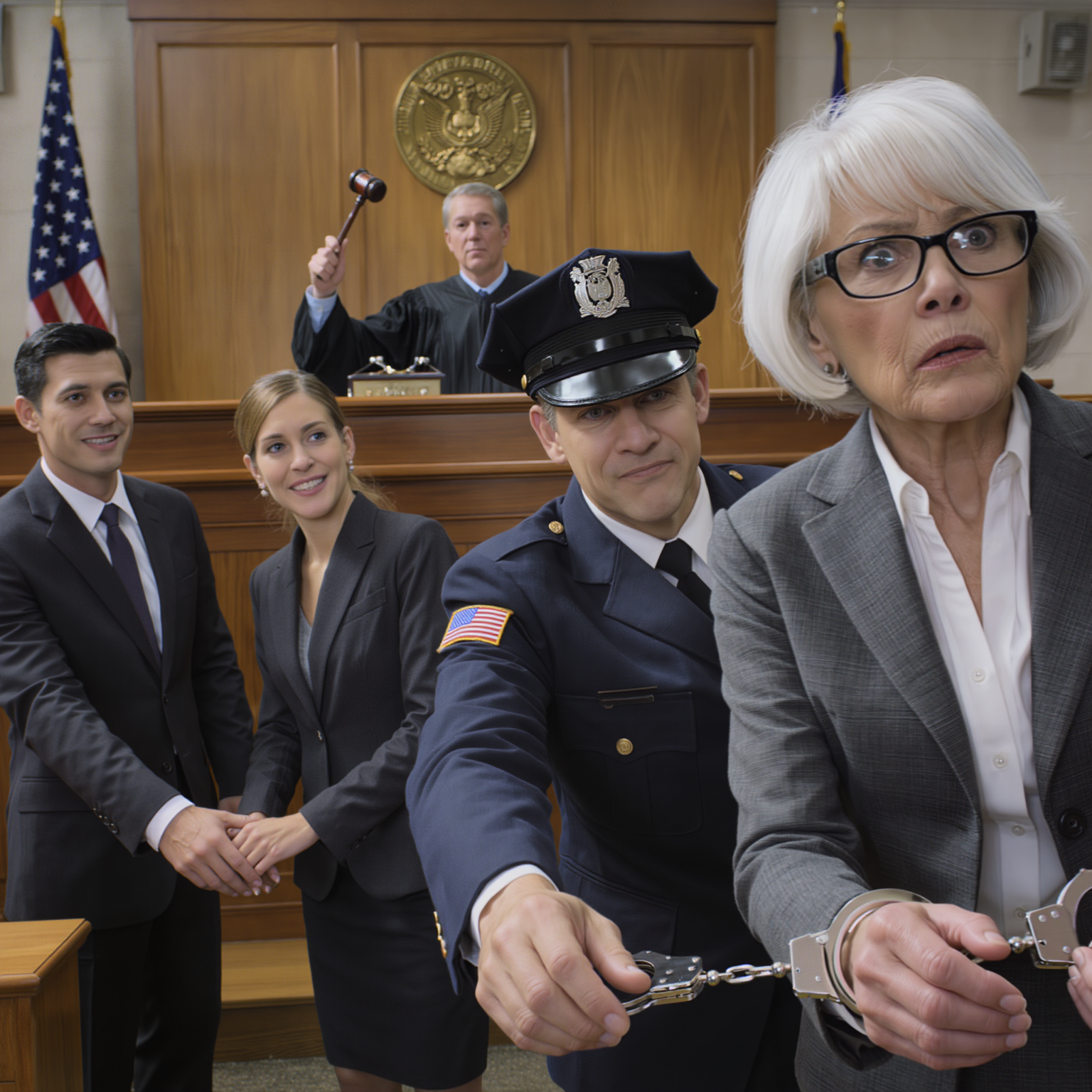
I remember the sound the instant it happened — the click-click of steel locking around wrists that had once held a newborn in the dead of night, that had smoothed forehead after fever, that had steadied trembling hands through heartbreaks and small victories alike. The cold cuffs snapped closed on my wrists right there in county court, and my son, Ethan, laughed — not with affection, not with righteous indignation, but with a cruel, echoing amusement I had never known in all my life. “Go ahead,” he said — raucous, unfiltered, as though the whole courtroom was his stage and I merely a punchline. “Let them escort you out, Mom — I’ll spend every last dime of your fortune.” The words landed like hammers against something inside me I didn’t realize was still soft enough to bruise. I didn’t cry. I didn’t shriek. I just stood still — body restrained but mind wide open — because there, in that moment of betrayal broadcast louder than any sentence, I finally saw him for who he truly was: not the awkward, beloved child I once knew, not the adult I hoped would become compassionate and gentle, but someone who equated love with entitlement and family with a ledger of debts to be collected.
The courtroom was stark: fluorescent lights, hard wood, sterile walls that seemed to amplify every sound. People stared — some in shock, others in uncomfortable silence — unsure whether to gawk or avert their eyes. I felt a strange quiet settle in my chest, like the world had taken a long breath and was waiting to exhale. My cuffs pinched coldly, but something inside me was starting to warm with clarity rather than panic. All those years of quiet support, of emotional labor and late-night drives to school, of forgiving the slights and smoothing over conflicts — none of that had earned me a place in his heart where empathy thrived. He wasn’t defending himself. He was attacking me in front of strangers, treating my name like it was an obstacle in his path to personal satisfaction.
I didn’t scream. I didn’t beg for dignity. I didn’t demand apologies. Instead, I did something quieter but more powerful: I stood upright as though the very air around me knew that I was not what he said I was. My body remained constrained, but my mind was free — clear, and unclouded by fear — and I began to understand something profound: you don’t lose yourself in someone else’s cruelty unless you give them that power consciously. I had loved him for years. I had believed in goodness that I hoped was inside him. But today proved that some people will choose selfishness when given even the smallest opportunity.
The prosecutor called my name next, and I answered, voice calm, unwavering, even as those cold cuffs weighed against my wrists. I was accused of mismanagement — a term so clinical it felt like a slap disguised in paperwork. It was a strange contradiction: the legal language was sterile, antiseptic, and yet the betrayal was as deep and visceral as a knife to the heart. Witnesses were called, documents were presented, arguments were made with all the precision and detachment a courtroom could muster. But in the back of my mind, through every question and answer, one truth echoed with vivid clarity: this was not about justice. This was about resentment and entitlement — the belief that love can be purchased with self-interest and earned with opportunistic cruelty.
Ethan’s lawyer shtick tried to paint it as generational disagreement, as motives driven by concern for his future and financial stability. But the way Ethan laughed — the way he seemed to delight in the idea of me being stripped of autonomy — demolished that façade faster than any evidentiary objection the defense might have raised. It wasn’t concern. It was triumph in another’s downfall — the exact opposite of family loyalty.
And as the judge called for a recess, the bailiffs approached with patient professionalism, touching my arms gently to guide me out, a flash of sympathy in their eyes that no one else had bothered to show, I realized I wasn’t leaving the courtroom as a victim of circumstance — I was leaving with clarity I had never asked for but desperately needed.
Outside in the hallway, one of the officers — a woman old enough to have grandchildren of her own — leaned in and said quietly, “Don’t let anyone define your worth based on this. You are not alone, and you’re not the problem here.” Her words were simple, not grand or overly comforting, but they were rooted in truth. And in that moment, surrounded by the mundane sounds of courthouse life — distant conversations, clicking heels, the whoosh of opening doors — I felt the first flicker of something I thought I had lost: dignity that didn’t depend on someone else’s approval.
When they read the verdict the next day, I stood tall — not defiant in a theatrical way, but composed in the quiet confidence of someone who understood her own heart better than someone else’s outburst could shake it. The judge ruled in my favor on every count: no mismanagement, no criminal intent, no grounds for the accusations leveled against me. The courtroom was silent for a heartbeat, then murmurs rippled outward like wind across a still lake. Ethan didn’t smile. He just looked… shocked. The smirk I had seen the day before had faded, replaced by something hollow. I didn’t gloat. I didn’t savor a moment of vindication. I simply watched the truth land where it belonged.
Afterward, in the cold parking lot where autumn leaves skittered in invisible eddies, I stood alone for a moment, shivering in the crisp air not because of cold but because of relief — relief that truth, however delayed, eventually had its turn under the light of clarity. I popped the cuffs open, the click of metal falling away sounding nothing like a defeat but like a release from something far heavier than physical restraint ever was.
Later that afternoon, I sat by a window in a quiet café, sipping tea that was warm in a way only small comforts can be. I thought about the years of kindness that had brought me there, about the love I had freely given, and about the future that would no longer be shaped by someone who saw generosity as an invitation for exploitation. Some people believe family means unconditional acceptance; but true family — the kind that matters — is woven from respect, empathy, and reciprocity. I had learned that now not through gentle unfolding, but through fire and clarity and a betrayal that showed its teeth with merciless precision.
I did not walk away bitter. I walked away aware — aware that some chapters end not because love failed, but because truth needed space to breathe. I did not need to reforge my identity from the shards of accusation. I simply needed to recognize that I deserved to live in a world where my worth was measured by integrity, not exploitation.
And when the sun set that evening, casting long golden lines across the sidewalk, I realized something powerful: freedom is not merely release from restraint. Freedom is taking back the definition of your own worth — and no one, not even the closest blood, gets to write that for you.