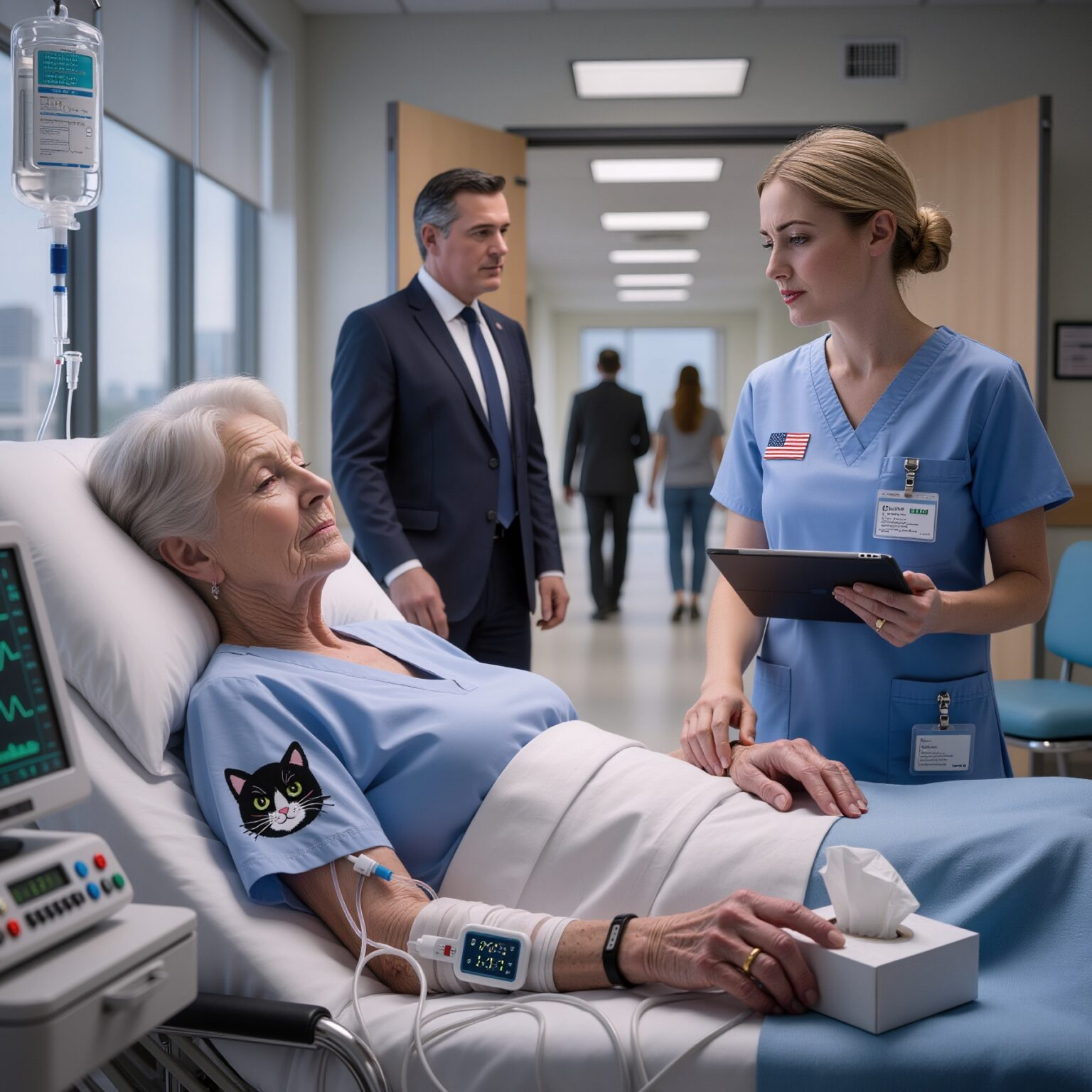
When I opened my eyes after the foggy hush of anesthesia, the world came back in pieces — white lights above me, the gentle beeping of a monitor, the humming softness of hospital air that never reaches the nose quite right. My mouth tasted like metal and my head felt like a foggy meadow after too much rain — uncertain, soft, heavy. I blinked a few times, trying to trace where I was, and the nurse’s gentle voice filled the space between my thoughts like a cautious question. She leaned in slightly, clipboard in hand, expression polite but strained — the practiced concern of someone who has seen too many human stories in too little time.
When she said, “Your children left. They said the parking was too expensive,” something in my chest collapsed like a bridge giving way to floodwaters. I didn’t fully understand at first. My children — the two people who once clung to my fingers with their scraped knees and asked bedtime questions that never ended — left me at the hospital because of parking fees? My throat clenched, a sob formed, and before I could stop it, I was shaking with the kind of sobbing that doesn’t make noise so much as it shakes your bones. Tears burned hot and sharp, not just from being alone after surgery, but from the sheer absurdity of feeling abandoned and reduced to something inconvenient rather than someone cherished. I felt small — smaller than I had in years — as though every moment of care I had given them, every bedtime story, every bandaged knee, every quiet reassurance in the dark, had been erased by a sentence about parking costs.
And then — while I was still trying to breathe normally again, trying to understand what rejection feels like when it arrives without drama, just blunt simplicity — the door opened softly, and a tall man in a suit walked in. Not doctor, not nurse, not someone with a name badge. Just a tall man in a suit, sleeves perfectly pressed, shoes that whispered polish and attention, and eyes that didn’t belong to someone looking at a patient, but someone looking at a person. He didn’t speak at first. He simply closed the door behind him, moved toward the edge of the bed with the quiet assurance of someone accustomed to stillness, and then gently held my hand — not in a way that startled, but in a way that grounded my scattering thoughts.
His touch wasn’t clinical. It wasn’t perfunctory. It was comforting in that deeply human way that doesn’t require question or explanation, only presence.
He sat beside me without announcing anything pompous or authoritative. No, he simply said — with an unexpected softness that didn’t belong to someone in the business of practicalities like parking or schedules — “You’re not here alone.” That’s it. Not a declaration of grand philosophy, not a dramatic revelation of lifelong connection, just a simple sentence that felt like an anchor in stormy waters.
I looked at him, confusion and awe warring in my gaze, and he smiled — not a rehearsed, polite smile, but the kind that acknowledges pain without dismissing it. Then he explained, gently and without ceremony, that he had been waiting outside my room when my children left, had overheard the nurse’s words, and something in his heart didn’t allow him to walk away. He didn’t introduce himself as anyone important. He didn’t claim to be a distant relative or a guardian angel. He simply said his name — Richard — and that he had seen too much hurried life and too little kindness to leave someone crying alone after surgery.
There was no judgment in his voice. There was only empathy — that rare, unforced type that arrives not to fix a problem, but to share its weight so it feels less crushing. In that moment, the hospital walls — sterile, achingly white, echoing with footsteps and distant beeps — felt less like a place of abandonment and more like a space where compassion still had room to breathe.
We talked, slowly at first, carefully like people meeting for the first time but somehow finding familiarity in the cadence of shared stories. He told me about how he had recently lost someone dear to him — his own mother — and how seeing someone left alone after something as vulnerable as surgery stirred something deeper than curiosity. He didn’t claim to be a philosopher or someone with answers. He just said that humanity matters in the quietest moments, and that watching someone sob with loneliness had touched something in him he wasn’t prepared to ignore.
We spoke about fear, about heartbreak, about moments when life doesn’t go according to plans or expectations. And in that conversation — unanticipated, unplanned, unfolding with the gentle cadence of two people sharing vulnerability rather than performance — I understood something profound not about abandonment, but about presence: presence that doesn’t demand repayment, presence that doesn’t need history or obligation to show up, presence that simply stays.
Eventually my phone buzzed — messages from my son and daughter, at first curt, then apologetic, the kinds of messages people send when they realize their priorities have been questioned by something harsher than confrontation: absence. But the harshness of their choices no longer felt like a wound — it felt like a clarity of boundaries that needed to settle before reconciliation could occur.
I didn’t walk away in anger. I didn’t cut ties with them forever. But I did understand — with a new emotional precision — that belonging isn’t earned only through closeness or obligation, but through responsiveness and care when someone is most vulnerable.
Richard — the kind stranger in a suit who shouldn’t have been there, but was — didn’t replace family. He reminded me that family is not only the people who carry your blood, but also the people who choose to show up when it matters most.
As I left the hospital later — walking unassisted, with Richard’s calm smile still lingering in memory — I didn’t feel abandoned. I felt seen. I felt held. Not by obligation, not by expectation, but by simple, rare compassion — the kind that enters quietly and stays long enough to transform pain into presence.
And in that transformation, I learned something essential about human connection:
Compassion offered freely — without agenda, without expectation — is one of the deepest forms of belonging there is.
Not because it replaces family,
but because it reminds us that we are truly human when we choose to stay, even in silence, when someone needs presence most.