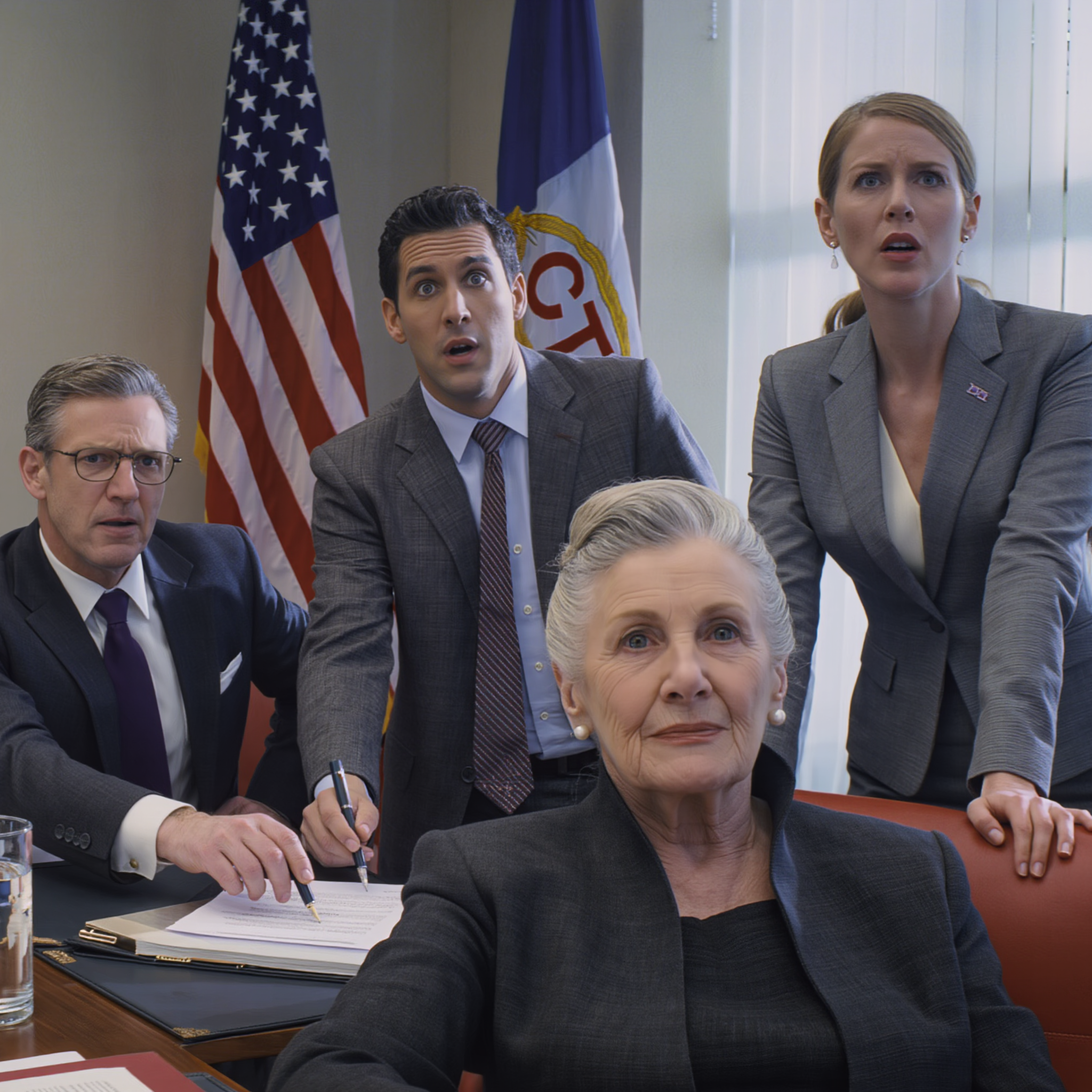
I remember the courthouse hallway before it all began — that cold quiet where echoes go to linger, where the polished marble floor absorbs every anxious footstep, and where time feels stretched like an old film reel. I stood beside my attorney, heart thumping with a nervous certainty that this hearing was pivotal, but nothing in my life had prepared me for the weight of what was about to unfold. Across the room sat my daughter Emily — poised, assured, her eyes the color of confident conviction and that familiar smirk that had once meant ”I’ve got this.” Today, it meant something far more calculated, far more charged. She believed she had crafted every outcome with meticulous strategy — a smirk anchored in the belief that truth was negotiable and advantage was everything.
When the judge called the hearing to order, his voice was even, firm, and unreadable, as though centuries of legal theatrics had tempered him against spectacle. My attorney whispered last-minute reminders — stay calm, answer truthfully — but I barely heard him. I felt more like a witness to a story I had once written in love and intention but that Emily now sought to rewrite with ambition and self-interest.
When the judge looked up from the stack of documents before him — solemn, focused — and then leaned in so only the courtroom’s smallest circle could hear him whisper, “It’s her…” — something seismic shifted in the atmosphere. Not dramatic in sound, but dramatic in its silent impact: a tremor that barely registered outwardly but knocked Emily’s confident façade off-balance before the world even realized what was happening.
Her smirk didn’t fade.
It cracked.
Not like a polite pause.
Not like a subtle shift.
But like glass under pressure — fracturing from an internal tension no one but her had ever acknowledged.
I watched it from my seat just a few feet away, as though the moment was happening in slow motion: the tiniest tremor at the edge of her expression, that half-caught blink, the way her posture betrayed a pulse of surprise — not at the judge’s words themselves, but at the implication that someone else held the deeper truth.
You see, this case wasn’t just a dry legal dispute about property, contracts, or inheritance. It was about authentic legacy versus manufactured entitlement. Emily had presented herself as the orchestrator of her father’s final wishes — meticulous, articulate, assertive — insisting that every asset, every account, every decision be directed her way. She had crafted narratives of care and loyalty, of financial stewardship and family responsibility. She had convinced many that she was the rightful successor not only of wealth but of heartfelt devotion.
Then the judge whispered, “It’s her…” — not because he was passing some cryptic judgment on moral grounds, but because he had just recognized a document, a name, a signature that hadn’t yet been introduced, and it changed the entire legal landscape.
The way Emily reacted — not with denial, not with swift composure, but with that tiny rupture of confidence — told everyone in the room that she had never expected the truth to surface in that precise moment. Her smirk — shorn of certainty like a mask slipping off in mid-scene — cracked not because the world saw weakness, but because she was confronted with the revelation that her carefully crafted narrative was no longer in control.
I didn’t gasp.
I didn’t rise to defend her.
I simply watched.
Because the situation had shifted from accusation to clarity in the blink of the judge’s almost-inaudible whisper.
Then the judge spoke — not loudly, but with the authority that turned every head in the room toward the same realization: there was another name, another statement, another intention documented long before any dispute had arisen. A directive — quietly penned months earlier by my late husband — that clarified exactly how he intended his legacy to be managed, not according to strategic advantage or familial competition, but with authentic respect for connection, merit, and life’s deeper values.
And the name on that directive —
the one now confirmed beyond dispute?
Not Emily’s.
The room shifted — a subtle wave of recognition, like a breeze passing through an open window, followed by an exhale of tension that had been held too long. My husband’s final words — recorded officially, notarized carefully before his passing — revealed a legacy far more substantial than financial distribution alone: a testament to integrity, heartfelt intention, and discerning recognition of where responsibility truly belonged.
Emily — once unshakeable in her confidence — sat stunned, her smirk fully gone, replaced by a quiet unease I had rarely witnessed. She had believed that diligence and determination were the keys to legacy. What she hadn’t accounted for was truth anchored in love, not ambition, and plans made in quiet integrity rather than loud assertion.
I did not rise to gloat.
I did not stand to admonish her.
I simply watched her — not with triumph, not with judgment, but with the kind of compassionate clarity that says, Truth reveals what intention alone cannot mask.
Because sometimes the most powerful moments in life are not the ones where we are vindicated,
but the ones where truth — long prepared and quietly waiting — finally speaks.
And when it does, even the strongest smirk — once cracked — shows us not only where confidence failed,
but where authenticity prevails.
In that courtroom silence — transformed by the judge’s whispered recognition — I learned that legacy isn’t determined by loud claims or polished confidence, but by the unseen intention that lives in quiet preparation long before anyone notices it. And that truth — once revealed — resonates with a power far deeper than any dispute ever could.