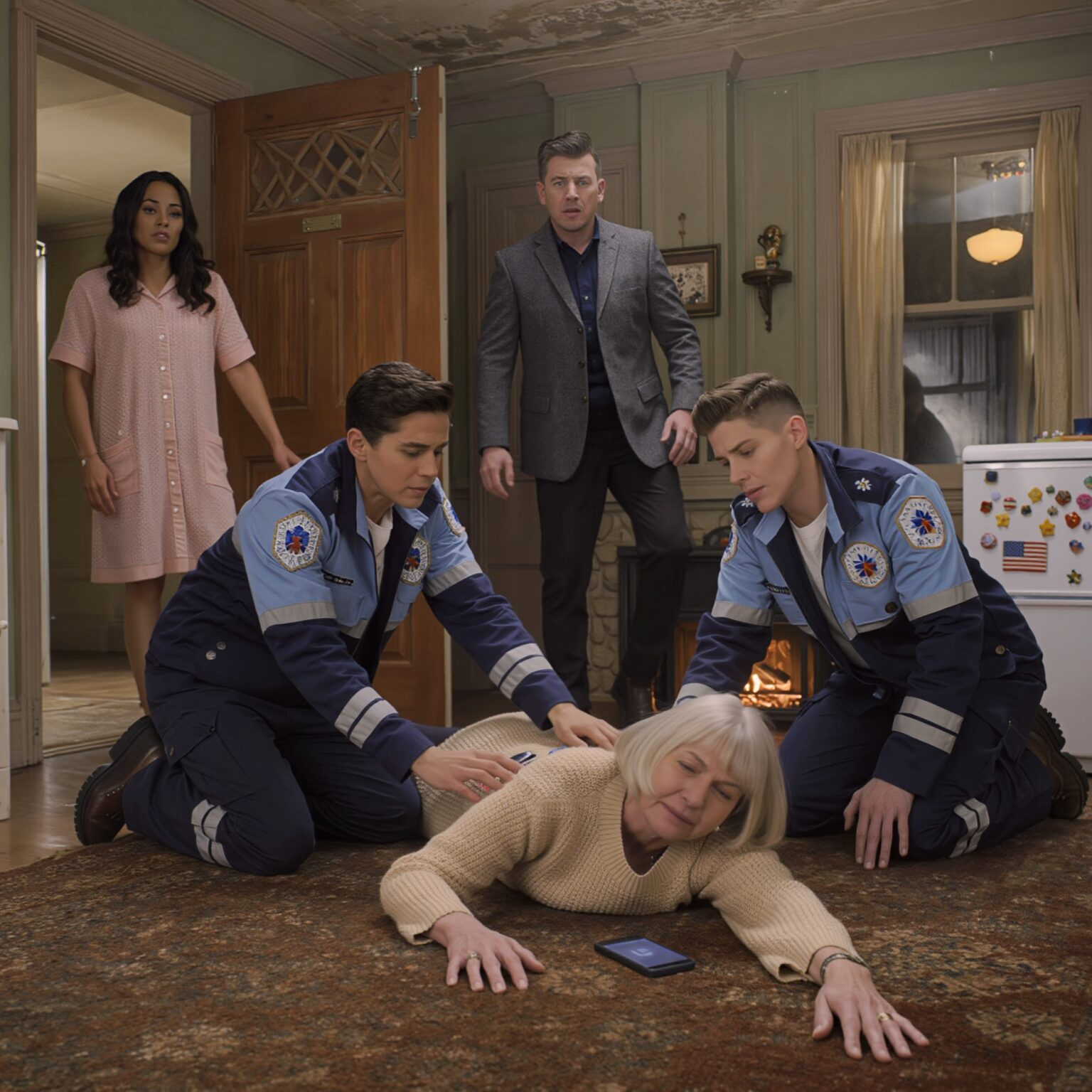
It began slowly — the way only something serious can, like a shadow creeping across a room before anyone notices its full shape. I remember how the sunlight slanted through the curtained windows on that morning of my 70th birthday, how the coffee smelled just a bit sweeter than usual, how I stood in the kitchen humming an old tune while making breakfast. Then suddenly — without fanfare, without warning — my chest tightened, my breath thinned, and the world blurred like ink smudged on paper. My legs weakened, my knees hit the cool floor, and within seconds I was lying there, struggling to breathe like someone trying to inhale through a straw. I was alone, and in that instant, alone felt like a cavernous thing — enormous and frightening, all at once.
My first thought wasn’t fear.
It was connection.
I needed help.
I reached for my phone — that small rectangle of light and lifeline that most of life now travels through. My fingers fumbled, shaking from panic and lack of oxygen, and the screen blinked with options I could barely see. I meant to send a quick text to my neighbor, Mrs. Ortega — someone dependable, caring, the kind of person who knew me well enough to check in on me regularly. But in the fog of pain and diminishing breath, my finger slipped.
Instead of Mrs. Ortega’s name, the message popped up addressed to someone I hadn’t heard from in years:
“Ethan.”
Ethan — my grandson.
The boy I hadn’t spoken to since his mother’s wedding six years ago, when heat and pride collided in ways that fractured our family into quiet, persistent halves. He had stopped answering my calls. His visits dried up. Birthdays, holidays, quiet Sundays — all passed with the sound of no reply echoing through my heart more sharply than any spoken rejection ever could.
And there it was on the screen:
Ethan — Are you there? I think I’m having a hard time breathing — please come.
I didn’t have the strength to read it twice. Just send.
I opened my eyes again, breath rattling like dry wood in an empty fireplace, and waited.
Moments later — or maybe it felt like hours — my phone buzzed.
His name lit up the screen:
Ethan: Where are you? I’m coming.
The simplicity of those words — that immediate, unhesitating concern — pierced through the panic as sharply as any sharp noise could have. Something in me — a quiet, dormant hope — stirred. I didn’t expect him to show up. Not really. Not after so many years of silence. But he did. Within minutes that felt too swift for disbelief but entirely right for something deeper than logic, I heard the thump of footsteps in the hallway, then the heavy-footed sort of rush that comes when someone is more afraid of arriving too late than arriving at all.
He found me on the floor, pale as morning fog, trembling and speechless, and in that moment — that fragility suspended between fear and relief — he didn’t ask why I had cut him out of my life. He didn’t quote old hurts. He didn’t mention arguments or distance. He simply knelt beside me, took my hand — the one I had texted him with — and held it like it was the most important thing in the world. And in that gesture, something bigger than mere presence took shape: recognition. Not of blame. Not of expectation. But of shared humanity.
He stayed with me as the ambulance arrived. He spoke to the EMTs with steady answers, calm and sure, as though this wasn’t just the neighbor’s elderly grandmother in trouble — but his grandmother. And in the sheen of sweat on his brow, in the quick exhale of relief when he saw me stabilize, I saw something I hadn’t seen in years: care that had never really vanished, just obscured by silence.
At the hospital, as machines beeped and nurses moved with practiced precision, Ethan didn’t leave my side. Not once. And in the long, quiet corridor where hospital lights hummed and time somehow stretched, he looked at me — not with reproach, not with old hurt, but with the careful softness of someone who had felt fear and was surprised to find love waiting.
He spoke then — quietly, as though out of habit, as though speaking had become foreign after years of mutual absence — “Why didn’t you call me?” Not accusatory. Just curious, tentative, like someone seeking truth without pretense.
I didn’t answer immediately. I didn’t offer excuses or polished explanations. I simply said this, gently, with a clarity that felt like a breath I had once forgotten how to take: “I was afraid. Afraid of rejection. Afraid of reopening old wounds. But I wasn’t afraid of you — just the idea of losing you again.” Not in tears. Not in regret. Just honesty.
He sat with that.
Not dismissing it.
Not weaponizing it.
Just sitting with it — like someone finally hearing a truth that had been waiting in a quiet room for years.
And then he did something even more surprising.
Instead of walking away, instead of turning silence into armor, he reached out and hugged me — not awkwardly, not hesitatingly — but with the simple sincerity of someone grateful that we still had a chance.
The next weeks were not perfect.
There were conversations that felt too long, too heavy, too overdue.
There were tears — mine and his — not because of drama,
but because of truth finally spoken:
truth that said forgiveness isn’t forgetting,
but it is choosing connection over absence.
In the days that followed, I walked again.
I breathed more steadily.
I felt the strength of someone rebuilt not in isolation,
but in reunion.
And though I still live with the memory of that fall —
the fear,
the loneliness,
the fragile moment between breath and panic —
I also live with the memory of his name lighting up that screen
and his footsteps coming toward me —
not with hesitation,
not with doubt,
but with love.
Because sometimes a mistake —
a slipped finger,
a misdirected text,
a crisis shared —
is not a fracture.
It is an opening.
And sometimes the best parts of our story
begin not with intention
but with unexpected connection when we need it most.
That day — my seventy-first year — wasn’t the end of a life.
It was the start of a rediscovered one.