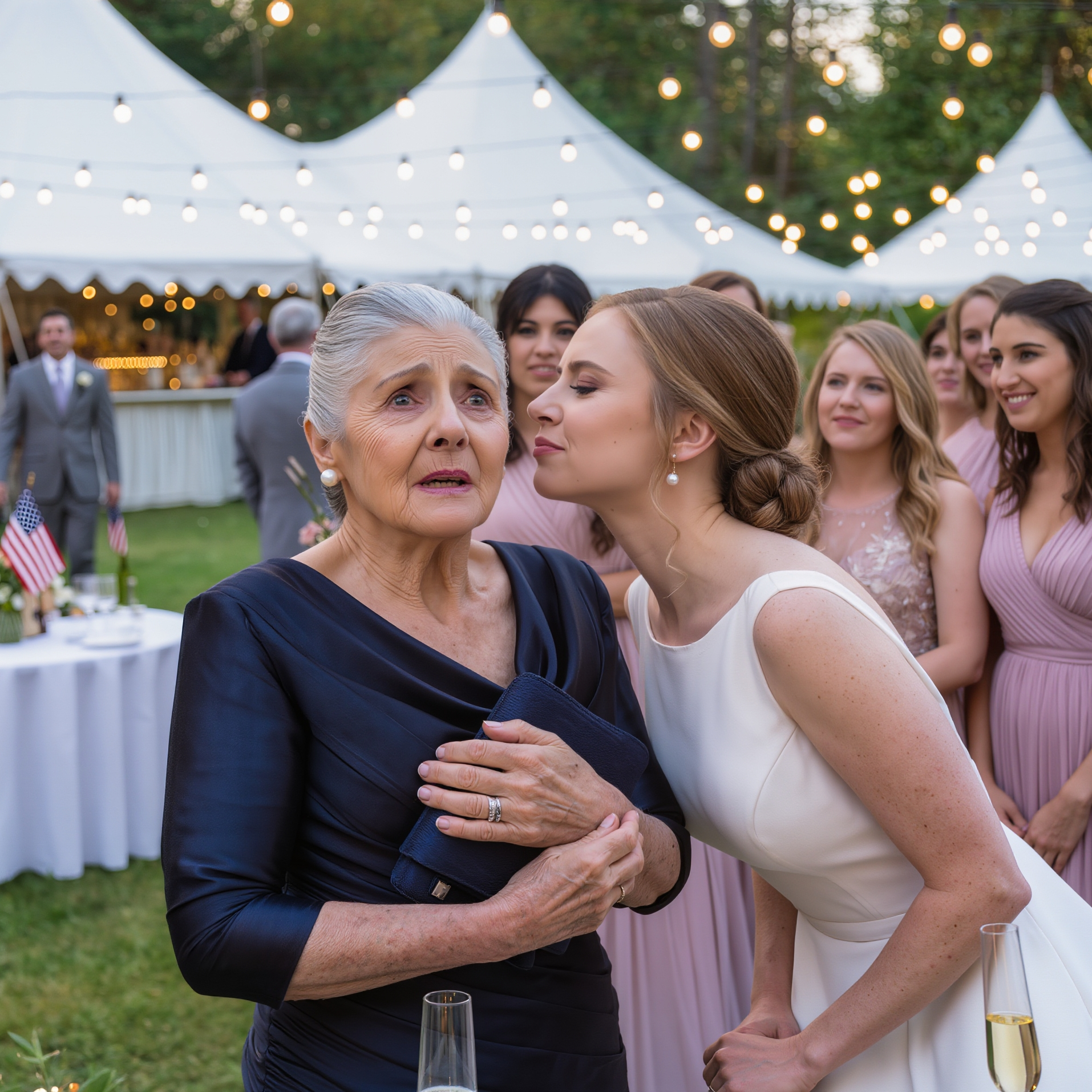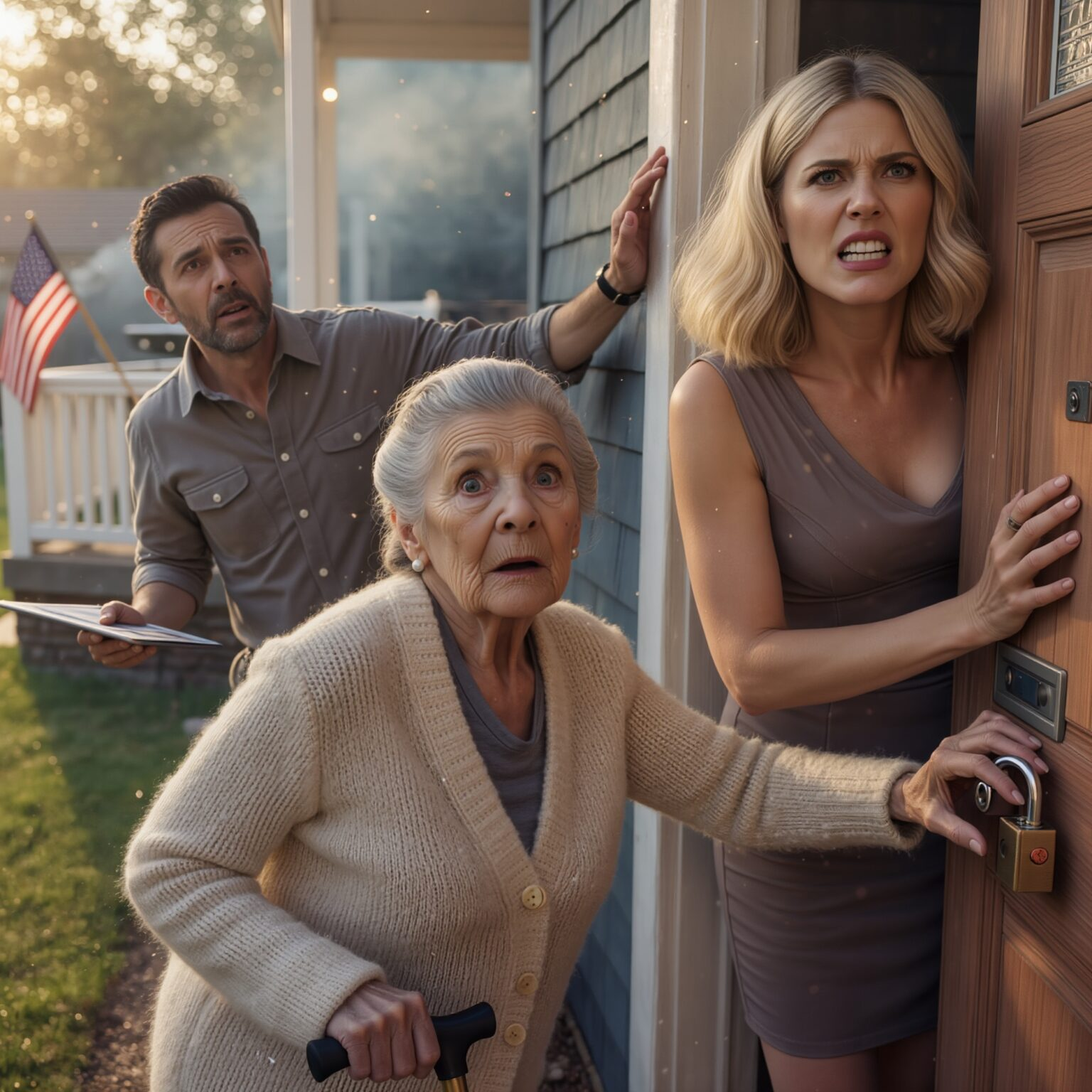
I didn’t hear the footsteps behind me until it was already too late — until I felt the impact of her shove sending me stumbling backward, skin cooling at the edges where sunlight didn’t reach, and the sharp clang of the shed door slamming shut behind me like the banged-shut judgment of a world that suddenly felt very small and very cold. My daughter — the same person who once fit into my arms as a toddler, whose first steps I encouraged on the very grass outside that shed — turned the key on the outside lock and said, with a brittle confidence that echoed louder than her words, “Scream all you want — nobody can hear you out here.” That moment didn’t just jolt my physical sense of safety. It rewired something deeper inside me: the understanding that fear is not the absence of love, but sometimes the echo of its confusion. I didn’t immediately scream — not because my voice was gone, but because shock delays certain reactions in the body, like someone pausing mid-sentence when everything in a room suddenly changes color and tone. The walls of that shed — the same rough wood we once used to store holiday decorations and old gardening tools — felt alien now, as though the warmth they once symbolized in memory had been replaced by the chill of betrayal.
My heart beat fast, not just because of the confined space, but because of the disbelief that someone I loved — someone whose bloodstream once contained a piece of my own — could stand outside and deliver that sentence with such casual cruelty. There was no hesitation in her action, no flicker of doubt, no remnant of the daughter who once looked to me for comfort when nightmares crept into her dreams. There was only a locked door and the snap of a key turning in ignorance of emotional outcomes. Being alone in that shed — the sky above just a thin stripe of promise — made me suddenly aware of how deeply belonging and fear can intersect like opposing currents in the same body of water: one pulling toward connection, the other toward isolation.
I found my voice then — not a scream, not panic, but a quiet, trembling realization that even in fear there is room for clarity. I took a breath — slow, uneven, but determined — and said aloud, not to the locked door, but to myself: “This is not worth my worth.” Those words landed with surprising solidity inside me, like the first step toward stepping out of that emotional trap. Fear was real in that moment. But so was a deeper recognition: fear is not the authority of your worth.
Minutes passed.
Anger simmered.
Memory coiled.
But my sense of self — what had once been tender and unquestioned — began to unfold again in spite of the cold walls, in spite of her intention to contain me physically and emotionally.
Eventually the sound of a car door outside broke the stillness — her car, not mine. I heard footsteps retreat rather than approach, a final punctuation in that chapter of absurd hostility. And then I knew what I had to do: open the locked door. Not by force — the lock was thin and ordinary — but by intention. I reached for the simple metal latch, turned it from inside, and stepped out into the sunlight with a breath that felt like emergence rather than escape.
I didn’t run.
I didn’t cry.
I stood — quiet and steady.
My daughter was already walking back toward the house without looking at me. I could have yelled, asked for explanation, pleaded for acknowledgment. I didn’t. Instead, I walked past her with calm awareness — not the brittle calm of avoidance, but the firm, centered calm of someone who had just learned something fundamental: Your worth is not defined by how others treat you. It is defined by how you choose to see yourself when treatment falls short of love.
Later that day, I walked into my own living room — the place where so much of our family’s laughter used to echo — and I sat down with a notebook and pen. I wrote: “I will never again allow someone else’s fear, frustration, or misunderstanding to dictate the narrative of my life.” I didn’t write it with bitterness. I wrote it with clarity — like someone who has looked fear in the eye and said, “You do not have authority here.”
In the days that followed, my daughter didn’t apologize. She didn’t ask for forgiveness. Instead, she avoided eye contact and continued her routines as though nothing significant had happened — or as though nothing significant could happen between people who once loved one another. It was in her avoidance, oddly enough, that I saw something I hadn’t seen before: you can love someone and still lose them to their own unresolved hurt. Her action wasn’t just cruelty. It was a mirror showing me that some people are so consumed by their own fears and entitlements that they forget what it means to hold another humanely.
I didn’t choose estrangement right away. I chose boundaries.
A boundary is not a wall.
It’s a gentle firmness about what behavior you will accept in your life.
That’s not weak.
That’s not abandonment.
That’s emotional self-respect.
I continued my life with quiet dignity: tending my garden, walking to church on Sundays, sitting on the porch with my thoughts, and slowly reassembling a sense of belonging that did not hinge on someone’s moment of rage or mistreatment. I saw friends and neighbors with warmer eyes than ever before, and I sensed a subtle shift inside me — a growing understanding that fear and love can occupy the same space, but choice determines which emotion gets invited to stay.
One evening, months later, I saw my daughter at a neighbor’s barbecue. She glanced my way, recognition flickering in her eyes — not hostility, not apology, just awareness. I offered a polite nod — simple and human, not dismissive, not inviting conflict. She returned it with something softer than avoidance: the hesitation of someone who has met their reflection and noticed the truth for the first time.
Then, as the sun gave way to stars, I turned and walked back to my own porch, breathing in the cool air that no longer felt like confinement. In that simple, unhurried step back into my own space, I realized something profound:
Love is not always granted,
but self-respect is always within reach.
And sometimes —
in the echo of doors closing,
in the quiet aftermath of fear —
we discover not only who others are,
but who we truly are.
And that — that clarity —
is worth more than a thousand apologies left unsaid.