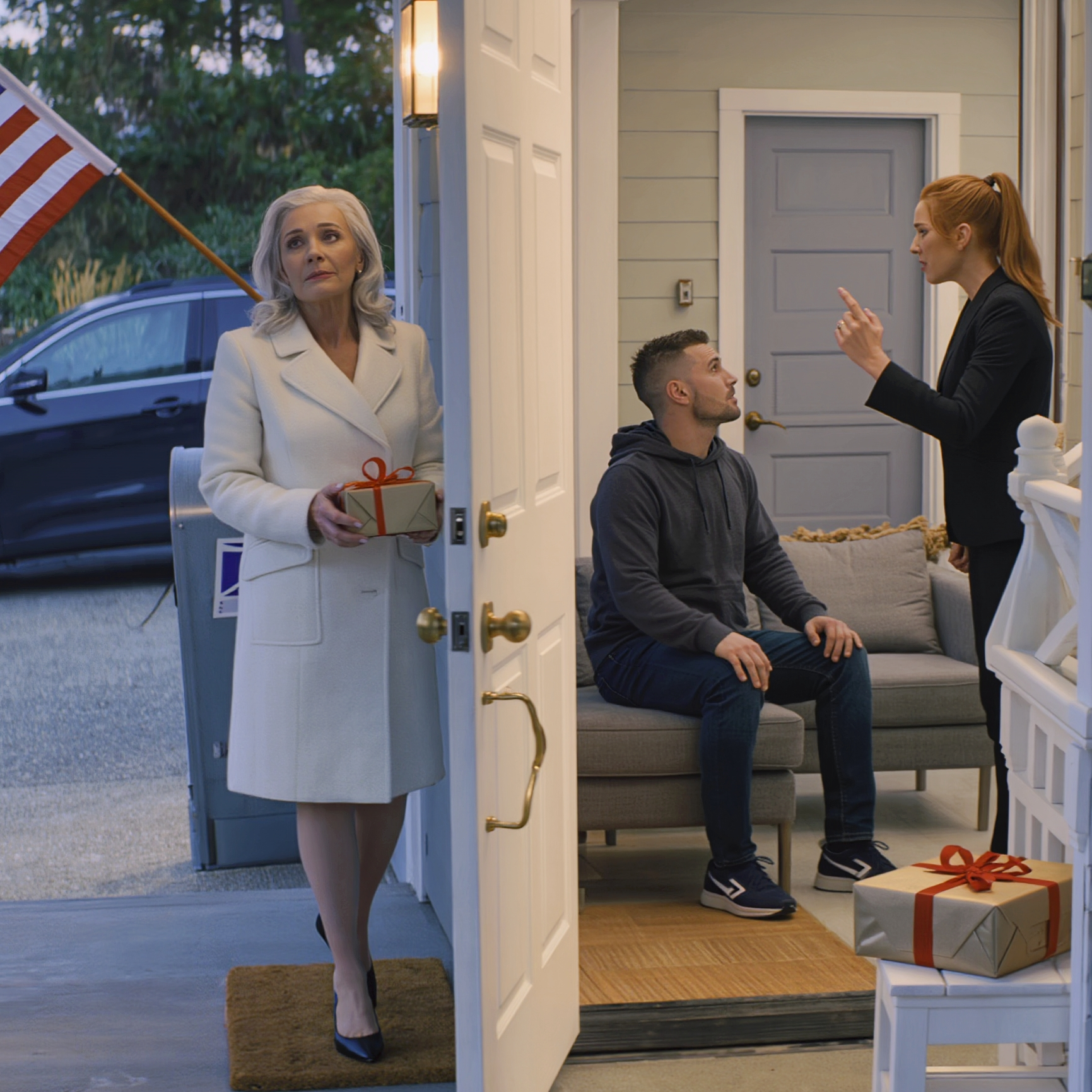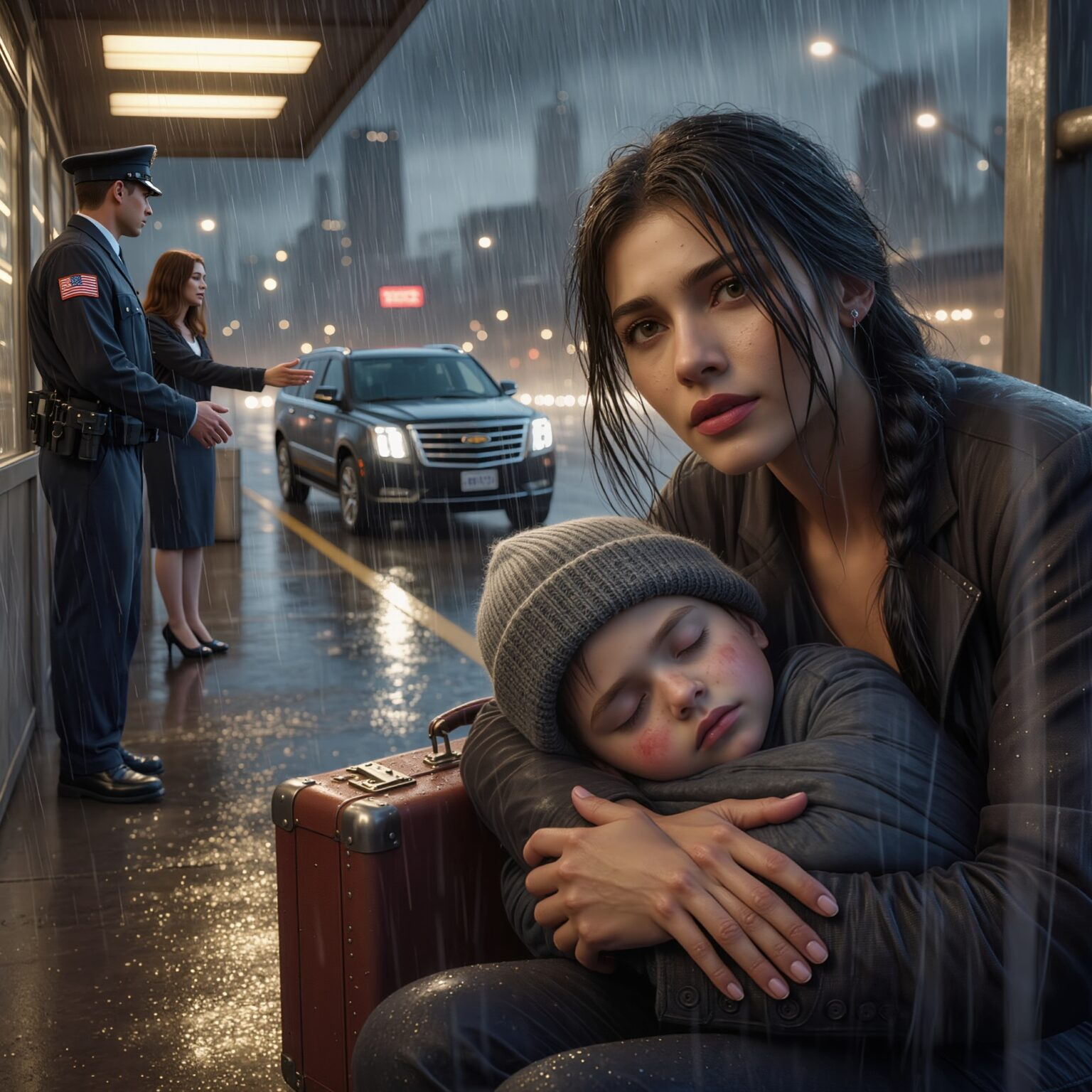
I remember the rain that night like someone remembering a song that once meant comfort but suddenly became dissonant instead — heavy, unyielding, cold in a way that seeped past skin and lodged in the bones like unwelcome truth. My suitcase — the only physical thing I still owned of the life we built — lay crooked in a puddle on that stone porch, wheels spinning uselessly, as if gravity itself had turned against me. My mother-in-law stood nearby — arms crossed, expression a distillation of dismissive certainty — and she uttered words I thought no one would ever say to a woman with her own five-year-old clutched to her hand: “You two are burdens. I don’t have space in this house or in this family for either of you.” And just like that, with a kick of disdain and a storm pounding above, she transformed a familiar doorstep into a symbolic crossroads of humiliation and sudden displacement.
We walked away without a backward glance — not because we weren’t wounded, but because standing still felt like giving validity to the moment. My son shivered under his tiny jacket, not from cold but confusion: “Mommy, why did Grandma say that?” His voice was small, like moth wings brushing silence, and I had no ready answer. I only knew that the world had just taught him something harsh about love — that family can fracture with a single spoken sentence — and I had to be strong when I didn’t feel capable of breath.
The weeks that followed were a quiet blur of hotel rooms, worn blankets, and whispered lullabies that attempted to shield him from the emotional cut of rejection. I watched his laughter grow smaller each day, like a tide receding from a shore it no longer visited. And in the empty hours when he slept, I tried to stitch a new existence from the threads of everyday life — grocery runs, school drop-offs, job applications, nights spent staring at ceilings as though answers might hover there like dust motes in sunlight.
Then — three weeks after that rainy evening and the brutal dismissal on the porch — there came a knock at my door. Not a firm, familiar knock. Not the hesitant knock of someone unsure. No — it was gentle and unassuming, as though the knocker expected no one to answer. When I opened it, standing on the threshold was a woman I didn’t recognize —late-twenties, soft eyes framed by an anxious kind of worry, and hands folded together like she was carrying something invisible but very heavy.
Before I could speak, she said quietly: “I need to talk to you about your mother-in-law.” My heart — already battered and tender — felt a sudden, uncomfortable jolt. About her? Not about us, not about the weather, not about missing luggage or lost days — no, about her. I swallowed, bracing myself like I had braced through difficult conversations before, and invited her inside without knowing why, only that something in her eyes suggested urgency and sincerity.
She sat on my sofa — the one we had bought with careful deliberation years ago, one I had never imagined would become witness to such pain — and took a breath before speaking again. “My name is Jenna,” she began, “and I’m your mother-in-law’s niece.” Confusion knotted in my chest — I hadn’t known she had a niece. “She’s not well,” Jenna continued — voice steady but soft. “She didn’t want to tell you this herself, but she’s been diagnosed with a serious illness, and she asked me to find you and your son.” My breath — caught somewhere between disbelief and cautious hope — felt too large for the space between us.
I didn’t react immediately. I just listened as Jenna spoke of her aunt’s regret, of long years tangled in old resentments, of the stubborn pride that had led her to lash out instead of reaching out. She explained that my mother-in-law’s behavior wasn’t random cruelty — it was fear disguised as anger, fear of vulnerability and loss, fear of appearing weak, fear of facing her own mortality and what that meant for the family she thought she understood. Jenna didn’t excuse the cruelty. She simply offered context — the kind that doesn’t erase pain, but illuminates it in a way that makes room for understanding rather than mere reaction.
I sat still — letting the words unfold like petals in the quiet afternoon light — and thought of my son’s small voice on that porch, his confusion shaped by someone else’s bitterness. I thought of myself, trying to build a new life from fragments, unsure whether mercy had a place in my story anymore.
Jenna stayed long enough to answer questions, to hand me a letter — written in my mother-in-law’s shaky handwriting — expressing remorse, fear, and a wish to see both of us before it was too late. It wasn’t a grand apology. It wasn’t an attempt to undo the moment in the rain. It was, simply, truth delivered late but sincerely.
When Jenna left, I sat in silence — not empty silence, but quiet reflection. The pain I carried didn’t evaporate. The memory of that rainy porch didn’t dissolve. But something subtle began to shift in me: a recognition that hurt and fear often occupy the same emotional space, and sometimes cruelty is a cry for help wrapped in its own despair.
That night, as my son slept, I read the letter again — aloud, not to him, but to the stillness that held both of us. In the careful lines of regret and fear, I found a doorway I hadn’t anticipated: the possibility that people can hurt out of fear, not malice, and that reconciliation doesn’t erase pain but reframes the story with grace.
I didn’t contact my mother-in-law that night. I didn’t rush to forgiveness or immediate reconciliation. What I did was understand that love and fear can be strangers who sometimes stand on the same doorstep. And the best of us — even those who falter — can still choose to step over our own fears and speak truth when it finally arrives.
Life didn’t become perfect.
The wound didn’t instantly heal.
But the narrative — once closed in anger — now had room for another chapter.
And sometimes — just sometimes —
that’s how healing begins.