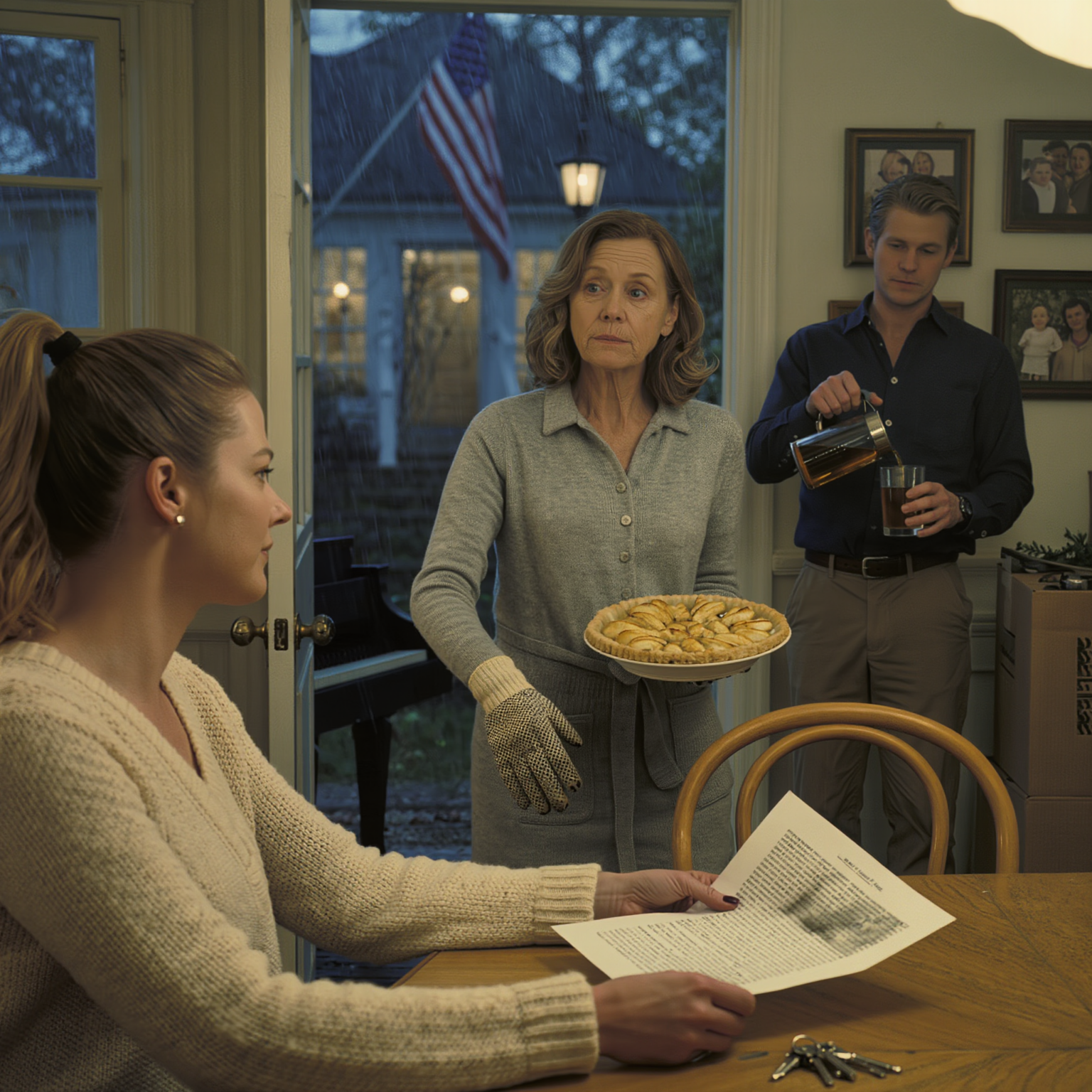
I had always imagined that if the day came when my son Owen and his wife Haley moved into the Apple Tree House — the house my late husband and I built room by room with our sweat and laughter and midnight plans — it would be a day marked by emotional fanfare, clumsy goodbyes, loud declarations of “thank you” and “it wouldn’t be the same without you.” I pictured grand gestures or at least a few sentimental tears. What actually happened wasn’t dramatic. There were no raised voices, no heartbreaking slams of doors, no storming out or whispered insults. Instead it happened in the quietest way possible — through a stack of paint swatches laid out on the old pine dining table, colors ranging from ivory to oatmeal cream to seventeen variations of beige, each one a subtle shade meant to “modernize the place,” as Haley said with a polite smile that didn’t quite reach her eyes.
I was alone in the kitchen that morning, the sun flooding the old hardwood floors that creaked just like they always had, when Owen brought the swatches in one by one and spread them across the table like someone unfurling a map of territory he planned to navigate. My first thought wasn’t outrage. It was the soft echo of familiarity — the echo of my husband’s voice recommending a warm cream over stark white because light can feel like wind at times. And there, among those carefully chosen neutrals, I felt something shift inside me, not with resistance, not with anger, but with that subtle, unsettling awareness that this — this moment — was the beginning of change. Not upheaval, not rebellion, not a declaration of difference, but the quiet logistics of a future being sketched out before I had even finished my cup of morning tea.
They didn’t announce their intention with thunderous proclamation. They didn’t demand I leave or suggest I had to move into the guest cottage. They simply said, in a conversational tone that carried ease rather than confrontation, “We thought we’d start with the paint. It’s a good neutral base.” Neutral. The word clanged in my chest like a tiny bell struck at the wrong moment — not beloved resonance, but a hint of disorientation. The Apple Tree House wasn’t just some generic space with walls and windows; it was our life’s work. Every floorboard held summer footprints, every gable watched autumn leaves fall in patterns we had memorized, every window bore the soft diffused memory of decades of light.
But there they were — swatches in hand, exchanging looks of mild excitement about undertones and which color “reads warmer with the afternoon sun.” They were not dismissive. They were merely practical. And in that practicality, I sensed something deeper than awkward transition: I sensed the quiet, everyday way that a home becomes someone else’s life.
I didn’t raise my voice. I didn’t insist on tradition. I did the only thing that felt true in that moment: I walked over to the swatches, picked up the beige that most closely resembled the walls my husband and I had once chosen together, and said, softly, “This one catches the light in much the same way the living room used to.” Not a protest. Not a surrender. Just truth.
They looked at me then — Owen with something like sudden clarity, Haley with something like unexpected warmth — and the room changed ever so subtly. It didn’t shape-shift with drama. It simply opened with the gentle realignment of human understanding: that love for a home isn’t a static claim but a living connection.
We didn’t paint that day. We sat in the living room — the heart of the old house — and drank tea while the paint swatches lay between us like unspoken possibilities rather than battles to be won. I saw in their eyes not entitlement but curiosity about how light moved across the walls in early morning. I saw in Owen’s smile a trace of his childhood wonder when he used to chase sunlight patches along these same floors. I saw in Haley’s steady gaze a genuine intention to belong, not overshadow.
No door was ever slammed.
No resentment was ever loudly proclaimed.
No dramatic declaration of “this is mine now” was spoken.
Instead, the Apple Tree House began to transition in the gentlest of ways — through shared observation of sunlight and color, through laughter over which shade made the hallway look cozier, through a long afternoon of quiet conversation that felt more like family adaptation than family fracture.
In that softness I understood something essential:
Homes are not inherited by force.
They are embraced through shared memory, respect, and mutual care.
Yes, this house was built by my hands and my husband’s hands, but it was lived in by all of us — the echoes of childhood, the warmth of family gatherings, the scent of countless dinners and spontaneous laughter. What made it home wasn’t the walls alone, but the meaning etched into each one.
I didn’t leave the room that day.
I didn’t withhold my presence or nostalgia.
I simply stayed — present in memory and open to change.
And when Owen finally said, with that thoughtful sincerity that still reminded me of the boy he once was, “Mom, we want this to be a place where we all feel at home,”
I realized that wasn’t a claim of ownership.
It was an invitation.
Not to erase the past.
Not to overwrite it.
But to fold our stories together in the quiet, thoughtful way people build something stronger than mere walls —
they build belonging.
And that — more than beige paint and neutral walls —
is what turns a house into a home.