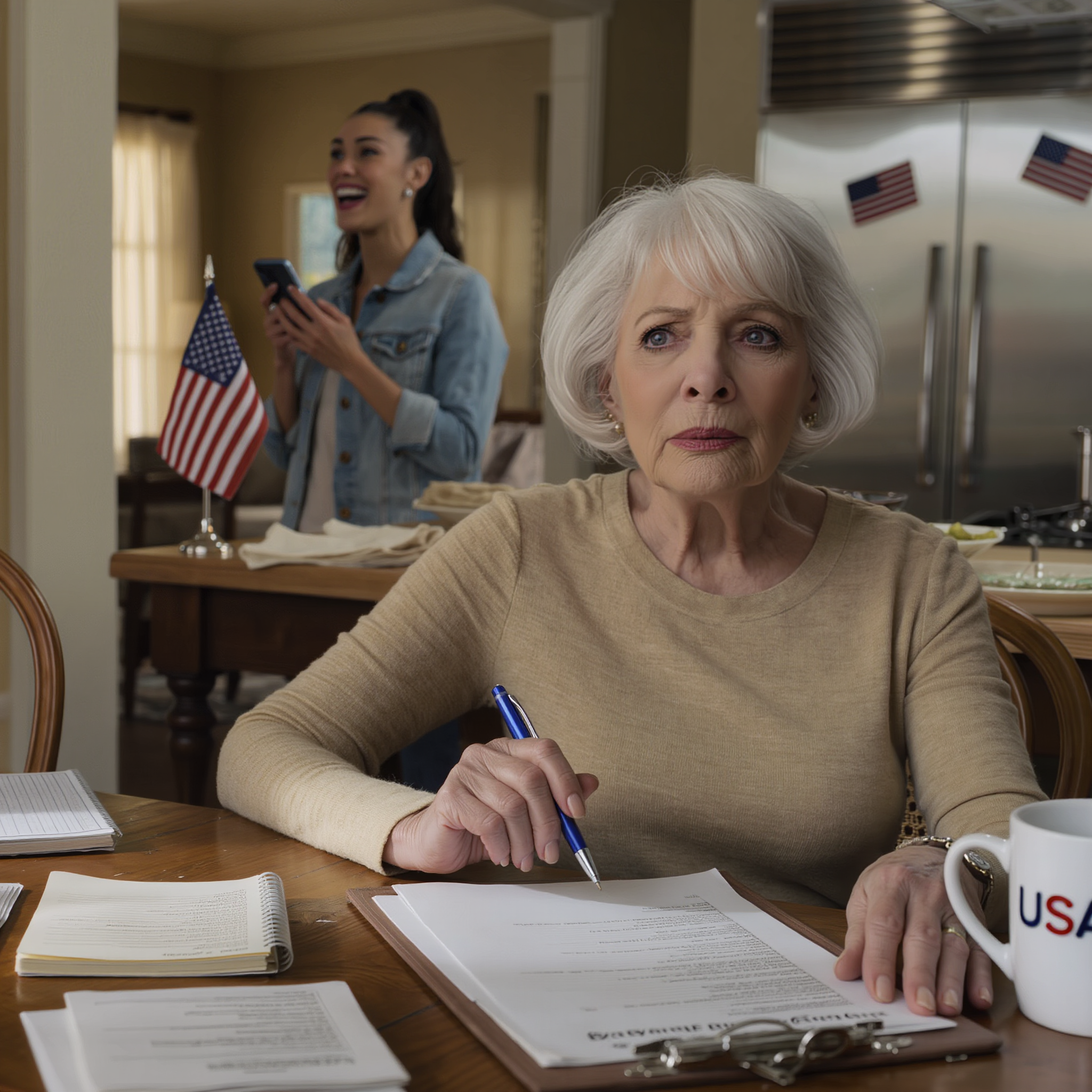
I was sitting at the kitchen table on a crisp spring morning — that quiet hour between waking and doing, when the sun pours through the windows and makes everything feel possible — signing the final wedding invoices for my granddaughter’s upcoming $80,000 celebration when I heard her name clearly, unmistakably, drifting up the stairs from the living room where she was on a video call with a friend. I had the invoice for the florist in my hand, that elegant script showing roses and hydrangeas and a price that made me swallow hard, and I thought about how excited she had been when I first offered to help pay for the wedding of her dreams. I thought about all the years I had quietly saved, the modest retirement I had carefully budgeted, the few comforts I allowed myself because I always believed family comes first — especially a granddaughter who had called me her best friend before she even knew what that phrase really meant. I don’t know when exactly I became the person who wrote checks for lavish affairs instead of quietly tending my garden or taking long afternoon walks like I used to. Maybe it was the loneliness my husband’s passing left behind, or maybe it was the need to feel needed after decades of giving to others. Whatever the reason, here I was, poised to put my name on another large sum of money that would be spent on catering, dresses, rings, venues and photographers, all with a bright, fluttery feeling in my chest that I was doing something right — something loving and generous and meaningful — until I heard her voice, not lifted to me but lowered in conspiratorial tones, say: “If Grandma would just disappear before the big day… no one would ever complain about money again.” At first I thought I had misheard, because the mind often protects us from the most wounding truths by letting them echo faintly at first, like a distant bell. I stared at the invoice for a long moment, pen hovering above the signature line, while my granddaughter continued, unaware that I was only a hallway away, confiding in her friend that my presence at the wedding was somehow inconvenient, embarrassing, or less than desirable — phrases she didn’t use exactly, but the implication hung in the air between them like an unspoken demand. My breath felt like lead in that instant, not because of shock alone but because of the practicality in her tone, the way she seemed to treat me more like a line item on an expense sheet than the woman who had tucked her into bed when she was sick, paid for school supplies when money was tight, helped with babysitting without asking for a single thank-you. I remember the taste of coffee suddenly turning bitter in my mouth as I pushed the invoice aside and listened harder, my heart tightening around the way she said the word disappear — that cold, almost casual suggestion that if I simply weren’t there, life would be easier, more elegant, more without friction. It was as though a switch was flipped inside me, from I am your grandmother to I am a problem to be managed, and that realization stabbed me with a vulnerability I didn’t expect to feel at my age and stage of life. I didn’t burst into tears. I didn’t storm out. I just stood still in the kitchen, the morning light on the maple floors suddenly too bright, too revealing. I realized in that moment that I had been operating on a story about myself that wasn’t entirely true — the story that I was beloved simply because I loved. And here was evidence in the sound of my granddaughter’s voice over an ordinary phone call that love is not always welcomed, even when given freely. In the next heartbeat, I heard her friend laugh and say, “Yeah, Grandma doesn’t need to make it awkward with her presence anyway…” and that was like a second strike, not because it was cruel, but because it was so matter-of-fact, like something that had been assumed rather than acknowledged as hurtful. My knees felt weak and I had to grip the edge of the kitchen table with both hands, the wood grain pressing into my palms as though I needed something solid to hold onto outside of the emotional ground shifting beneath me. I had been giving — giving without hesitation, giving without boundaries, giving with the assumption that appreciation followed generosity — but what I had not anticipated was that generosity could be seen as a liability, an accessory, even an annoyance. I remembered that morning how she had hugged me the last time she visited, a brief peck on the cheek with a distracted smile, eyes already flitting to her phone. I remembered how she thanked me — not heartily — but in the clipped, polite way one thanks a host for dinner, not a grandmother for decades of love. I realized then that there were layers of expectation and entitlement here that had nothing to do with me personally and everything to do with the world she was growing into — a world where convenience mattered more than connection, where perceptions outweighed presence, and where luxury overshadowed simplicity. Even as these thoughts swirled in my mind, I felt something else rising in me — not indignation exactly, not in that dramatic way people imagine rage to be, but a clear, cold awareness that I had crossed a line in my own heart as well: I had tied my worth to being needed, to being essential, to being welcomed into every moment of their lives. And in doing so, I had placed my joy in their hands, rather than holding it myself. I remembered the countless times I picked up the phone with anticipation only to be met with short, distracted replies. I remembered holidays that felt rushed rather than heartfelt. I remembered dinners where laughter never reached my eyes, where my presence was acknowledged but my voice felt peripheral. In that silence — that deep, internal stillness — I made a decision that was not born from hurt, though hurt was undeniably there. It was born from clarity. I put my pen down and stood up fully, as though I was rising not just from a chair but from a lifetime of assumptions I had made about how love and generosity were supposed to work. I walked toward the living room but stopped before crossing the threshold, not because I was afraid, but because I needed space to think. I replayed what I had heard not as a granddaughter who was deeply flawed and perhaps not fully thoughtful, but as an adult woman who had allowed her own sense of value to be dictated by the comments and casual dismissals of others. I realized then that I had two choices: sign the invoices and continue giving from a place of dependence on their gratitude, or take a moment — a long moment — to protect not just my finances but my heart. I sat back down in the kitchen, not to sign, but to breathe. And as I breathed, I felt the sting of tears well up, not out of self-pity, but out of recognition that I had to teach myself what it means to be needed in a mutual way before I could give in a healthy way again. I thought about my husband — gone now for many years — and how he always saw me not as a burden but as a partner, how he listened to me, really listened, not just waited to speak next. I thought about the little things he used to say, the ways he would acknowledge both my efforts and my emotions as equally important. Then I thought about my granddaughter, just six years old and still too young to fully understand how her words could wound, and I felt a different sort of sadness: the sadness of a love that had not yet learned how to express itself without diminishing the other. I realized that children often repeat what they observe, and her dismissal of me might have been learned, not innate — a reflection of the environment around her rather than her own fully formed heart. In that moment, I felt compassion and awareness — compassion for her, awareness of myself. I didn’t storm into her room. I didn’t demand explanations or apologies. I simply sat at the kitchen table and let the morning light wash over me, feeling a sense of reorientation rather than collapse. I picked up my phone and scrolled through the wedding invoices not to sign them, but to review them with a new lens, one that considered what I was giving and why. I thought about calling the florist and explaining I needed more time. I thought about reaching out to the caterer and postponing the final arrangements. More than that, I considered calling a close friend, someone who genuinely cares about me and would listen without judgment. In that silence — thick, reflective, humbling — I began to understand that generosity without boundaries can become a form of self-erasure, and that love, to be healthy, must be mutual rather than transactional. I realized also that this wedding, while important to my granddaughter, did not have to define my self-worth or my place in the family. I could be generous because I wanted to be, not because I believed I was required to be. I could offer love, support, and presence without sacrificing my dignity or letting casual remarks diminish my value. That afternoon I made a cup of tea and sat in the sunshine on my porch, the invoice still unsigned on the kitchen table behind me. I didn’t feel triumphant, but I felt steady — a feeling stronger than elation and deeper than sadness. I realized that some lessons in life don’t arrive with fanfare but with quiet moments of overheard truth, and that growth sometimes begins not when love is welcomed but when it is questioned. I looked out at my garden, where flowers were just beginning to bloom, and understood that just as blossoms unfurl in their own time, so too does self-respect. It doesn’t need permission. It doesn’t require approval. It simply grows. I didn’t write a message to my granddaughter that day. I didn’t demand an apology from her or her parents. I gave myself space, reflection, and a kind of internal permission to be more discerning with my love and generosity. And when I stood up later to finally walk toward the living room — not to confront, argue, or retract kindness — but to speak honestly with my son and his wife about what I had overheard and how it made me feel, I knew I was not returning as someone begging for acceptance. I was returning as someone who had learned a hard lesson about dignity, boundaries, love, and the way we choose to give without losing ourselves. And that — far more than any wedding, any invoice, any casual remark of inconvenience — was what truly mattered.
Sitting in My Kitchen, I Was Signing the Final Invoices for My Granddaughter’s $80,000 Wedding — Until I Overheard Her Tell a Friend, “If Grandma Would Just Disappear Before the Big Day…”