I didn’t expect the numbness to hit me the way it did — I pictured shock, maybe tears, maybe a rush of memories rushing back all at once like a flood when I pulled up the long winding driveway of the mansion I had once called home, the place I bought with years of hard work and quiet dreams, the place I intended to be a refuge for my daughter if life ever got hard for her. Fifteen years away in the United Kingdom — building a life, building a career, building distance after a bitter divorce — had changed my accent, softened some parts of me and toughened others, and I fully believed that when I returned to the States, my first priority would be to embrace her, not simply recognize her. I didn’t think I would feel numb. I didn’t think I would stand there — framed by the opulent portico of the mansion I had left her — and feel nothing at the first, heavy, echoing sight of her.
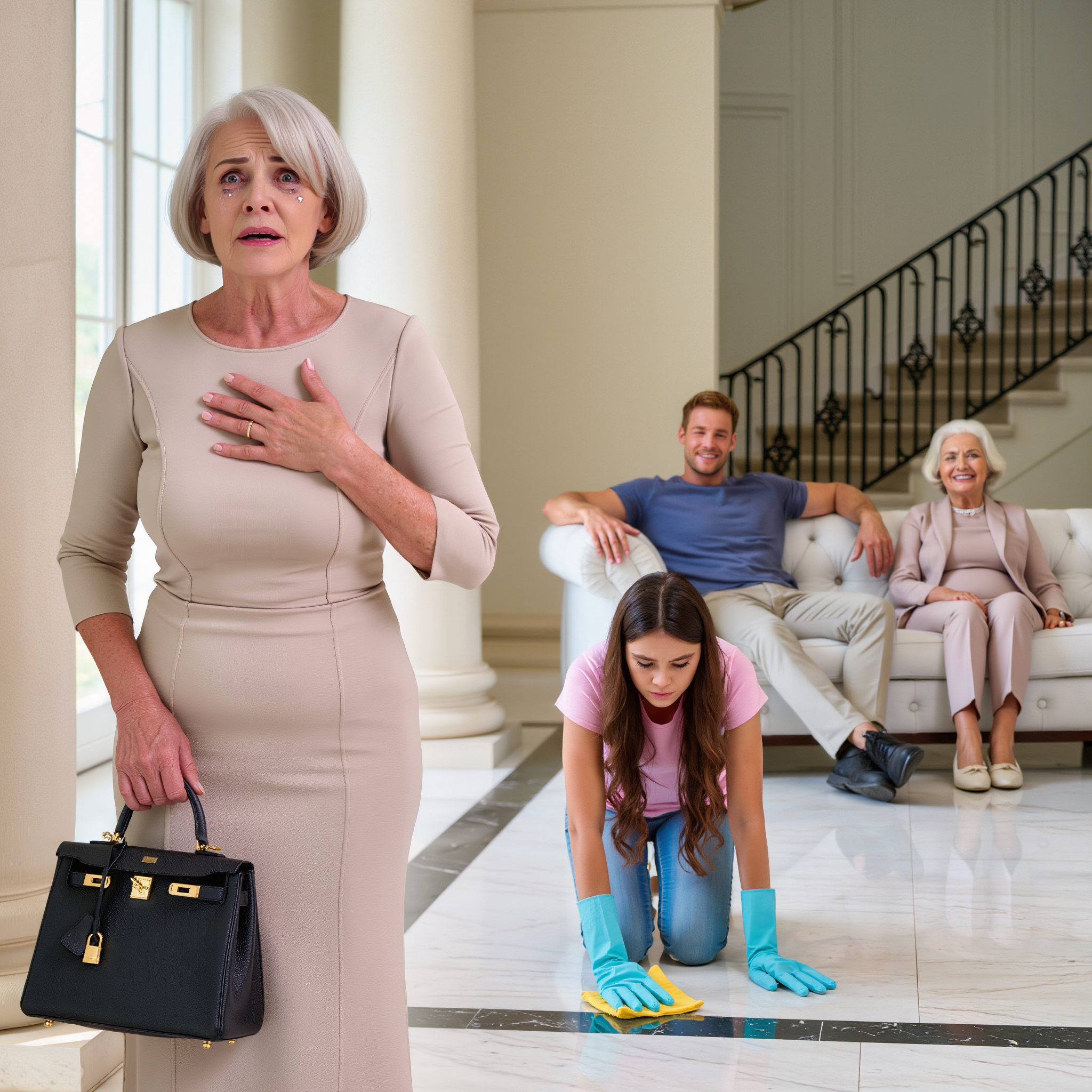
I saw her first through the tall, floor-to-ceiling windows, moving in patterns that resembled work more than leisure, like someone who never quite leaves a room because there is always some task demanding attention. She carried arms overloaded with towels, her shoulders stooped in a way I had never seen before — the taut, exhausted curve of someone who sleeps little, worries constantly, gives everything without replenishing anything. Her eyes didn’t light up when she glanced outside; in fact, she barely met my gaze at all. There was a hollow quality to them — not anger, not sorrow, but weariness so deep that it felt like a wound that had never been allowed to bleed.
I walked up onto the porch and the front door opened before I even knocked, as though she had sensed someone else nearby, someone unfamiliar, someone not part of the invisible rhythm of her daily chores. When she saw me standing there — a stranger at first glance — I thought she would pause, blink, perhaps take a breath that carried recognition from memory. Instead, she froze for a fraction of a second and looked past me, a kind of weary uncertainty flickering in her expression as though she was trying to place which moment of her past this visitor might belong to. “Mom?” I said, my voice softer than I expected — not a question, more of a gently extended invitation into a memory I hoped was still intact. Her eyes widened slightly, but not with joy or surprise. Just processing. Then she closed her mouth, and her lips formed something that looked like a reflex rather than an emotional response: the barest hint of polite acknowledgment. A name tag on an apron would have looked more emotionally engaged.
I didn’t recoil. I just stood there, the cool morning air brushing against my skin, listening to the slight thrum of activity inside — doors closing gently, the distant tick of a grandfather clock, the faint hum of a household constantly in motion — as though the walls themselves were whispering about all the years I had been gone.
“I’m home,” I said again, a little louder, a little steadier, and then I watched something shift in her face — not recognition, not warmth, but a flicker of awareness that someone known was standing at her threshold. She blinked once, twice, and then said in a voice that surprised me with its thinness — “Oh.” Just that. And then she stepped aside and — almost without emotion — let me into the house I had once filled with laughter, arguments, quiet breakfasts, and sticky fingerprints on every light switch.
Walking inside was like stepping into a world that had been repurposed while I was away. The furniture was grand and modern, the walls adorned with art that matched the mansion’s aesthetic, but the air carried a heaviness I had never felt here before — like tension had soaked into the upholstery, like the smiles that must have once filled this space were now stored behind locked doors, rarely accessed, rarely spoken. I looked at the gleaming floors and thought about how much had changed, and how much had stayed eerily the same.
She guided me through the grand hallways with mechanical precision, barely meeting my eyes, as though she was showing a guest around rather than greeting her own mother. It wasn’t rudeness. It was exhaustion. And beneath the exhaustion, a kind of emotional resignation that cut deeper than any sharp word ever could.
I tried small talk — a cautious question about her job, about friends, about how she had been spending her time — and each answer was carefully measured, short, almost pre-programmed. I saw how her husband stood behind her, tall and composed, a man who carried ease and confidence like a second skin, a man who looked at me not with warmth but with that inert civility people use when they perceive someone as background. They introduced themselves politely — everything polite, nothing warm, and I knew in that moment that this was more than awkwardness. This was a relationship reduced to a formality.
And then something even more telling happened. I asked her how work was going — not the polished version she might have been expected to give — and she hesitated. Not out of fear or discomfort. Just… pause. A pause that carried the weight of years of unasked questions that had gone unspoken. Then she said, in that muted voice that seemed to echo all the way from a place of tiredness I had never known when she was a child, “Busy.” That was it. Busy. Not joyful. Not fulfilled. Not thriving. Just busy, like a machine in motion with no internal rest.
It was then — standing in the foyer bathed in impossible wealth and strangely absent of warmth — that I realized how deeply numb I had become. Not because I had been away, but because what I saw in my daughter’s eyes was a version of her I had never wanted to recognize: a daughter who had learned to survive, not live. A daughter whose life, even in abundance, felt like an endless series of tasks rather than a tapestry of meaning.
I didn’t cry. I didn’t shout. I simply felt an emptiness spread through me, like someone unplugging a light I didn’t even know was on. The mansion was worth millions — elegant hallways, plush living rooms, towering windows that looked out on endless lawns — and yet I felt colder here than I ever did in rented flats in rainy England. Because this house — all marble and glass and grandeur — felt like a gilded cage if a person never had the chance to breathe.
Her husband — smartly dressed, well-spoken, well-composed — stood beside her with the effortless poise of someone accustomed to having things under control. He asked me how my flight was, whether I needed anything, whether I was comfortable, and his questions were polished, careful, like the sort of questions people ask when they want to appear hospitable but don’t actually care deeply about the answers. And beneath his polite tone, I heard a kind of equanimity that didn’t belong to affection — it belonged to efficiency. This was a man who managed things: schedules, dinners, appearances, expectations — but who had never managed the fragile, beating heart of a human being who once loved his daughter fiercely.
I watched my daughter move around the kitchen, arranging glasses and dishes with a kind of robotic grace, and I thought about all the dinners we had shared here long ago — less grand, simpler, but full of laughter and urgency and imperfect joy. And I realized that she wasn’t bad in any moral sense. She was simply worn down, depleted by graft, generosity spent without nourishment, given too much responsibility without being asked how she felt about it. I felt my throat tighten not with anger but with a deep fatherly sorrow for someone I had raised with laughter in their eyes and dreams in their heart.
I said something — cautious, gentle — about how beautiful the house was, how proud I was of her, how glad I was to be home, and she gave me a half-smile that faded too quickly, like someone trying to remember what warmth felt like. And in that half-smile, I saw something that made my breath catch: the reflection of someone I barely recognized, overshadowed by tasks, buried beneath commitments that never breathed life back into her, and walked through as though existence were more important than fulfillment.
I didn’t blame her husband directly. I didn’t accuse him of intentional cruelty. But I did see — with heartbreaking clarity — the quiet way dominance can wear the mask of care, the way people can adopt someone else’s life not to protect it, but to control it, the way a person can be surrounded by luxury yet feel impoverished in spirit.
That night, I didn’t sleep in the master bedroom. I chose the guest room — a simpler space, not as grand, not as styled, but with windows that looked out onto a garden where the breeze seemed to carry its own story. I lay there, listening to silence that felt heavier than any storm I had ever experienced, and realized something profound: comfort without connection is a hollow shell.
The next day, I asked my daughter if she wanted to go for a walk, just the two of us, and she agreed — quietly, almost uncertainly, like someone who hadn’t been asked that question in a very long time. We walked through the gardens once more, past fountains that whispered cold water into polished stone, past lawns that seemed endless yet empty, and eventually to a small garden bench under an old oak tree that had stood there long before anything else.
We sat there in silence at first — not awkward, just quiet, like two people tentatively reacquainting with the sound of each other’s breath. Then she looked at me — her eyes not sharp, not angry, just tired — and said, “I don’t even know how I got here.” Not an accusation. Not a complaint. Just truth. And in that moment, I understood something that I had tried to ignore in my own heart for years: I had given her wealth, stability, plans, inheritance — I had even bought this mansion to be her sanctuary — but I had never asked her what she needed, how she felt, how her spirit was doing in the midst of all that abundance.
I didn’t respond immediately with solutions. I didn’t offer commentary or gentle assurances. I simply sat with her, my presence not intrusive, just there, like the steady roots of an old tree that have stood through seasons of storm and sunlight alike. And then — slowly, not dramatically, not all at once — she began to speak: about how tired she felt, about how her husband’s expectations weighed on her, about how the mansion — beautiful as it was — felt like a cage where every room carried a whispered obligation rather than a welcomed memory.
I listened without interruption, without judgment, without assuming I knew her pain better than she did, and in that quiet listening I understood more about her life than I had in all the years I had been away. I saw the way her laughter was cautious, how she flinched slightly when praised, how her hands trembled subtly when she felt rushed or overwhelmed. These weren’t dramatic signs. They were gentle, subtle, human — signs of someone who had given everything without being asked how to replenish herself.
When she finally paused, I didn’t say, “You should leave him.” I didn’t offer solutions. I said only this: “You are more than what you do every day. You are allowed to take space for who you are.” Not advice — just permission.
She looked at me then — really looked — and for the first time in years, the hollow exhaustion in her eyes softened. Not fully. Not like a sudden healing. But enough to let in possibility.
We walked back to the mansion not as though nothing had changed, but as though something had shifted. Not the walls, not the lawns, not the polished floors — but the space between us, the kind of space where honesty began to have weight again and presence became more than just living somewhere.
In the days that followed, our conversations deepened. Not all of them easy, not all of them gentle — but real. She told me about the ways her husband’s family treated her ambitions like interruptions, about how he took on burdens without sharing them, about how the mansion — for all its beauty — became a measure of other people’s expectations rather than her own joy. I didn’t judge her husband harshly. I didn’t paint him as a villain. But I saw the way power and control can slip into relationships when generosity becomes assumption and expectation becomes entitlement.
I also saw something else: that my daughter — worn though she was — still had dreams inside her, soft and bruised but very much alive. She spoke of them not with self-pity but with weary hope, and that was when I realized something profound: no matter how much distance or time has passed, a parent can still recognize the voice of their child’s heart when it speaks quietly — even if that voice has been muted by circumstances that demanded survival more than joy.
We began to spend mornings walking through the gardens together, talking about books, about weather, about things that felt small and possible rather than enormous and obligatory. I invited her to share meals with friends I knew locally who fed the heart as well as the body. I didn’t push her into grand decisions about her marriage or her living situation — that was her journey to navigate — but I taught her something crucial: her worth was not measured by how tirelessly she worked, nor by how much she pleased others, but by the presence she carried inside herself.
And here’s what I eventually understood, the thing that changed both of us in ways neither of us expected: a life of luxury without autonomy can feel poorer than a modest life of purpose with dignity. The mansion did not imprison my daughter. The expectation that she serve it, that she belong to its daily mechanics rather than to her own being did. Once she realized she had permission to choose what her days looked like — not just follow them — the hollow weariness in her eyes began to shift into something softer, like dawn light after a long night.
Her husband didn’t resist all of it. Not with dramatic protests. Not with confrontation. Just by the subtle, almost unconscious recognition that the woman he married — his partner — was becoming more herself again rather than the caretaker of a house that never asked if she wanted to be its keeper. The tension that once hovered between them eased not because everything was fixed, but because two people began to remember that love is healthier when both hearts are nourished rather than one consumed.
Many years later — well past the shock of that first day I walked through the mansion’s doors — we look back on that moment not as something that defined her, but as something that revealed her. It revealed not weakness, not emptiness, but the quiet resilience of a woman who had never ceased to hope for something deeper than obligation. It revealed the power of gentle presence, of listening more than advising, of permission more than expectation.
And for me — after fifteen years away, after that moment of numbness that almost eclipsed my breath — I finally understood something transformative:
*A home is not a mansion.
A home is not a set of objects or rooms.
A home is a heart acknowledged, a soul nourished, a presence welcomed not for what it does but for who it is.
In that understanding, my daughter reclaimed her life, her dignity, and her capacity for joy. She didn’t simply move out of a mansion — she moved into her own humanity again. And that — more than any property or legacy — is the true inheritance we pass to the people we love.