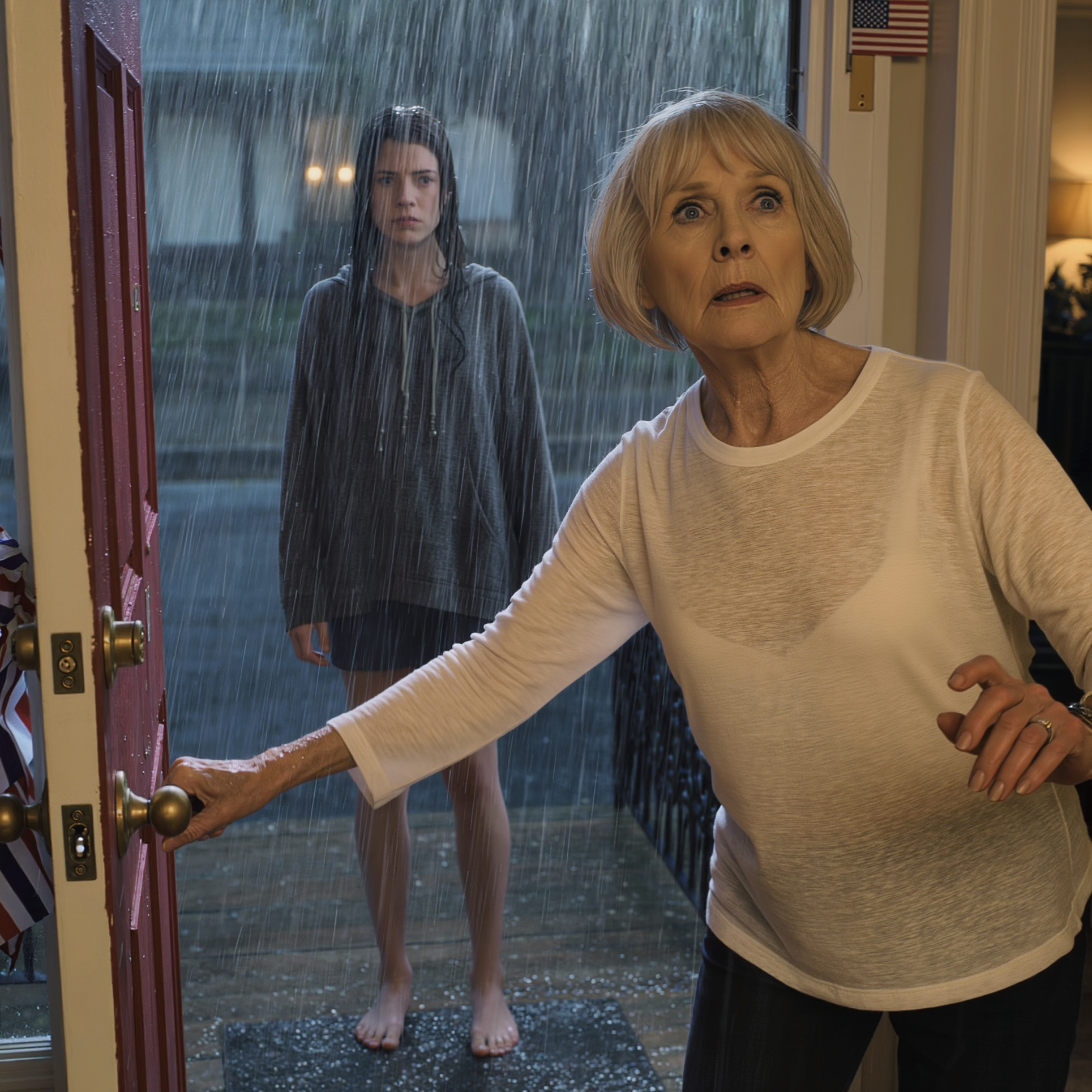
It was in that strange, unforgiving hour just past midnight — that hour when the world feels too quiet and the darkness too close — that my phone rang. The display blinked with her name. I knew instantly whose voice it claimed to be. My heart stopped, but not in shock, not yet, just in a quiet way that felt like the breath being held in a deep, unconscious place I didn’t even know existed anymore. It simply didn’t compute — because the name on the caller ID wasn’t just familiar. It was the one I had wept for, the one I had mourned, the one whose absence had become a dull ache in my bones over four long, unrelenting years. When I answered, her voice was thin, trembling, fragile — a whisper shaped like a shiver — and she said, “Mom, let me in … it’s so cold out here.” The end of her sentence felt like a distant echo, as though I was hearing it from underwater, something muffled and familiar but distant and impossibly unreachable. That voice had once been warm, tender, full of life; it had called me “Mom” a thousand times with laughter and impatience and affection. But this time … it was hollow, fragile like a breath on a fogged window, and it sent a bolt of something stranger than fear through me — a surreal mixture of shock, disbelief, memory and a sudden, inexplicable certainty that this moment was not normal, not ordinary, not explainable by logic or time. I froze for a heartbeat — longer than a heartbeat, really — listening to the tremor in her voice, partly terrified and partly drawn by something I couldn’t yet understand. My mind raced with rational explanations at first — a dream, a hoax call, someone using her old number for some prank. But her voice — the subtle inflections, that tiny quiver of familiarity — it was unmistakably hers. “Where are you?” I managed to whisper, not wanting to say her name out loud at first because it felt sacred and too big for 1 a.m. “At the door … I’m so cold, Mom,” she said again. That was when my foot began to move — almost without my conscious command — toward the front door. Everything inside me felt surreal, as though I were watching someone else do this, as though my body was responding to a message that my brain refused to accept. My hand reached out for the doorknob, my breath caught in that strange, tense twilight between sleep and wakefulness, and when I pulled the deadbolt aside and opened the door … she stood there. Pale under the porch light, hair slightly tousled, clothes soaked and darkened by what looked like drizzle, shivering as though the cold was seeping into her bones. Her eyes — those familiar eyes — met mine, wide and almost bewildered, and for a moment I couldn’t move, couldn’t think, couldn’t process what I was seeing. Not because it was frightening — no, it was more complicated than that — it was like looking at someone I knew better than myself, someone I had cherished, touched, kissed goodnight, and lost — standing right there on the very porch that years ago I had watched her climb down from as a child, brimming with stories from school. My legs felt weak, my voice stuck somewhere deep in my throat, and only after many long seconds did I manage to whisper, “Honey … how are you here?” Her lips quivered, not with speech at first but with that uncontrollable shiver that comes from being cold in more ways than one. She looked down at her feet, and when she spoke again it was almost as if she were answering a question she had been trying to form in her own heart: “I don’t know. I just … I felt so cold. I needed you.” Her words were simple, but they reverberated through me with a force that had nothing to do with the temperature outside. I wanted to reach for her, to pull her in, to brush the chilled dampness from her cheeks — that was the initial, human instinct. But something inside me hesitated, a faint alarm bell that whispered this is not how life works. This is not normal. Still, her presence was impossibly real, as distinct and physical as the wood beneath the porch and the crisp night air on my face. I thought about the years that had passed since she died — the funeral, the empty room, the holidays that ache like old wounds, the memories that sometimes felt heavier than the silence that followed her loss. And here she was — at my doorstep, alive in voice and form — or at least something like alive, something shimmering on the edge between this world and something I previously could never have believed possible. Her eyes flicked up to mine again, tired but familiar, and a sudden, sharp wave of fear washed over me, not fear of her but fear of what I was witnessing and what truth it might hold. My first thought was to reach out and touch her face, because if I could just feel that she was solid, then perhaps this was some extraordinary dream, a blessing, a miracle. But my hand trembled in mid-air because the place between hope and terror is where the heart seems to beat without actually connecting the dots in the brain. “Honey,” I whispered again, voice shaking slightly, “you — you can’t be here.” She looked up at me then, and her eyes were filled with confusion and something softer — not sadness, not anger, but a kind of aching uncertainty, like she didn’t understand where she was either. “Mom,” she said, and her voice cracked just a little, “please. I’m so cold. Let me in.” I glanced past her to the dark road and the cold night beyond, and then back into her eyes — those eyes that once sparkled but now carried exhaustion like a physical weight. For reasons I still can’t fully explain, instinct and disbelief collided in a strange, overwhelming way, and I did the unthinkable: I stepped aside, opened the door wider, and let her come in. Inside the house felt warmer, but not warm enough to chase away that chill in her bones. She shivered, and I wrapped a blanket around her shoulders, the fabric smelling faintly like the linen closet and home, and she closed her eyes momentarily as though that small gesture — that simple warmth — was a balm she had forgotten how to receive. I kept waiting for her to fade, for the moment to dissolve like mist in sunlight, but she stayed — solid, breathing, physically present in the room — and that was when the terror fully sank in: she was real here, but she had died years ago in another place and time. I had watched her funeral, buried her, stood over her casket in clothes that weighed like regret, and said goodbye to a daughter whose laughter I thought I would never forget. And yet here she was, pale and cold and trembling, standing in my living room with eyes that weren’t empty but exhausted, as though she had been walking in some harsh darkness before arriving here. I asked her softly, voice almost breaking, “Sweetheart … what happened to you?” She blinked slowly, and her tears began without sound, the corners of her eyes glistening like dew on fragile glass. “I’m so tired,” she said. “I don’t understand where I am. I just remember the cold … and I needed you.” My heart shattered behind my ribs in a way that felt both like grief and like a strange, unexpected blessing. I knelt beside her on the sofa, not sure if I was supposed to cry or stay composed or speak words of comfort, and all the old memories surged up — bedtime stories, scraped knees, graduation photos, summer evenings in the yard — every moment lived and lost surged like tides in my chest. Her trembling grew gentler then, not from warmth but from relief that she was not alone anymore. I didn’t even know what to do. I simply let her lean against me, and that physical closeness — impossible as it was — felt like a dream long postponed but finally found. Hours passed like seconds, and as the house grew quieter, I learned pieces of her — not how she died, because she couldn’t remember that, only bits and fragments of being cold and needing safety and wanting her mother. No logic explained it. No amount of rational thought could make sense of her presence because she had died in a hospital bed in another city, yet here she was — alive enough to shiver in a blanket and sob into my shoulder. I did what any parent in such a surreal situation might do: I wrapped her in warmth, made her tea, and listened. I didn’t demand answers. I didn’t panic. Even though my mind raced, part of my heart — the part that lives in memory — knew that love sometimes appears in forms we are not prepared for, in times we least expect, in breaths we thought we had lost forever. In the days that followed, my daughter didn’t disappear like a ghost stepping back into legend. She stayed — for a time — living in that same house where we had once made pancakes on Sunday mornings, laughing at jokes too silly to remember years later, talking about things she couldn’t quite remember and things I couldn’t bear to ask. And with each passing hour, she seemed more real — more grounded, more physical, less like a memory drifting in from another realm and more like someone whose heart simply found its way home. I never got a clear explanation from her about how she returned. Some things she said were fragmented, like dreams half-remembered: a cold place she couldn’t name, a sensation of walking without feet, of calling out for warmth she couldn’t find. In that hazy space between sleeping and waking, she found me. I wasn’t ready to believe it was a miracle, though every part of me felt moved by wonder. I wasn’t ready to call it a haunting, though the supernatural fingerprints were clear. I simply accepted it as her, the same girl who once asked for comfort with the innocence of childhood, now asking for comfort with the vulnerability of something far deeper. Friends, doctors, and spiritual counselors all offered theories — some scientific, some metaphysical, some deeply rooted in belief systems I had never fully explored. Some called it a neurological event, others a visitation, others an unresolved echo of love beyond mortality. I listened to every possibility with an open but cautious mind because the truth — whatever it was — couldn’t be fully grasped by words alone. The thing I knew most clearly was that my daughter was here — present, breathing, trembling — and that presence was more profound than any diagnosis, any doctrine, any rational dismissal could ever explain. She slowly regained strength, her body no longer shivering, her eyes no longer hollow with despair. We talked about everything and nothing, about the world she couldn’t remember leaving and about the world she had left behind. In the quiet evenings, we would sit side by side on the couch as though reconnecting threads of a tapestry that had been torn apart by time and circumstance. And as she grew more herself again, I realized something deep and irreversible: love doesn’t vanish when the body does. It lingers in the places we shared, in the memories etched in muscle and bone, in the spaces where absence becomes presence again in forms we never thought possible. I asked her once — in that gentle moment where the house was still and the air felt safe — if she was afraid. She shook her head slowly and said, “I was cold … and then I remembered you.” And that — more than any explanation or theory — was the part of the story that reshaped everything I believed about loss, about love, and about the inexplicable ways our hearts find their way back to each other even after the longest, darkest nights. Years later, when my daughter walks beside me in sunlight instead of standing at the door in a midnight storm, we still talk about the night she came home. Not as a ghost story, not as a tragedy, not as a question without answer — but as a chapter in our lives that reminded us both that some bonds are beyond the reach of death, and some returns are the most profound forms of healing. And in the quiet of ordinary days — ordinary because she is here, and here is real — I remember that night not as something terrifying but as something extraordinary: a testament to the deep and enduring connection between us that not even absence could erase.
At 1 a.m. My Daughter Called — “Mom, Let Me In, It’s So Cold Out Here” — I Froze in Shock … She Had Died Four Years Ago