The Fabric of a Mother’s Love
I spent six months searching for the perfect dress. I wanted something elegant—a soft navy lace that spoke of dignity and the quiet pride of a woman who had raised her only son, Julian, through every scraped knee and every heartbreak. I had spent forty years working as a nurse, standing on my feet until they ached, saving every penny so that when Julian found “the one,” I could give him the wedding of his dreams.
The venue was a sprawling estate on the coast, with white roses draped over every pillar and champagne that cost more per bottle than my monthly grocery budget. I had paid for all of it. Every flower, every musician, every gold-rimmed plate. I did it because Julian looked at Tiffany with a light in his eyes I’d never seen before.
But as I stood in the lobby of the venue, adjusting my lace sleeves, I felt a prickle of unease. Tiffany had been “thinly polite” during the planning—the kind of politeness that felt like a temporary truce rather than an alliance. She was beautiful, yes, but it was a sharp, jagged beauty that seemed to demand space rather than invite you into it.
The Moment the Music Stopped
The ceremony was beautiful, though I noticed Julian wouldn’t quite meet my eyes as he stood at the altar. I brushed it off as nerves. But it was during the reception, as the guests were finishing their first course and the wine was flowing, that the mask didn’t just slip—it shattered.
I had walked over to the head table, hoping to give Tiffany a hug and officially welcome her to the family. I had a small velvet box in my hand—a pair of diamond earrings that had belonged to my mother.
“Tiffany, dear,” I began, my voice warm. “I just wanted to say—”
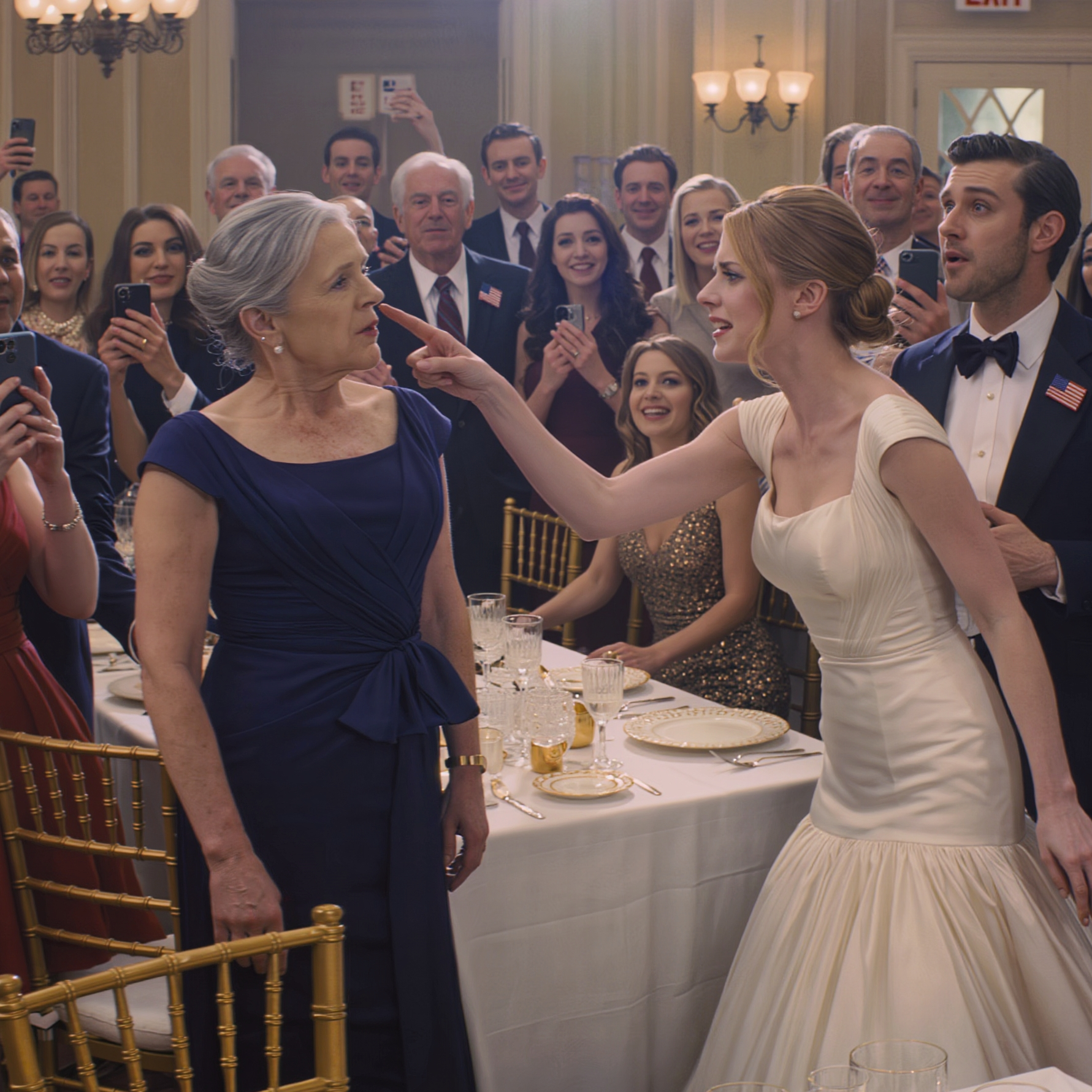
Tiffany turned, her face flushed with more than just champagne. She looked at me, then at the guests at the nearest table. She didn’t take the box. Instead, she laughed—a harsh, braying sound that cut through the soft jazz of the band.
“Look at this,” she said, pointing a manicured finger at my waistline. “Julian, look at her. You told me your mother was a woman of class. This?” She gestured to me with total disgust. “That’s not his mother. She’s a fat pig. Look at her bursting out of that lace. It’s embarrassing to have her in the photos.”
The room went silent for a heartbeat, and then, a group of her bridesmaids and several of her friends burst into laughter. It started as a titter and grew into a roar. I stood there, the velvet box clutched in my hand, feeling the heat of two hundred pairs of eyes burning into my skin.
I looked at Julian. My son. The boy I had protected from every bully. He looked down at his plate. He didn’t stand up. He didn’t tell her to stop. He didn’t even reach for my hand. His silence was a physical blow, heavier and more painful than any word Tiffany could ever scream.
The Toast That Changed Everything
I didn’t cry. When you spend thirty years in an ICU, you learn how to compartmentalize pain so you can do what needs to be done. I felt a cold, crystalline clarity settle over me. The humiliation was there, but beneath it was a fierce, roaring sense of justice.
I walked toward the stage. The band stopped playing. The laughter died down into a confused murmur as I took the microphone from the stand.
“Excuse me,” I said, my voice steady and amplified through the speakers. “I’d like to offer a toast to the happy couple.”
Julian finally looked up, his face pale. Tiffany smirked, whispering something to her maid of honor, likely expecting me to deliver a tearful, bumbling apology for my existence.
“Today has been a day of revelations,” I began. “Tiffany just shared her true feelings about me. She called me a ‘fat pig’ in front of all of you. And my son, the man I raised to respect women and honor his family, agreed with his silence.”
The room was so quiet you could hear the waves crashing on the beach outside.
“I spent $85,000 on this wedding,” I continued. “I paid for the silk on Tiffany’s back and the lobster on your plates. I did it because I believed in love. But I’ve realized something in the last five minutes. You can buy a wedding, but you cannot buy class. And you certainly cannot buy a backbone for a man who has lost his.”
I looked directly at Julian. “Since I am so ’embarrassing’ to have in the photos, I’ve decided to make things easier for everyone. I have already called the coordinator. The bar is closed. The premium service is over. And the honeymoon in Italy? The tickets are in my name, and I’ll be taking my best friend instead.”
The Empty Hall
The murmur in the room turned into a gasp. Tiffany stood up, her face turning a blotchy red. “You can’t do that! This is my wedding!”
“No, Tiffany,” I said, placing the microphone back on the stand. “This was a transaction. And the contract has just been canceled for a total lack of character.”
I turned and walked out of the ballroom. I didn’t stop to look back at the chaos I left behind—the shouting, the sobbing, or the sight of my son finally standing up, far too late to save anything.
I walked to the parking lot, the salt air cool against my face. For the first time in years, I didn’t feel the weight of my body or the weight of my expectations for Julian. I felt light.
The Aftermath
The marriage lasted exactly forty-eight hours. Without the “bank of Mom” to fund their lifestyle, the cracks between Julian and Tiffany became canyons. She didn’t want a life with him; she wanted the life I could provide for him. When the money vanished, so did she.
Julian tried to come home. He sat on my porch and cried, telling me he was “in shock,” that he “didn’t know what to say.”
I loved him, but I didn’t let him in. Not yet.
“Julian,” I told him through the screen door. “I raised you to be a man. A man stands up when the person who gave him everything is being spat on. You didn’t just let her insult me; you let her erase me. Until you find your own worth, you aren’t ready to be part of mine.”
I took that trip to Italy. I ate the pasta, I drank the wine, and I wore my navy lace dress to a five-star dinner in Rome. I didn’t look like a “fat pig.” I looked like a woman who had finally learned that the most important person to honor at any table is yourself.
Respect isn’t something you inherit, and it’s not something you can buy with an $85,000 check. It’s something you demand by walking away from anyone who thinks you’re worth anything less.
I am not a victim of a wedding disaster. I am the survivor of a family illusion. And for the first time, I am living for me.