The Architecture of a Mother’s Sacrifice
For decades, I believed that the greatest legacy a parent could leave was a path cleared of obstacles. My late husband, Arthur, and I spent forty years building a specialized manufacturing firm from a two-car garage into a regional powerhouse. We didn’t take vacations; we didn’t buy flashy cars. Every penny of profit was funneled into a Diversified Family Trust designed to ensure our only son, Kevin, would never know the sting of a declined credit card or the anxiety of a mortgage payment. We paid for his private tutors, his elite boarding school, and eventually, his MBA at a prestigious university. When Arthur passed away three years ago, the weight of this legacy fell entirely on my shoulders. I moved to a modest condo in Florida, choosing to live on a small fraction of the interest so that the principal—a staggering multi-million dollar sum—could continue to grow for Kevin and his children. I viewed myself as the steward of his future, the silent engine keeping his high-flying New York lifestyle airborne. I assumed that even if we weren’t “friends” in the modern sense, there was a bedrock of mutual respect and blood-loyalty that could never be shaken. I was wrong.
The distance between us had become more than just miles. In the three years since Arthur’s funeral, Kevin’s calls had dwindled from weekly check-ins to monthly “status reports.” He spoke to me like a bored executive speaking to a minor shareholder. He was always “closing a deal” or “attending a gala.” His wife, Cynthia, was even more distant, usually communicating through cold, professionally drafted holiday cards. Despite this, the loneliness of my Florida condo began to gnaw at me as my 72nd birthday approached. I looked at the photos of Kevin’s children—grandkids I barely knew—and decided that life was too short for formal invitations. I didn’t want a party; I just wanted to see my son’s face and hear the chaos of a lived-in home. I packed a small carry-on, baked three dozen of the oatmeal lace cookies Kevin used to crave as a boy, and booked a first-class ticket to JFK. I felt like a girl again, giddy with the prospect of a surprise reunion, imagining the look of shock and joy on his face when he saw his mother on the doorstep.
The Threshold of Betrayal
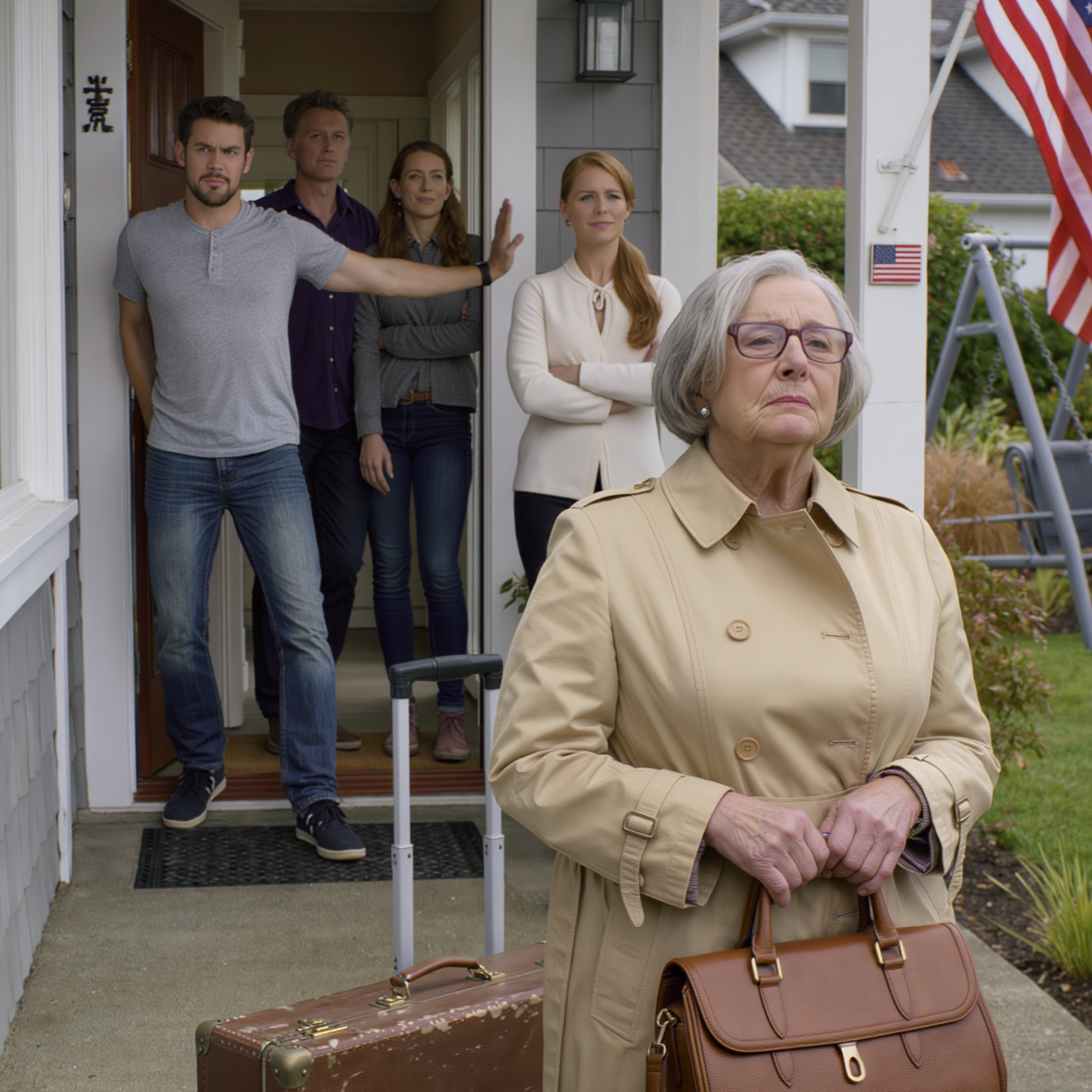
The taxi ride from the airport to the affluent suburbs of Westchester was a blur of golden autumn leaves and rising expectations. I arrived at his home—a sprawling $3 million colonial that I had provided the 40% down payment for—just as the sun was setting. The driveway was packed with luxury European SUVs, and the warm glow of candlelight flickered through the floor-to-ceiling windows of the dining room. I straightened my sensible wool coat, clutched the tin of cookies, and rang the bell. I expected a flurry of activity, perhaps a confused housekeeper, but it was Kevin himself who opened the door. He was wearing a tuxedo, a glass of vintage scotch in his hand. The moment his eyes landed on me, the “joy” I had imagined was nowhere to be found. Instead, his face contorted into a mask of pure, unadulterated irritation. He didn’t step out to hug me; he didn’t even say hello. He stepped out onto the porch and pulled the heavy oak door shut behind him, as if he were trying to prevent a stray dog from slipping into a palace.
The conversation that followed was the coldest ten minutes of my life. Kevin didn’t ask how I got there or if I had a place to stay. He looked at my modest attire—a outfit that looked “Florida retired” rather than “New York elite”—and hissed, “Who invited you, Mom? You can’t just show up here. We are hosting a dinner for the senior partners of my firm and a few potential investors. This is a high-stakes night for my career, and you look like… well, you look like you walked out of a grocery store. You’re not on the guest list, and frankly, your presence here is a distraction I don’t have time to manage. It’s embarrassing. You need to go. Take a cab back to the city, find a hotel, or just go back to the airport. We’ll talk in a few weeks when things aren’t so ‘busy.’ Just leave, okay?” He didn’t even take the cookies. He turned his back on me and walked back into the house I paid for, to eat a meal funded by my husband’s hard work, leaving me standing in the dark on a porch that smelled of expensive jasmine and rejection.
The Midnight Liquidation
I sat in the back of a Lyft heading toward a sterile hotel near JFK, the tin of cookies sitting like a lead weight in my lap. The shock had worn off, replaced by a crystalline, freezing clarity. For years, I had treated Kevin as a partner in our family’s success, but he viewed me as a shameful relic of a “lower” life. He loved the trust fund, but he hated the woman who filled it. As I checked into my room, I realized that if I was an “embarrassment” to his social circle, then my financial support was a “conflict of interest” to his independence. I am not a woman who screams or throws fits; I am a woman who spent forty years managing a balance sheet. I sat at the small desk in the hotel room, opened my laptop, and began the process of a “Legacy Audit.” If Kevin wanted a life where I didn’t exist, he was about to get exactly what he asked for, starting with the foundation.
At midnight, I placed a call to my brother, Edward, who served as the legal trustee for the secondary branches of the family estate. Edward was used to my late-night business calls from the old days, but he wasn’t prepared for this. I instructed him to immediately invoke the “Discretionary Moral Clause” in the trust’s bylaws—a clause Arthur had insisted on, which allowed the executor to cease all voluntary distributions if the beneficiary demonstrated “gross familial neglect or character instability.” I told Edward to cut off the $15,000 monthly “lifestyle stipend” that Kevin used to maintain his club memberships and luxury leases. I told him to stop the tuition payments for my grandchildren’s $50,000-a-year private academy. Finally, I told him to list the Manhattan “satellite office”—a $2 million condo owned by the trust that Kevin used for his private ventures—for sale on Monday morning. “He asked who invited me, Edward,” I told him, my voice steady. “I’m just revoking the invitation he thought was a permanent right.”
The Morning of Absolute Panic
The silence of my hotel room was broken at 7:30 AM by the frantic ringing of my cell phone. I didn’t answer. I went down to the hotel lobby, ordered a decadent breakfast of eggs benedict and a mimosa, and watched the sunrise over the tarmac. By 8:15 AM, I had seventeen missed calls and a string of texts that progressed from confusion to outright hostility to pathetic begging. Kevin had clearly tried to use his “black” card for an early morning business breakfast, only to find it declined. His wife had likely received an automated alert from the school’s billing department. The “important guests” from the night before were long gone, and the reality of their “self-made” life was crumbling. I waited until I was finished with my coffee before I finally picked up the phone for Kevin’s nineteenth attempt.
The man on the other end didn’t sound like the arrogant tuxedo-clad executive from the night before. He sounded small, breathless, and terrified. “Mom! What have you done? I just got a call from the estate office! They said the trust is being restructured and all distributions are suspended! My car lease payment failed, the kids’ school is asking for a wire transfer by noon, and Cynthia is losing her mind! You can’t just flip a switch and ruin our lives because of a misunderstanding at the door! We had guests, Mom! I was stressed! You have to fix this right now!” I listened to him rant for three full minutes, marveling at how he still believed he could command me. When he finally ran out of breath, I spoke with the calm authority of a woman who held every single card in the deck.
The Final Audit
“Kevin,” I said softly, “you asked me who invited me. It was a fair question. I realized that for the last three years, I’ve been an uninvited guest in your life, providing a lifestyle for a man who is ‘ashamed’ of my presence. Since I’m such an embarrassment to your high-stakes world, I’ve decided to remove the embarrassment entirely. I’ve moved my personal assets and the trust’s discretionary funds into a charitable foundation for elderly widows—women who, unlike me, actually need a support system because their families have abandoned them. You wanted me to leave, so I’m leaving. I’m boarding a flight in an hour, but it’s not to Florida. I’m going on a tour of the Swiss Alps. You’re a senior partner at a firm, Kevin. You’re a ‘big man’ with ‘important guests.’ I’m sure you don’t need a ‘poor, embarrassing’ woman’s money to keep your house. You have twenty-four hours to vacate the Manhattan office, and I suggest you look into the public school system—I hear it builds character.”
I hung up before he could respond. I spent the flight to Europe reflecting on the fact that I had spent forty years building a mountain for my son to stand on, only for him to use that height to look down on me. By the time I landed in Zurich, I felt lighter than I had in a decade. Kevin and Cynthia had to sell their Westchester home at a loss and move into a rental. The “important guests” disappeared the moment the money did. As for me, I finally found a circle of people who invite me to dinner because they enjoy my stories, not because they’re waiting for my estate to clear. I learned that the most powerful thing a mother can do is stop being a safety net for someone who has forgotten how to be a son.