The Warning in the Checkout Line
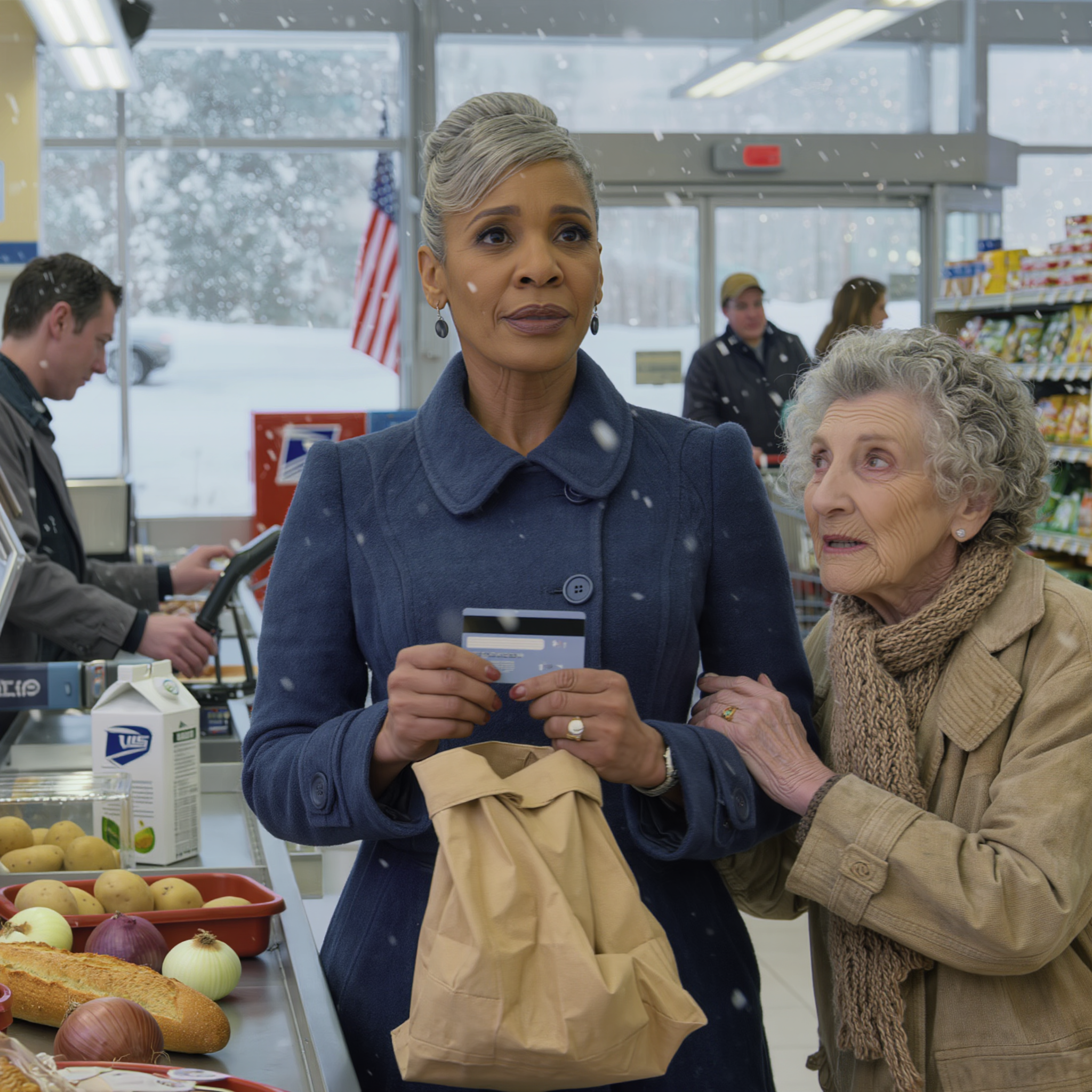
The snow was already beginning to dust the parking lot of the local grocer when I stood behind a frail woman in a threadbare coat. Her hands shook as she counted out nickels for a carton of milk and a small loaf of bread. Impulsively, I reached forward and swiped my card, paying for her entire bag. She didn’t offer a traditional “thank you.” Instead, she gripped my wrist with surprising strength, her eyes clouded with cataracts but piercingly intense. She leaned in so close I could smell the faint scent of cedar and old paper. “Listen to me, child,” she hissed. “When your husband goes on his business trip tomorrow, do not touch the snow in the back yard. No matter what you see, no matter what you hear. Leave the white blanket alone.” I laughed it off as the ramblings of a confused mind, but as I drove home to our secluded estate, the silence of the falling flakes started to feel less like a postcard and more like a shroud.
My husband, Thomas, was a successful architect who prided himself on the perfect, pristine aesthetics of our home. He was leaving for a three-day conference in Chicago, and as he kissed me goodbye, he reminded me to stay inside. “The storm is going to be brutal, Sarah. Don’t worry about the driveway or the yard. I’ll hire a service to clear it when I get back. Just stay by the fire.” His insistence felt protective at the time, but as his taillights vanished into the white-out, the elderly woman’s words echoed in my mind. The yard was a perfect, flat expanse of white, untouched and eerily level. It was beautiful, but it was the kind of beauty that felt artificial, like a sheet pulled over a messy room to hide the clutter.
The Architect of a Frozen Silence
The first night of the blizzard was deafeningly quiet. I sat by the window, watching the drifts pile up against the glass. Around midnight, I heard a frantic scratching at the back door. It was our neighbor’s golden retriever, Copper, who had escaped his kennel. I reached for the handle to let him in, but then I remembered the woman’s warning. I hesitated. Copper wasn’t at the door; he was out in the middle of the yard, barking at something beneath the surface of the snow. Suddenly, the barking stopped. It didn’t fade away; it simply ceased, as if a hand had been placed over his muzzle. I watched in horror as the dog seemed to sink into the drifts, the snow swallowing him whole without a single ripple or paw print left behind.
I wanted to run out there, to dig him out, but the fear that had been planted at the grocery store took root. I realized then that Thomas had spent the entire autumn “leveling” the back yard, claiming he was installing a new drainage system. He had spent weeks pouring concrete and hauling in heavy bags of lime. He told me it was for the foundation of a new gazebo, but he never actually built the structure. As the wind howled, I realized the yard wasn’t just earth and grass. It was a carefully constructed trap, a series of hollowed-out chambers hidden beneath a false floor of thin plywood and mesh, designed to be invisible once the winter snow covered the tracks.
The Reckoning of the Hidden Depths
The next morning, the storm broke, leaving the world in a blinding, crystalline white. I couldn’t stay inside anymore. I put on my heaviest boots and grabbed a long pole from the garage. Standing on the edge of the patio, I prodded the snow a few feet out. The pole didn’t hit solid ground; it slipped through the white surface and vanished into a dark void. I began to clear the snow with a broom, my heart hammering against my ribs. Beneath the six inches of fresh powder was a reinforced glass pane, and beneath that pane was a room—a subterranean bunker Thomas had built without a single permit or mention to me.
Inside the glass-walled chamber, illuminated by motion-sensor lights, I didn’t find a “man cave” or a storage unit. I found a meticulously organized archive of our lives, but everything was wrong. There were photos of me from before we met, taken from angles I didn’t recognize. There were recordings of our phone calls and a collection of items I thought I had lost over the years—keys, jewelry, old letters. But in the center of the room, preserved in a vacuum-sealed case, was a wedding dress that wasn’t mine. It was a vintage gown from the 1980s, stained with something dark and rust-colored. I realized that the “business trips” Thomas took weren’t for architecture. They were for collecting.
The Silence of the Returning Predator
I heard the sound of a car engine in the driveway—Thomas was home early. The blizzard had cleared the roads faster than expected. I scrambled back inside, pulse racing, trying to act as though I had never left the living room. He walked in, smelling of cold air and expensive cologne, his smile as perfect as the snow outside. “You stayed inside, didn’t you, Sarah?” he asked, his eyes darting toward the back window. I nodded, my voice trapped in my throat. He walked over to the window and stared out at the yard. “Good. The snow is so fragile this time of year. One wrong step and the whole illusion falls apart.”
He didn’t know I had seen the bunker, but he knew I was afraid. I spent the next few hours in a state of hyper-vigilance, realizing that the man I had shared a bed with for ten years was a stranger who lived beneath our feet. I waited until he went into the shower, then I called the local police and gave them the address. I told them there was a “sinkhole” in the yard and a domestic emergency. When the officers arrived and began to investigate the “leveling” project, Thomas’s composure shattered. They found the mechanism for the trap doors and the entrance to the archive hidden behind a false wall in the basement.
The Peace of the Thaw
Thomas was arrested that afternoon. The investigation revealed that he was linked to several “cold cases” involving missing women in the tri-state area—women who had all been “collected” before he met me. The bunker was his museum, and the snow in the yard was his security system. The elderly woman at the store had been a survivor of his earlier years, someone he had terrorized but let go, and she had been waiting for the right moment to save the next victim.
I sold the house as soon as the snow melted and the yard was excavated. I don’t pay for people’s groceries anymore out of a sense of obligation, but out of a sense of gratitude for the strangers who see the things we are too blind to notice. I live in a high-rise apartment now, far away from yards and basements. I learned that the most dangerous things in life aren’t the storms we see coming, but the things that hide beneath the surface, waiting for the world to turn white so they can disappear. The snow has melted, the secrets are out, and for the first time in a decade, I am walking on solid ground.