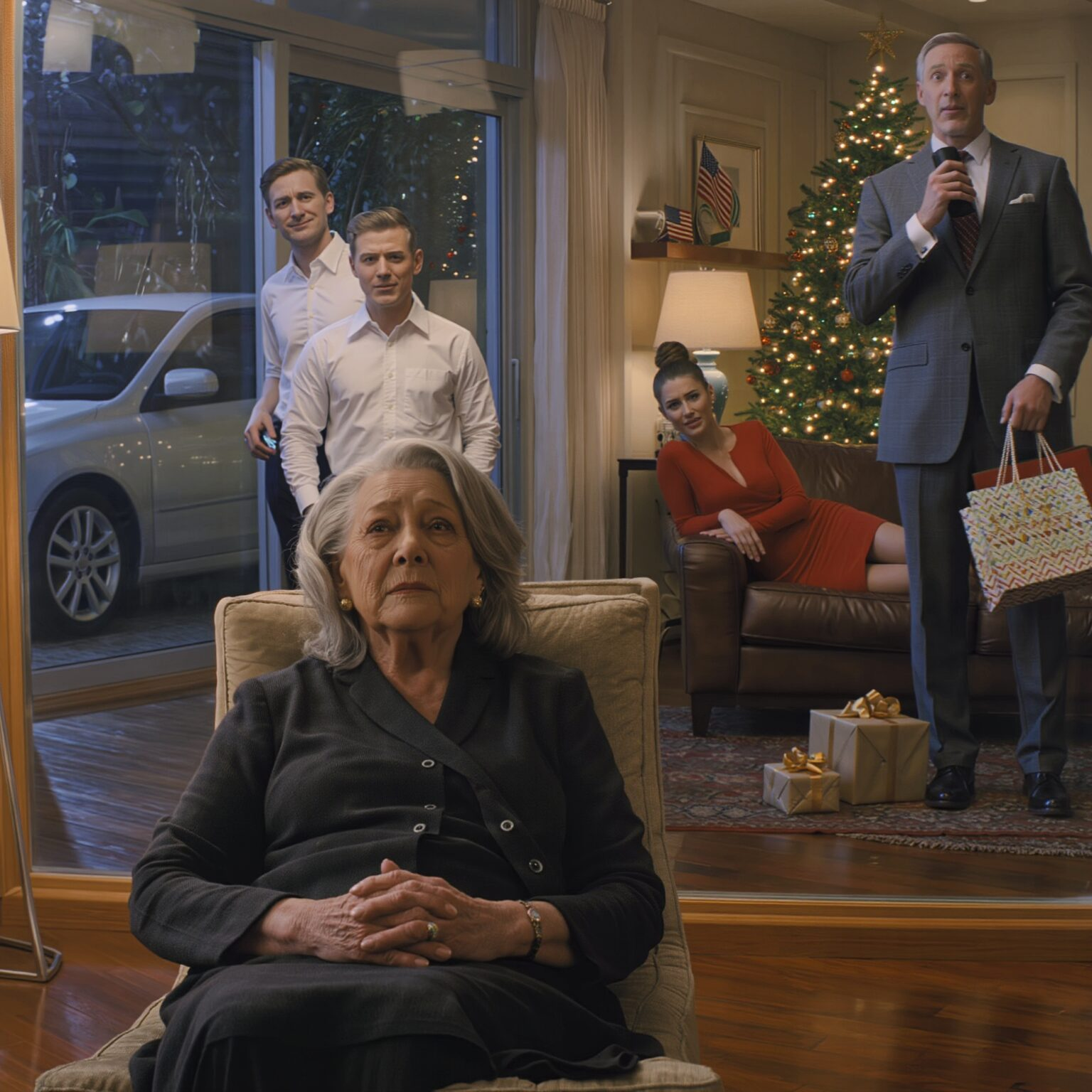
I remember the cold more than anything — not the chill in the air, but the sudden drop in warmth in the room when my brother stepped inside with his arms full of gift bags, bells jingling, the last hints of holiday cheer fizzing at the seams of his breathless smile. He stood in the doorway for a moment like someone trying to adjust to a change in lighting, and then he looked around the living room, the garland on the mantle, the half-unwrapped presents under the tree — and then he looked at me, his eyes narrowing ever so slightly, and asked the question that cracked the moment open like a poorly tied lid: “Where’s your mother?” There was no hesitation in his tone, no softening of concern, just a blunt sort of curiosity that felt almost like accusation.
I froze for a beat before answering, because I knew the next words had weight — not just for him, but for the entire history between us. I didn’t answer with explanation. I didn’t ask him first to sit, to warm up, to breathe. I simply said — quietly, deliberately, with a calm no one in that room expected — “I kicked her out. She was just taking up space.” Those words hung in the air like a sudden chill right after a flame goes out, and in that instant I saw something shift in my brother’s face — surprise, disbelief, maybe something like regret for having walked right into the moment without knowing the story behind it.
My brother didn’t laugh. He didn’t scoff. He didn’t say, “You did what?” He just stood there, arms full of presents, trying to process the fact that I had spoken those words — words more hardened than I intended, but words that reflected something raw and unresolved beneath them. He set the gift bags down gently on the couch as though the weight of each one suddenly felt heavy with consequence.
To understand why I said what I said, you must know my mother — not the version everyone politely remembers at holiday dinners, with sugar cookies and cheerful stories about Christmases past — but the woman she had become. Not cruel in the violent sense, but cruel in the relational, erosive sense. She had perfected the art of making others feel small while insisting she was only “educating” them. She could take a room full of laughter and, with a single sentence, turn it into awkward silence. She didn’t raise her voice, but her eyes held a sort of dismissive calculation that watched others for weakness and probed for reasons to judge. I loved her as a child loves the idea of their mother; I respected her as an adult who knew too much about polish and performance. But in the end — at 60 years old, living in a world that has exacted its own suite of lessons on me — I realized that love without safety is just endurance.
So when she’d arrived earlier that morning, unannounced and with a suitcase full of half-baked “suggestions” about how I should run my home, how I should speak to my children, how I should respond to every minor decision as though I didn’t possess a mind of my own — I reached a quiet limit. Not dramatic. Not explosive. Not something set off by a single insult. But something cumulative, like water wearing away stone. I asked her kindly, one time, to please respect the boundaries of my home and my life. She refused. She condescended. She stayed. And in the slow, grinding cadence of repeated disrespect, I made the decision to protect not my pride, but my peace.
So when my brother asked where she was, and I answered plainly that she was gone, that I had asked her to leave because she was taking up emotional space I didn’t have to give, it wasn’t a cruel outburst. It was an honest truth delivered after years of quiet erosion in the very place where love should have offered sanctuary.
And that’s when I saw the look in my brother’s eyes — a mixture of shock and something softer, something like recognition — as if suddenly the history of holidays past, those tiny moments of subtle cruelty I’d endured in silence, flickered across his memory in a new way. He didn’t know, of course. He had never lived with her. He had never sat through her backhanded comments disguised as casual observation. He had never learned that sometimes people don’t just hurt you, they diminish you in ways that are slow and invisible until you look back and realize you no longer recognize yourself.
He cleared his throat awkwardly and asked, not unkindly, but with uncertainty: “Are you sure that’s what you want?” Not with judgment, but with a sincerity that softened the sharp edges of my statement. It was the first time someone didn’t recoil at the truth but actually heard it.
And in that moment, standing by the Christmas tree with wrapped gifts untouched and the quiet hum of holiday music playing softly on the speaker, I realized that truth spoken with calm conviction can reshape an entire room. Not through conflict, not through force, but through clarity and dignity.
My brother didn’t blame me. He didn’t defend her. He simply said, quietly, “I’m here with you.” And that — far more than any perfectly wrapped present, any holiday ritual, or any tradition — is what Christmas really means.
Because family isn’t always the people who show up.
Sometimes it’s the people who stand beside you
when everyone else assumed you were wrong.
I didn’t celebrate that Christmas with my mother.
But I did celebrate it with truth, respect, and peace —
the gifts I had finally learned to give myself.