I never expected the sting of humiliation to come wrapped in polite dinner napkins and birthday candles, but there I was on a warm Saturday evening, the sky soft with sunset and the scent of grilled rosemary in the air, standing in the backyard of a venue I’d never visited before, surrounded by sixty guests gathered to celebrate my son’s thirty-sixth birthday — not knowing I was about to become the centerpiece of a moment no celebration deserves. The tables were arranged in neat rows, white linen cloths glinting under fairy lights strung between oak trees, and the sound of laughter floated like a promise that everything was convivial and warm. I had come early, as I always did, to help greet people, to offer a smile, to see my son’s face when he saw the people who loved him most gathered for his happiness. I didn’t know then that some people at his table didn’t see me as someone to be honored, or even politely included — they saw me as background, an accessory to be managed, something to be positioned, and not a person to be treated with respect.
The evening began with the usual warmth: drinks passed around, stories recounted about my son’s childhood antics, neighbors and friends catching up after long months apart — all of it bathed in that gentle glow only summer evenings can conjure. I noticed my daughter-in-law arriving late, entering with that practiced grace couples cultivate when they want to be seen as elegant and effortless. She looked beautiful in a fitted dress, hair styled with that smooth precision that suggested every strand was exactly where it was meant to be. She smiled — thin, cautious, perfectly poised — and I assumed she was just one of those people who preferred formal cordiality to open affection. I didn’t think, not for a second, that behind that polite smile was a determination to make me feel small in a way that was deliberate and unnecessary.
My son, radiant with the joy of being celebrated, greeted me with a hug that felt heartfelt and true. “Mom,” he said, eyes shining, “I’m so glad you’re here.” I smiled back at him because even if there were undercurrents I hadn’t yet perceived, I came for him — not for anyone else’s approval. That had always been my role as his mother: love without conditions and pride without reservation.
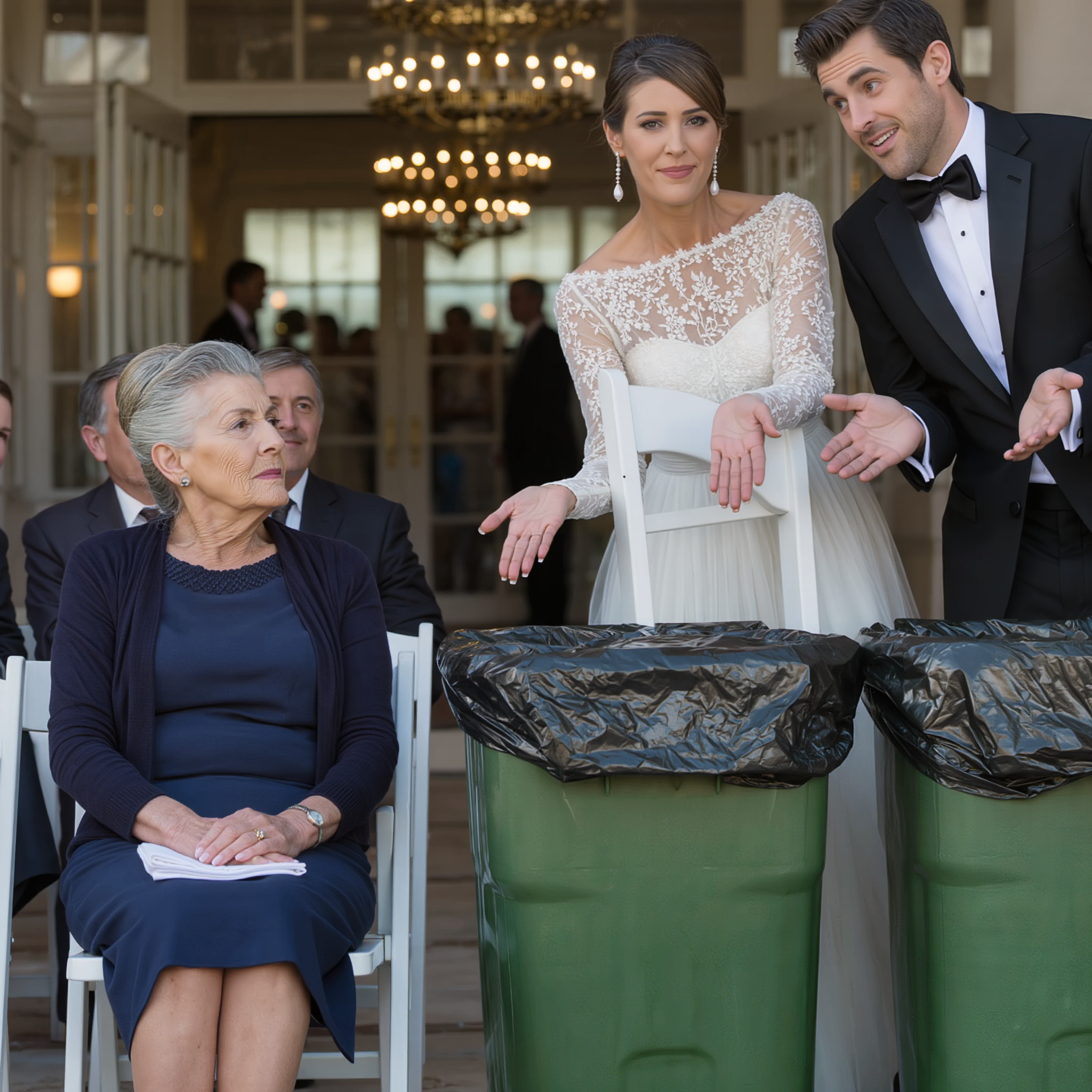
Then came the moment I will never forget — the pivot point where warmth dissipated into something chillier than any winter night. My daughter-in-law stepped forward, gently but with an undertone of assertion, and said, “Mom, we’ve set up your seat right over here.” Her voice was sweet, but her eyes locked onto mine with a faintly rehearsed sharpness — the kind people use when they’re asserting territory rather than inviting connection. Before I could follow her gesture with a question — a “Where?” or “Who else is sitting there?” — she began to lead me by the elbow.
I didn’t understand at first. She directed me almost ceremoniously, not toward the long table where family and friends had already taken their seats — where my son sat in the center with his cake candles waiting — but to a small folding chair beside a trash collection area, just beyond the edge of the guests’ circle, where garbage bins stood lined up like sentinels of disregard. The grass beneath us dipped slightly toward gravel and leaves, and for a moment I felt as though I was being placed somewhere between being seen and being intentionally dosed with invisibility. The guests didn’t look. No one said, “Oh, there’s your seat.” Nothing like that. They were too busy eating, talking, toasting, laughing — blissfully unaware that a quiet, cruel choreography was unfolding in their midst.
When she reached my side and gave that same thin, practiced smile, she said — loud enough for the few people nearest to hear — “This is where you belong.” I froze, not because I hadn’t heard cruel words before, but because I couldn’t believe cruelty was being spoken in a room full of warmth and celebration. I opened my mouth, uncertain whether I was in a dream or a reality that had just slipped the rails of expected human decency.
The laughter around me continued, unaware, as though kindness could cushion every blow — but not that one. People raised glasses, told stories, watched my son blow out his candles, and not one soul seemed to interpret my vicinity to trash cans as anything other than incidental.
I sat there, shell-shocked in that fold-out chair, beside bins no one bothered to hide from the party’s sparkle. The lights above me flickered as cicadas buzzed somewhere beyond the treeline, and I felt something deep and shocking rise in me: not humiliation, not collapse — but numbness. The kind of numbness that arrives right before clarity, the slow, whispering kind that says, “This is what they really think.”
My son eventually noticed. At first he didn’t — he was surrounded by friends and laughter and compliments and cake and all the reasons adults forget to see what’s happening in the periphery. But when his eyes caught mine — not for long, just a flicker — I saw that pause in his expression where confusion hovered, then apology flickered beneath it, and then went quietly invisible again because he was already the center of attention, already in motion, already absorbed in the celebration being about him.
I stayed in that seat beside the trash cans while people continued to celebrate, while waiters passed canapés without offering one to me, while friends toasted with sparkling wine, while laughter rose and fell like waves upon untroubled water. And I wondered, not for the first time in my life, whether love — or the idea of love — always carries with it the assumption that certain people are more deserving of warmth, and others are quietly expendable.
In that numbness, I saw the pattern laid bare: the polite smile that meant presentation, not acceptance; the careful praise that stopped short of genuine warmth; the laughter filled with everyone except the person already seated in disgrace. The party went on — unremarked — as if nothing had happened. No one paused to say, “Why is your mother sitting over there?” No one nudged a bench closer. No one offered a cushion, a kind word, a water, a look that said you matter. Everyone seemed content to let the choreography stand — even as it said more about them than it ever did about me.
I breathed slowly, as though the air itself needed to be coaxed into my lungs, and I noticed something subtle dawning beneath the hurt: this wasn’t about the chair. It wasn’t about the trash cans. It wasn’t even about a single sentence spoken with perfunctory cruelty. It was about where people choose to affirm each other and where they choose to let others disappear into the background.
I watched the guests. I watched their faces. I watched their laughter. I watched how none of them turned toward me with discomfort or concern. And I realized then — not with dramatic clarity, but with the quiet knowledge that rises when sandpaper rubs away illusion — that some people only accept others as long as it doesn’t inconvenience them, or disrupt the picture they want to paint, or interfere with the glow of their own self-image. I understood something deeper about human behavior in that moment: that kindness isn’t universal, and that even families can be arenas of exclusion dressed up as celebration.
I sat there until the candles on the cake were blown out, until the happy birthday songs were sung, until the plates were cleared, until guests drifted into animated conversation again, then slowly walked over to the table, not to reclaim the seat beside my son, not to demand apologies, not to confront anyone, but just to stand where dignity still exists, even in silence. My daughter-in-law followed me then, her expression unreadable, the same tight smile as earlier flickering like a candle in a breeze, and she said — not loudly, not theatrically — just coldly, “You’re welcome to stay here, if you want.” That thin phrase, offered without warmth, echoed louder than any insult I had ever heard.
I didn’t respond.
I simply looked at her, and in my quiet gaze there was no collapse, no fury, just calm presence — the kind that comes from someone who has loved deeply and learned that not all love is mutual, and not all respect is deserved, and not all places at a table are earned by kindness alone. I saw not a villain, not a monster, not an enemy, but a person who believed her actions were normal, her smile sufficient, her crowd applause enough to validate cruelty. And that was the truly shocking part: not that someone could be unkind, but that someone could mistake their social ease for moral correctness.
I decided then, somewhere in the quiet place where disappointment ends and self-awareness begins, that I would no longer let someone else’s opinion of me determine my value. I stood up straight, uncurled my shoulders that had bent too long with the weight of assumed responsibility for everyone else’s happiness, and looked around the party — not with bitterness, not with judgment, but with a kind of clear-eyed observation that felt stronger than I had felt in years.
My son saw me then — not immediately, but when someone asked him a question behind me and he turned with something like *recognition rather than presentation. His face shifted — not dramatically, not with apology right away, but with that momentary hesitation people have when they suddenly perceive someone they assumed would always be there, right where they left them. I walked over and stood beside him, not in front of him, not behind him, but beside him — balanced, present, visible — and simply said, quietly yet unmistakably, “Thank you for celebrating with me.”
There was no drama. No loud confrontation. No tearful revelations. Just a steady voice that declared something deeper than embarrassment or anger: I am here. I am aware. I am not invisible. And in saying only that, I reclaimed my place not because someone else gave it to me, but because I stood in it with dignity.
The party continued. No one offered explanations. No one came over to comfort me or invite me back to the main table. They were too busy with their conversations, their toasts, their laughter — the same laughter that once felt warm enough to wrap a person in belonging but now felt distant, polite, convenient.
Later that night I walked home slowly, not with bitterness but with clarity. I thought about all the family dinners, all the holidays, all the moments I had placed everyone else’s happiness ahead of my own without ever asking for a moment of genuine warmth in return. I thought about how easy it is to stand in a room full of people and feel alone when no one acknowledges you fully.
And I realized something profound:
A person’s worth is not measured by where someone places them around a table, nor by the chairs others choose for them, but by how they carry themselves when the world forgets to notice them. There is dignity in presence. There is strength in calm acknowledgment of self. There is grace in showing up without needing validation.
I didn’t go back to the party. I didn’t have to. I walked forward — not away from them, not with resentment, but into a version of life where respect was something I gave myself first. I understood then that love isn’t always visible in crowds. Sometimes it shows in quiet resilience. Sometimes it shows in the soft yet unyielding decision not to internalize another’s dismissal.
My son and I eventually talked about it — not in an angry confrontation, not in a shouting match, but in gentle honesty. He admitted he hadn’t understood what was done, what was implied, what was felt — not at the moment, not with awareness, not until he saw the hurt in my eyes that night. His daughter-in-law offered nothing, and that, too, was a kind of answer.
It wasn’t about the trash cans.
It wasn’t about the chairs.
It wasn’t about the smile or the words.
It was about where people place you when they believe you’ll always stay seated in smallness.
And I stood up.
I walked forward.
I chose myself.
And that — not applause, not acknowledgment from others —
is what true belonging feels like.