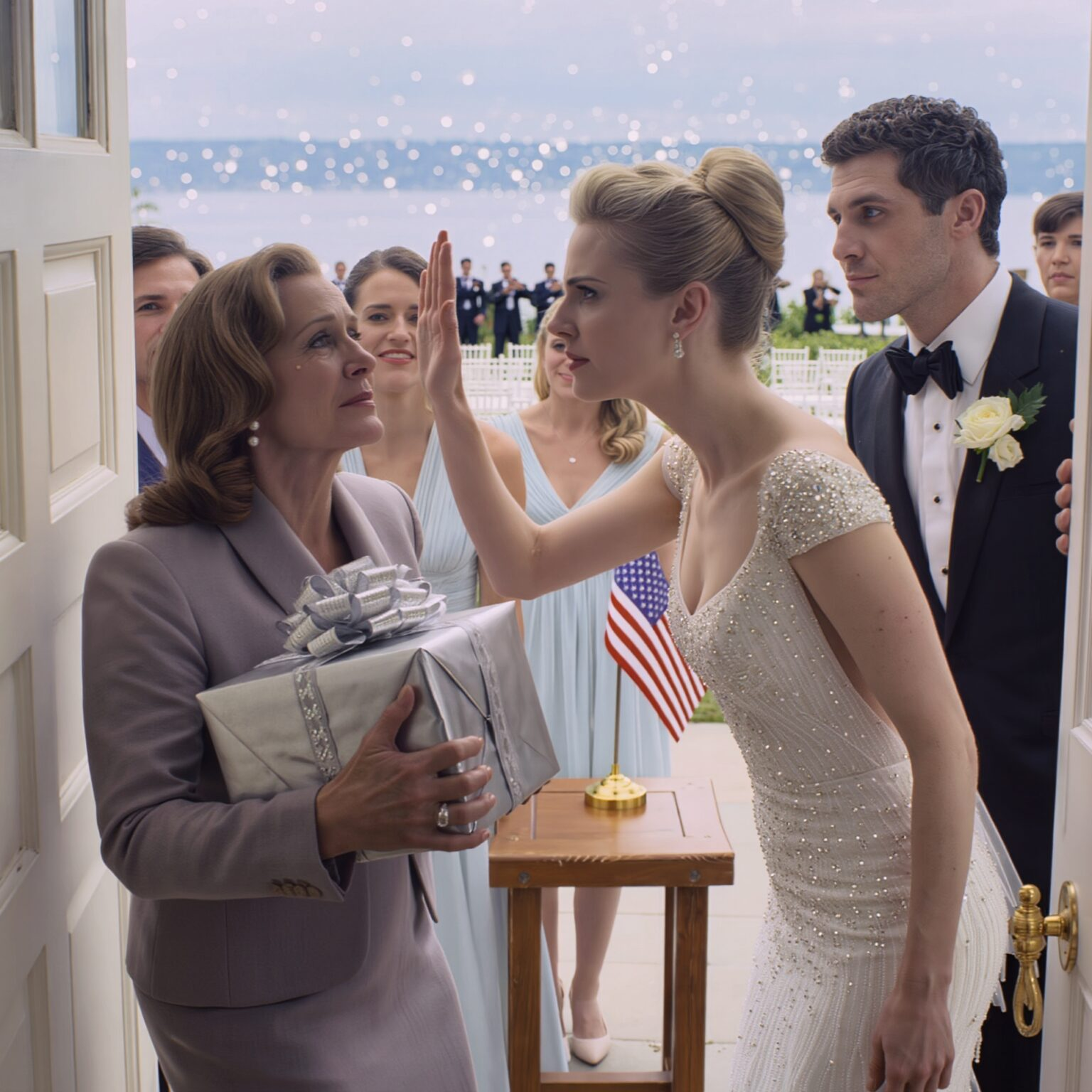
I remember exactly where I was standing — just inside the garden entrance of the wedding venue, surrounded by the scent of white roses and warm late-afternoon sunshine, my heart swollen with memories of the little girl who once wore mismatched socks and proudly proclaimed herself “Mommy’s helper.” My husband stood beside me, steady and silent, dressed in his best suit, one hand in his pocket, the other gently holding mine. We looked forward to celebrating our daughter’s wedding — or so we thought — until the moment she approached us with a still-smiling face that didn’t quite reach her eyes and said, “Mom, Dad — you’re not invited.” Not quietly. Not apologetically. Just plainly, matter-of-factly — like she was reading from a script written long before today.
For a heartbeat the world froze. I saw her veil drift slightly in the breeze. I saw the meticulously arranged chairs in neat rows. I saw guests murmuring near the aisle, unaware that a family was quietly fracturing just steps away. But all I heard was the echo of you’re not invited. My husband didn’t move. His face didn’t redden with anger. He didn’t shout or grab for explanation. He simply released my hand long enough to gently rest his palm on my shoulder — not to steady me, but to stand with me. And then — ten minutes after our daughter’s words had landed like a sudden winter chill — he leaned in and whispered something so quiet that I only heard it because I was listening for meaning rather than reaction: “She’s scared. That’s all.”
In that whisper — soft as a breeze but heavy with truth — something broke open inside me. Not in a dramatic, tear-falling way, but in that deep, internal sense of recognition that sometimes the most painful words aren’t spoken with intent to wound… but with fear trying to protect itself awkwardly and defensively. I didn’t immediately understand what he meant, but his calm presence — his refusal to escalate the moment — allowed me to breathe when the rest of me wanted only to collapse.
We stayed there in silence, not retreating, not advancing. In that pause I remembered all the times our daughter had been afraid — afraid of disappointing us, afraid of big crowds, afraid of letting go of control. She was a planner, always had been. Weddings — the ultimate symbol of transition and letting go — could easily become overwhelming in ways that logic alone cannot tame.
I didn’t rush to rationalize her words. I didn’t ask her why. Instead, I walked with my husband a few steps away from the entrance, turned toward the quiet of an olive tree courtyard, and closed my eyes for a long moment. I breathed in the warmth, the distant laughter of grandchildren playing tag near the fountain, the faint scent of jasmine — not as distraction, but as a reminder that life is composed of layered moments, some harsh, some kindly, all part of the human story.
After that pause, I opened my eyes and saw my husband watching me — not with pressure, not with judgment, but with softness that felt steadier than any greeting card wisdom. He repeated, gently: “She’s scared.” And in that repetition, I sensed that fear — not malice — had shaped her words. Fear of change. Fear of vulnerability. Fear that if she allowed us into one more intimate part of her life, she would feel exposed, judged, or misunderstood.
So instead of reacting with drama or elevation of hurt, I asked softly, “Would she talk to us later?” Not a demand, not a plea, just a question rooted in hope rather than despair. My husband nodded. Not overly confident, not resigned — just steady. “Yes,” he said. “But in her own time.”
We didn’t walk back inside immediately. Instead, we found a shaded bench near the garden’s edge and watched the stream of arriving guests, a few unaware of the tender turbulence unfolding less than twenty feet away. We didn’t need to fix what had happened. We only needed to be present for what might come after — whether that was reconciliation, conversation, or simply understanding.
Minutes later, my daughter emerged from the bridal suite — not angry, not calculating, but humanly conflicted. Her eyes darted toward us, then away like someone holding a secret too heavy to release yet too persistent to ignore. My heart didn’t rush to judgment. I simply offered her space rather than demand answers, because sometimes love chooses to give room rather than insist on immediate resolution.
Later, after the formal ceremony, when the golden light had softened into early evening and the music had begun in gentle chords, my daughter approached us — not perfectly composed, not fully healed, but willing to stand near rather than apart. She didn’t apologize with grand statements. She didn’t erase her earlier words. She just said, quietly, “I was scared.” Not a justification — just a truth laid bare.
And in that moment, something remarkable — subtle, fragile, and deeply human — unfolded: we understood each other not through perfection, but through patience.
My husband’s whispered insight — that fear was the real message behind the dismissal — didn’t erase the pain of hearing rejection on such a significant day. But it reframed it. It reminded me that when people lash out or distance themselves, it is sometimes not because of lack of love, but because they are wrestling with their own uncertainty about worth, acceptance, and change.
That wedding did not unfold exactly as expected. I did not walk down the aisle with my daughter at her side. But I stood at a table during dinner later that night — not at the head, not excluded, just present — and shared laughter with our family. Not because everything was perfect, but because the moment had transformed into something real: a living testament that family is not determined by invitation alone, but by the willingness to stand together even when the welcome isn’t effortless.
And as the music played softly, and the moonlight washed through the garden, I understood something essential:
Sometimes being invited back is not about ceremony.
It’s about patience, presence, and understanding the fear behind the words.
And that — more than any celebratory toast —
is one of the truest forms of love.