I never thought a single afternoon walk could change the course of my life. But that is exactly what happened — the day I wandered farther than usual down the river trail near our old neighborhood, the day I saw shadows huddled under a graffiti-covered bridge, the day I discovered the truth about my grandsons.
It had been years since my son, Daniel, died. Cancer took him far too young, leaving behind two boys — Noah and Oliver — and a wife, Rachel, who swore she would raise them with the love and pride their father would have wanted. I believed her. I helped. I visited. I sent money. I picked up the boys from summer camp. I took them on little trips to the lake. For a long time, everything looked normal on the surface.
After Daniel passed, I made a point of being there for my grandsons every single day I could. I watched them grow up, watched them struggle with grief, watched them wrestle with the absence of the father they scarcely got to know. But through all of it, I believed we were a family — connected, bonded, navigating life together.
Somewhere along the line, though, the connection started to fray.
First, the visits became less frequent. Then the phone calls. At first, I told myself they were busy. Homework. Part-time jobs. Standard teenage stuff. But there was a pull, a shift in the atmosphere that made my heart uneasy.
And then, one day, the calls stopped altogether.
I tried reaching out. I messaged. I called. I even showed up at their house — but the door was always answered by a hesitant, distracted Rachel who’d smile and say, “They’re just busy. They’ll call you soon.” Sometimes she’d say they were at the library. Sometimes at a friend’s house. Sometimes at a school event. But it became less about reasons and more about excuses.
I told myself not to worry. The boys were resilient, strong kids. And I trusted that Rachel was doing her best. After all, she had been Daniel’s wife — his high school sweetheart, the woman he loved with every ounce of his heart. I believed she would do right by their children.
But the silence gnawed at me.
The day I found them was a Saturday. It was hot — the kind of midsummer heat that makes the pavement shimmer and your mind drift. I decided to walk along the River Trail near the old mill, a place Daniel and I used to take the boys when they were little. Playful laughter used to echo along that path. Now it was just me and the sound of cicadas.
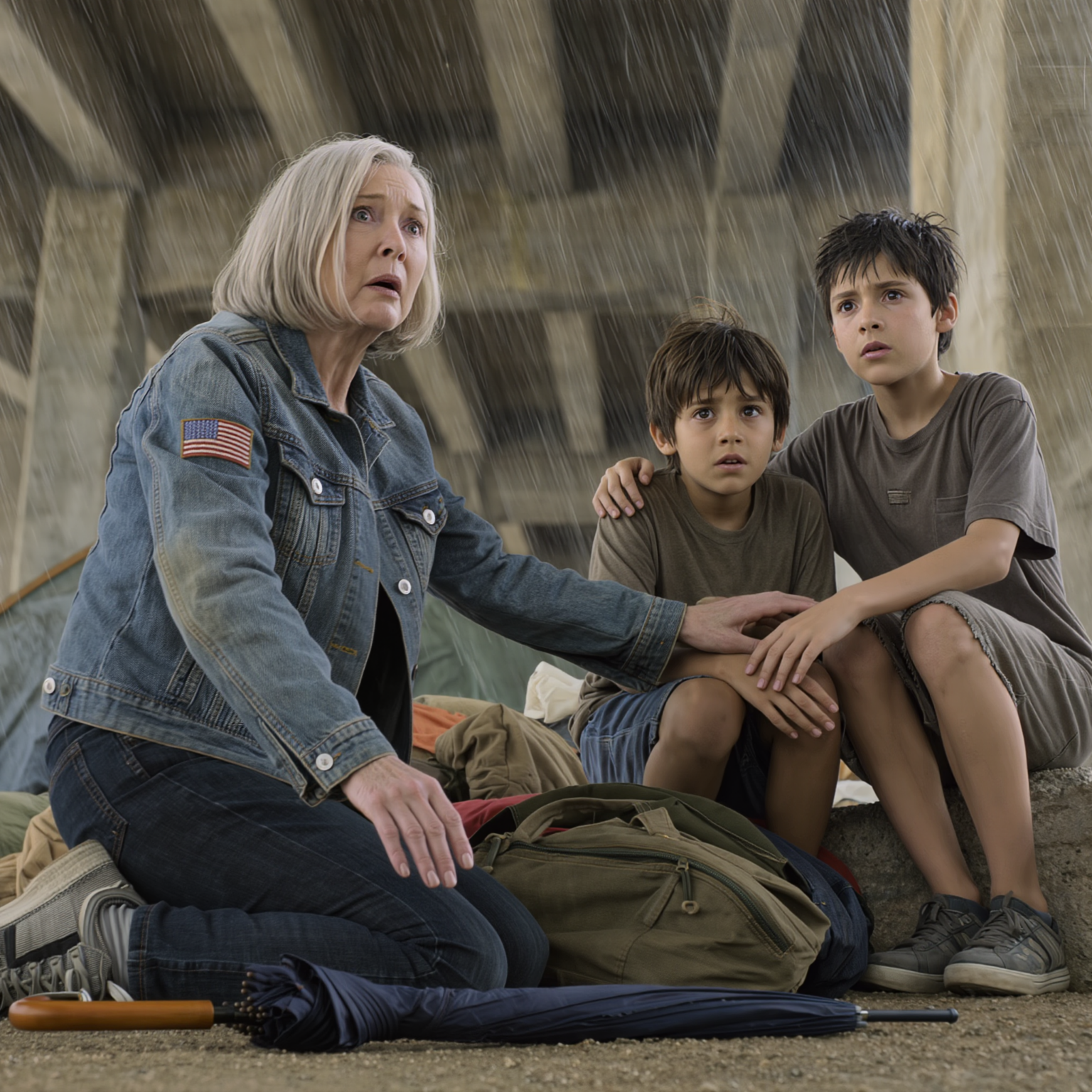
I walked farther than usual, lost in memories, when I noticed movement under the bridge. At first, I thought it was animals — the shadows of stray dogs or cats seeking shade. But as I got closer, the shapes became unmistakably human. Small. Thin. Huddled.
My breath caught.
My steps slowed.
It couldn’t be them.
And yet…
One of the figures tilted his head up.
And I saw the eyes.
Noah’s eyes.
Gray-blue, like his father’s.
I froze in shock, disbelief clawing at my throat. My heart hammered so loudly I was sure they could hear it. But it was true. There they were — my grandsons, not in school, not at home, not in some safe place — but under a bridge, living on the edge of the city.
The older boy — Noah — was fraying at the edges, his clothes tattered, his hair dirty, his face thin beyond his years. The younger, Oliver, clutched a worn blanket, eyes wide and terrified as if he expected someone to disappear at any moment.
I stood there, unmoving.
They didn’t see me at first.
They were frozen, staring at the trickle of water that ran beneath the bridge, the distant hum of traffic above, the harsh sun beating down on cracked concrete.
“Noah?” I whispered, my voice barely audible, like a breath pulled through fog.
The older boy’s head snapped up.
Recognition bloomed in his eyes — but not joy. Not excitement. Just shock. The kind of shock that twists your stomach into knots and makes your knees weak.
“Grandma?” His voice was thin, cautious, as though he wasn’t sure I was real.
I wanted to run to him, but my body didn’t respond. I just stood there, stunned at what I was seeing — the boys I raised, reduced to this.
“Oh my God…” I whispered, swallowing hard. “What happened?”
No tears came at first. Just silence. Just the heavy, miserable truth.
And then — Oliver began to shake.
“Grandma?” He repeated — smaller, softer, his voice cracking like a fragile leaf.
That was when my knees gave up. I fell to my own knees beside them, wrapping my arms around the boys who once clung to me for comfort when they couldn’t sleep.
“I’m here,” I murmured, my voice breaking. “I’m right here.”
They were alive. That was the relief — but the pain of their situation hit harder than anything I had felt in years.
It took a while before they could speak. They looked at me with a mixture of desperation and dignity — the kind of dignity only children thrust into hardship possess. They tried to reassure me, to play it down, to say they were “fine,” but I knew better.
“Where’s your mom?” I asked gently, my own heart trembling like a leaf in a storm.
Noah’s face fell.
“She… she’s not coming,” he said. “She said we weren’t safe. She said…” He looked down, swallowing hard. “…she said you didn’t care about us anymore.”
My heart cracked in two.
And the truth — the ugly, searing truth — hit me like a punch to the chest.
Somewhere along the way, someone had lied.
Someone had cut them off.
Someone had abandoned them.
I gathered them in my arms again, my tears finally falling freely, and I whispered, “I would never abandon you. I would never leave you.”
But their pain was real. And it was deeper than any excuse.
It took time for them to open up — weeks, really — once we were safe and back in my home. I called the authorities. I got them into school. I took them to medical appointments. I fed them real meals. And slowly, they began to speak.
They told me how they had lived for months under the bridge. How some nights they went hungry. How they tried to stay together, how they remembered their father, how they ached for love and stability.
And then came the part that broke my heart.
They told me what their mother had told them when she left.
“Grandma didn’t want us anymore,” Noah said. “She said she had a new life. A new family. That we were in the way.”
My stomach twisted.
The betrayal wasn’t just shocking — it was unimaginable.
Because when Daniel died, I asked Rachel repeatedly if she needed help. I offered support. I offered love. I offered a home. I offered my heart. But she refused. She said she could handle it. She said she didn’t want “charity.” She told me the boys were fine. That they were adjusting.
And I trusted her.
I should never have trusted her.
Not with my grandsons. Not with their futures. Not with their hearts.
The boys cried when they told me these things. Not tears of dramatic grief — but quiet, aching sorrow, the kind that stays in your chest long after the tears dry.
I held them.
I whispered to them.
I told them over and over that I loved them.
That I never stopped.
That I never would.
The day we left the shelter and moved into a small apartment near my house was overwhelming. It wasn’t much, but it was warm, it was safe, and it was ours. And more than anything, it was real.
I enrolled them in school right away. I helped them catch up on classes they missed. I took them to counseling. I bought them clothes that fit. I tucked them into bed every night and kissed their foreheads until they fell asleep.
And every morning, I woke up determined to give them something they had never stopped hoping for: stability.
Weeks passed. Months passed. And one afternoon, as we ate dinner together — a simple meal of roasted chicken and mashed potatoes — Noah looked up at me and said, “Grandma, I’m glad we’re here. I’m glad you found us.”
My eyes filled again. But this time, they were tears of healing — tears that said we were no longer lost.
It wasn’t easy. There are still hard days. There are still moments of fear and sadness. But each day we build a new kind of family, one stitched together with honesty, resilience, and love that survived abandonment and dishonesty.
And every so often, when it’s quiet and I hear their laughter echoing through the rooms, I realize that even the deepest pain can become the source of the strongest kind of joy.
They are here now.
They are safe.
And they are loved — more than I ever knew love could be.