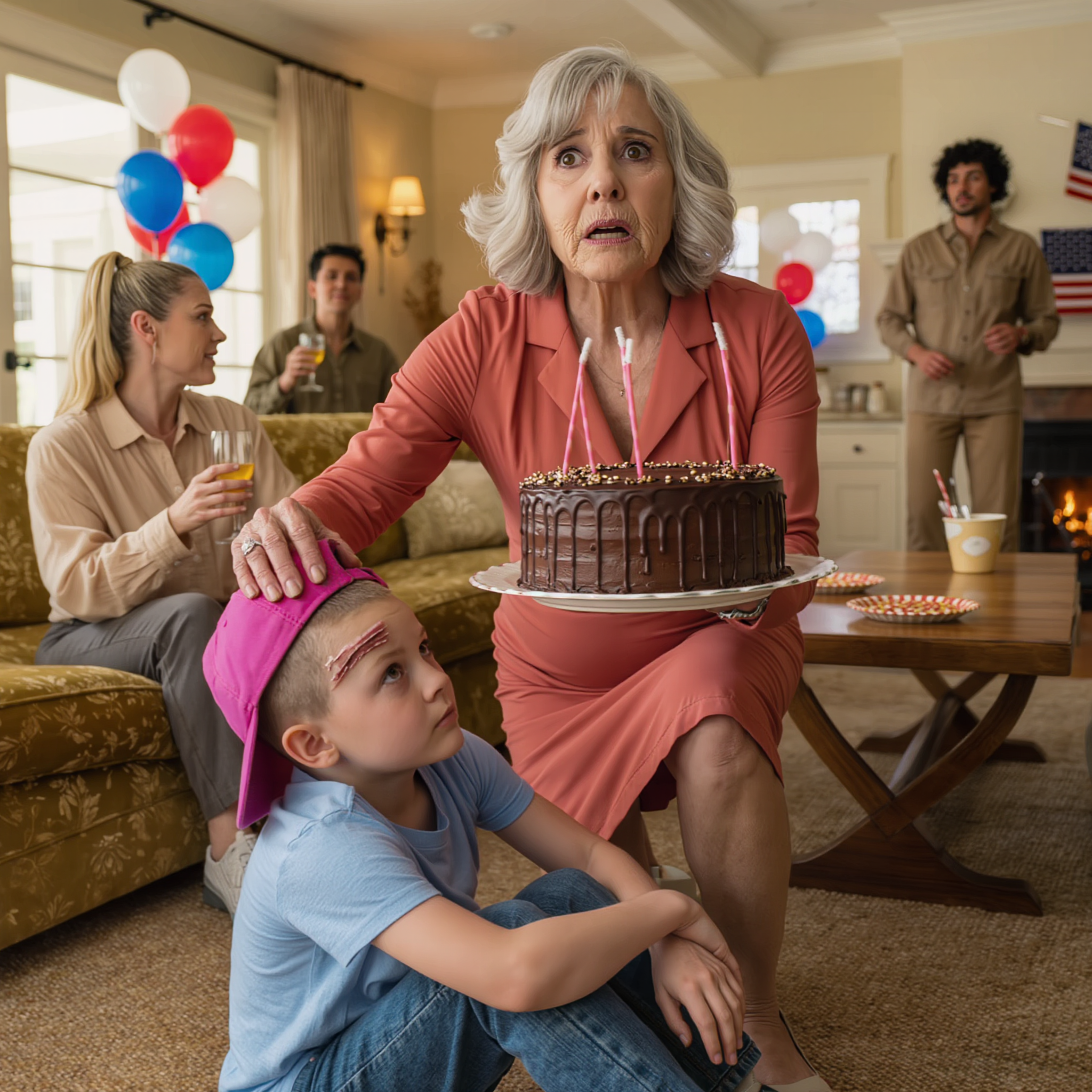
I wasn’t prepared for the way the sunlight caught that cap — soft, cotton pink, slightly too large for the little head it covered — at my son’s birthday celebration in the backyard. It was early afternoon, the sky a generous blue, laughter floating above tables laden with cake and sandwiches, the smell of charcoal and fresh grass weaving together like an invisible invitation to joy. And then I saw it: my six-year-old granddaughter standing near the garden gate, bright pink cap pulled so low that the bare skin of her scalp showed in the gaps where her hair had been clipped far too close. At first I froze — not in alarm so much as speechless recognition: this wasn’t a haircut chosen by a child. This was a haircut imposed on a child. Her bright eyes scanned the party guests the way children do when they want to fit into the world, not stand out in a way that makes them feel vulnerable. I didn’t move. I didn’t speak. I simply saw her — the tiny shoulders, the way her fingers curled around the edge of the cap as though it were both shield and signal flare.
And then I heard my daughter-in-law’s voice — laughter first, followed by the dismissive phrase, “Isn’t it adorable? Trendy, fun, so chic!” Her tone was easy, carefree, upbeat like someone describing cupcakes rather than a child’s defensive covering. My son chuckled too, not out of mockery but casual acceptance — like they both thought this haircut was just another quirky accessory in a gallery of modern parenting choices. At that moment something in me tightened — not with judgment, not with fright, but with that deep, untranslatable ache older people sometimes feel when they see a child in a tiny shadow of discomfort and sense why the world hasn’t yet taught that child to speak up for herself.
I didn’t rush to criticize. I didn’t interrupt the laughter. I simply walked — slowly and intentionally — to where she stood, near the pastel balloons that fluttered like silent onlookers, and crouched down to her level so my eyes met hers without loudness or glare. I didn’t tug the cap or ask why her hair was so short. I simply said, softly, “Hi sweetheart. That cap is a lovely color. Do you like wearing it?” There was no spectacle in my voice — just a calm presence. She blinked, shyly, and nodded. “It’s my favorite,” she said in a small voice that brushed against my heart like a gentle breeze.
But the captivation of her silence made me realize that the issue was not the cap alone — it was agency. She wasn’t wearing the cap because she chose to. She was wearing it because someone else decided for her. And there’s a profound difference between a child’s proud display and a child’s concealment.
I straightened up, and when my daughter-in-law approached, still grinning about the “fashion statement,” I said quietly — not accusingly, not theatrically, but with the firm softness that only years of observation can yield — “She looks pretty in pink, but is she happy with her haircut?” For a moment, laughter paused in the air like a balloon caught in slow motion. My daughter-in-law blinked — not angrily, not defensively at first, just caught off guard. Then she said, swiftly, “Of course she’s happy. She picked the color of her cap herself.” Her tone had that airy certainty people use when they want to sound reassuring without actually listening.
I didn’t escalate. I didn’t confront. I just looked at my granddaughter again — that small, brave girl holding her cap like it was a secret between her and the world — and said softly, “That’s wonderful that you chose your favorite color. But did you decide about your haircut too?” Her eyes dropped to the grass as though she thought that was a question she wasn’t supposed to answer out loud.
And then, like a fragile sigh, she said, “Mom thought I’d look cute.”
Not happy. Not proud. Just obedient.
It was in that simple sentence — “Mom thought I’d look cute” — that I saw something deeper than hairstyle or trend or even a birthday party talking point: I saw a child who was trying to fit into the expectations of others rather than express herself. And that’s when something inside me shifted — not in judgment, but in understanding of what children conceal behind brave little smiles and over-large caps.
I didn’t say anything to turn the party upside down. I didn’t launch into a lecture about autonomy or style. Instead, I took her small hand gently in mine and said, “Pretty is wonderful — but feeling good about yourself is even better.” No drama. No public correction. Just a moment between two generations, sharing something quiet and sincere.
Later, when the party had wound down and the candles were blown out and the last slice of cake was eaten, my daughter-in-law pulled me aside with a half-smile that wasn’t quite sure what to do:
“I thought it looked cute. She looked happy,” she said.
I nodded and offered something compassionate yet honest: “She’s lovely, and the pink is beautiful — but sometimes children wear what others choose for them long before they learn to express what they want.”
No accusations.
No judgement.
Just truth spoken with care.
And here’s the thing I realized afterward:
The story wasn’t about a haircut or a cap.
It was about the difference between an adult’s idea of cute and a child’s sense of self. A child doesn’t wear a cap to be fashionable. A child wears a cap because it feels safe. And — if we’re paying real attention — we can learn so much about nurturing from the way we listen, not the way we lecture.
That night, long after the guests left and the last balloon drooped against the wall, I tucked my granddaughter into bed. I didn’t talk about hair or fashion or etiquette. I asked her quietly — gently, as though it was a world-building question, not a correction — “If you could choose your next haircut, what would you like?”
She thought for a moment — eyes wide like little skies contemplating stars — and then she smiled, not coyly, not dutifully, but with a spark of real choice:
“I want hair that sways in the wind.”
And in that moment — simple, beautiful, unguarded — I realized something profound:
Children aren’t meant to be styled into someone else’s comfort;
they’re meant to be heard in the language of their own expression.
Not trend.
Not “cute.”
Not image.
Voice. Choice. Self-worth.
And that — more than any cap or haircut —
is what truly makes someone shine.