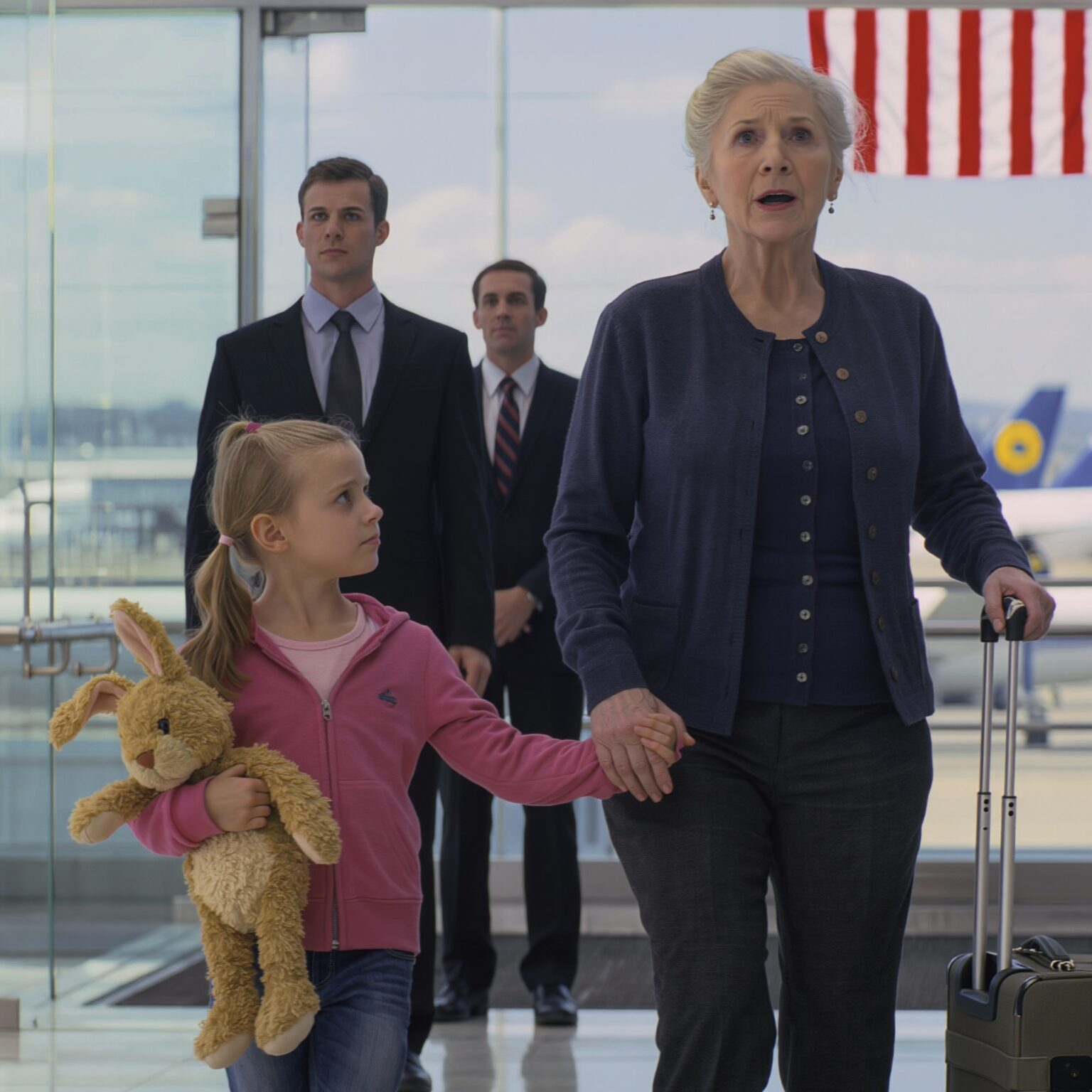
The airport had that peculiar mix of excitement and exhaustion, the kind of atmosphere where travelers forget the hours they’ve spent awake and focus only on the gates and boarding announcements. I had accompanied my son, Alex, on his business trip departure—not because he asked, but because I had insisted. It was a courtesy, a habit, a way of feeling like part of the adult world I had raised him to navigate. The halls were bright with overhead lights, and the polished floors reflected the moving shapes of rolling suitcases and flight attendants hurrying past with clipped efficiency. I had just watched him step onto the plane, briefcase in hand, with that composed, confident smile he always wore, the one that used to make me proud and sometimes wistful for the years that had gone too fast. I turned, ready to leave the waiting area, when I felt a small hand grip mine, so tight that it made my fingers ache.
It was Sophie, my seven-year-old granddaughter, and the look in her eyes made me stop in my tracks. She tugged me aside gently but with insistence, and her voice was so low that I almost didn’t hear it over the background announcements. “Grandma,” she whispered, “we have to leave. Now.” Her small face was pale, her eyes round and serious, the kind of expression children wear when they see adults ignoring something dangerous that no one else notices. I laughed nervously at first, because I thought it was part of a game, a dramatic imagination spilling into reality. But then I realized she wasn’t pretending. She wasn’t joking. Her hand was sweating in mine, and her tiny knuckles were white. “Please,” she said again, pressing closer, “we can’t stay here. They’re watching. They’re waiting.”
My heart started to beat faster, a rhythm entirely unconnected to the airport noise. “Sophie, who’s watching? What are you talking about?” I asked, my voice trembling despite my efforts to remain calm. She shook her head and looked around, eyes darting between the bustling travelers, the airline personnel, and the glass walls that separated the check-in counters from the gates. “Just trust me,” she whispered. “We have to go. It’s not safe.” The insistence in her voice left no room for argument. I bent down slightly, trying to meet her gaze, and I realized in that instant that I was being given a choice: follow a seven-year-old’s intuition—or ignore a warning I did not yet understand.
I followed her lead, letting her small hand guide me through the crowds, past the ticket counters, past the gift shops and coffee stands. Her grip never loosened. I asked again, softly, “Sophie, tell me what’s going on. Why now? Why after he left?” She shook her head, looking frightened even as she spoke. “You’ll see,” she said. “Just go.” I felt a rush of disbelief, a mixture of fear, confusion, and a strange thrill. My son, the one I had trusted all my life, had just left for a week-long trip, and yet the child I had nurtured and loved was now commanding my obedience in a way I had never experienced. And somehow, in that moment, I obeyed. We moved through the terminal with quiet urgency, avoiding the crowds, slipping into quieter hallways and service areas that most travelers didn’t notice. Her small stature allowed her to move swiftly, and I had to run a few steps to keep up.
Eventually, she led me out through an emergency exit, where the cold air of the night struck me in sharp contrast to the warm, artificial brightness of the airport. She kept tugging at my hand, insisting we move quickly to the parking lot. I obeyed, my mind racing with questions and doubts. Was this some kind of prank? A misunderstanding? Yet every instinct in me—the same instinct that had kept me alive through decades of challenges and dangers—told me she was right. Something was happening, and I needed to follow her instructions. She pulled me toward my car, parked in the shadow of the lot, far enough from the main exits that no one could easily see us. We got in, and she insisted I lock the doors. Her hands shook as she fumbled with the seatbelt, and I realized that she had anticipated every step, even something as mundane as locking a car.
I started the engine, my mind spinning. “Sophie, you have to tell me what’s going on,” I said firmly, finally breaking the silence. She swallowed hard, her eyes wide and serious, and said, “Grandma… they’re going to try to take the inheritance while he’s gone. They think you won’t notice. They think you won’t survive.” My stomach dropped. My mind filled with disbelief. “Who? What inheritance? My son? What are you talking about?” She shook her head again. “I can’t explain everything now. We need to go home. It’s not safe to stay here.” I had no choice but to obey, because the certainty in her voice carried a weight I could not ignore. Even at seven, Sophie had a clarity that surpassed most adults I knew. Her hand remained clenched in mine as we pulled out of the parking lot and merged into the city streets, quiet but alive with motion. The night was dark, but the city lights reflected on the wet pavement, creating patterns that seemed almost unreal, surreal in a way that heightened my unease. I kept glancing at her, expecting some sign that she was overreacting, but her expression never wavered.
As we drove, she began to speak in fragments, as if she was revealing truths carefully measured to not overwhelm me, yet sufficient to alert me to danger. “They’ve been planning it,” she whispered. “Selling things… moving papers… even the safe… they think you’ll never see. But I saw it. I saw them take pictures of the documents. I heard the conversations. Grandma, you have to stop them.” I could hardly believe what I was hearing. My children, my own flesh and blood, who I had nurtured for decades, planning against me? I tried to rationalize it, to tell myself it must be a mistake, that Sophie misunderstood. But the way she spoke, her eyes burning with urgency, made me question everything I thought I knew about the family I trusted.
We drove in silence for a while, the only sound the soft hum of the engine and the occasional distant siren echoing through the streets. My mind raced. What if she was right? What if this was real? I realized I had left the airport without any evidence, without any way to confirm her story, except for the sharp certainty in her voice. And yet, I knew one thing: I couldn’t go back. I couldn’t return to a place where my own child might betray me. Sophie’s hand in mine was my only anchor, a fragile link to the truth I could not yet grasp fully.
When we arrived at my apartment, I immediately checked all the doors and windows, locked them carefully, and then sat down with Sophie. I needed answers. She looked exhausted, even though she was only seven, her small frame shaking with the residual tension of the airport escape. Slowly, carefully, she explained what she had observed over the last few weeks, little pieces of information that suddenly formed a terrifying picture: strange phone calls, meetings with my other children that didn’t include me, whispers about property and money. She had been listening, observing, piecing it together on her own. I was stunned. My own child, my trusted son, and his siblings planning something that I had never imagined. And yet, here was the child I loved, seven years old, warning me, guiding me, keeping me safe.
The next hours were spent in cautious investigation. Sophie helped me recall details I had overlooked. The papers I had left on the dining table, the mail I had been too tired to check, the phone messages I had ignored—they suddenly had new significance. Together, we discovered that the documents being moved and the accounts being accessed had nothing to do with daily bills or mundane tasks—they were about inheritance, the one I had been quietly managing, intending to use responsibly for my family’s future. I was shaken to my core. How had I not seen it? How had the ones I trusted most plotted behind my back? And yet, Sophie’s presence reminded me that not all hope was lost.
By dawn, we had devised a plan. First, I contacted my lawyer remotely and explained the situation. I realized that the children’s assumption—that I would be unable to act or notice while Alex was away—was flawed. I had survived enough in life to understand strategy, planning, and caution. Sophie became my partner in vigilance, her small eyes noticing details I would have missed, her intuition guiding our actions in ways that defied her age. Together, we secured the accounts, moved critical documents, and created safeguards that would prevent anyone from acting without my knowledge. My heart raced constantly, but I felt alive in a way I hadn’t in years. The danger was real, but so was the possibility of survival and reclamation.
By the end of that week, I realized that my granddaughter had saved me in ways I could never have anticipated. Not only had she prevented betrayal, but she had also reminded me of the strength I had cultivated over decades. My children, who had assumed they could act with impunity, now faced a reality where their plans were blocked, monitored, and controlled. I did not confront them directly at first. I waited, allowing them to see that their assumptions about my incapacity were flawed. I spoke to Alex when he returned, carefully, measuredly, exposing only the facts he could not deny. He looked shocked, confused, and a little fearful. I had regained control of what was mine, and he had no argument.
Sophie, meanwhile, received my endless gratitude. I hugged her, held her close, and whispered what she already knew: she was brave, wise, and remarkable. She had observed, interpreted, and acted when adults around her had been blind to the truth. And in that moment, I realized that sometimes the smallest voices carry the loudest power. The next weeks involved careful adjustments—securing assets, reinforcing legal protections, and restoring normal routines—but the memory of that airport, of her small hand in mine, would remain etched in my heart forever. I had been warned, I had been guided, and I had survived. And the lesson, indelible and clear, was that family is sometimes found not only in blood but in those who act with courage when others fail.