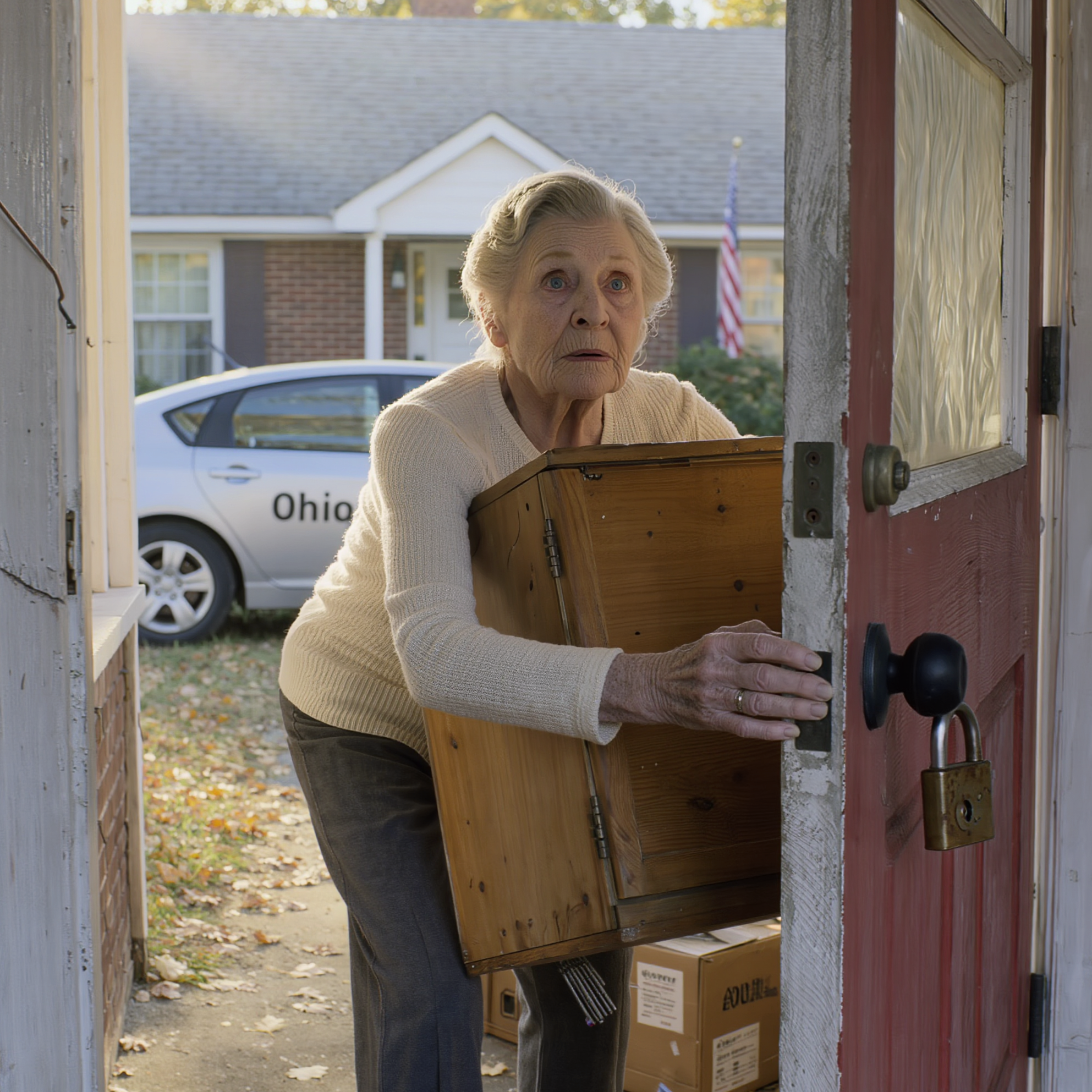
I still remember the January wind that night, sharp and unkind, rattling the loose frame of the old porch door as if warning me before anything even happened at all. I remember the sound of my kettle hissing low on the stove, the lights dim, my knitting basket open on the couch, and the silence of a house that had grown too used to being quiet without children. Then came the hurried knock—no rhythm, no politeness, just urgency—and when I opened the door, there she was, my daughter, my only child, eyes smeared with mascara and hands shaking not from regret but from the cold night she had forced herself into. She didn’t greet me, didn’t even look me in the eye; she simply pushed a blanket-wrapped bundle into my arms and muttered, “Mom, I can’t do this right now, the party’s still going, I’ll be back… I just need a break.” She didn’t wait for questions or for tears or even for me to process the warm little weight that suddenly pressed against my chest. She just ran back down my porch steps, back toward the blaring car music waiting at the end of the block, back toward her life, her friends, her night out and, most painfully, away from the baby boy whose tiny fingers curled instinctively against the wool of my old knitted sweater. The taillights disappeared before I even took my first breath of understanding, before I even unwrapped him fully. I whispered to the wind like a foolish old woman, “You forgot something, sweetheart,” but of course she hadn’t forgotten—she had chosen.
He didn’t cry at first. That still haunts me. Babies are supposed to cry, especially when handed off by a mother who doesn’t even pause to kiss a cheek, especially when the cold air bites and the world changes in a single passing moment. But he only blinked up at me, small chest rising and falling as if trusting me without question. It was I who cried. I who stumbled to close the door, rocking him lightly as if instinctively knowing what he needed, who heated the bottle left in the blanket as though my daughter had planned only for physical needs and not for the human heart beating under that little blue knit hat. When I first fed him and his tiny mouth greedily latched on, I made a silent oath—not because I wanted to, but because something ancient inside me rose up and decided for us both. If she didn’t come back in the morning, or the day after, or the week after, he would not end up lost, forgotten, or bounced from couch to couch, system to system. He would be safe, even if safe meant sacrifice I hadn’t prepared for.
Days became weeks, and though she sent messages—short, breezy, thoughtless—she never returned for him. “You’re doing great, Mom,” she’d type, as if I were babysitting, as if I weren’t watching her child grow new expressions, learn new sounds, recognize my footsteps instead of hers. She returned only twice in those early months, the first time still wearing the same kind of glitter she’d had on her cheeks the night she left him. She kissed him carelessly, more like greeting a cousin than a son, and told me she just needed more time to figure things out. The second time, she didn’t kiss him at all. Just stood in my doorway, looking tired but not in a way that motherhood makes one tired—more like life, parties, choices had worn her down. She hugged me with arms that felt fragile but never looked down at the little boy crawling toward her, eager for attention. She simply said, “He’s better with you for now,” and left before her own child could reach her feet.
God help me, I stopped expecting her after that.
He grew into his name—Elias, the name I chose because no one else claimed the right to give him one. He learned to walk on the patchwork rug I had for years been too stubborn to replace. He learned to talk at my kitchen table while I cut peaches into soft slices and blew on porridge. He learned to read in the old armchair by the bay window, the one with the faded roses printed across the cushions. He called me Grandma at first, as if the world still followed normal roles, and that title alone could have sustained a lifetime of gratitude from me. But one night when he couldn’t fall asleep and his little fingers curled around mine in the dark, he whispered, “You’re like my mom too,” and I had to bury my face in the pillow to keep from shaking with the flood of emotion his small voice carried.
The years unfolded without elegance but with meaning. I learned to stretch my pension, to buy secondhand clothes that looked new with careful ironing, to patch shoes instead of replacing, to cook soups and rice dishes that could feed us for two days. I played both roles quiet and steady, never claiming what wasn’t mine, never correcting him when he introduced me to teachers as the one who raised him. Life became the rhythm of school drop-offs, forgotten mittens, piano lessons paid in small monthly envelopes, and the pride of watching him study long hours at our kitchen table because he wanted more for himself than life had started him with.
My daughter wrote a few times over the years. Birthdays, holidays, bored afternoons. Never asking about him, only about her life, her travels, her new experiences, how time had freed her of responsibility and yet, she claimed, not of guilt. She once wrote, “Maybe when I’m ready, I’ll meet him.” I never answered that message, because I no longer knew if that meeting would be a gift or a wound.
Elias grew into a man without ever learning bitterness. He studied music—not because it was lucrative but because he once heard a pianist at a local church concert and came home silent, changed, eyes bright with purpose. He practiced for years on an old keyboard bought from a thrift shop, keys chipped, pedal squeaking, volume uneven. He played until the neighbors knew his scales by heart, until he won local competitions, then state scholarships, then national opportunities. He thanked me every time, every win, every step forward. There was not one moment I stood beside him in an auditorium, holding my old purse and ticket stub, that I didn’t marvel at what love—not perfect, not biological, but persistent—can build.
Then came the night in late autumn when he stepped onto a world-class stage, dressed in a suit that a sponsor had provided, his hair tied back neatly, his hands steady despite what he was about to do. I sat in the third row, clutching the program. My heart pounded loud enough I feared others could hear it, and when the lights lowered and he sat before the glossy black piano, I thought of that first night—the blanket, the cold, the car fading away. The conductor introduced him as “the rising talent, Elias Hartwell,” and I thought of how I had chosen that surname too, out of quiet dignity rather than shame. The piece began, swelling rich and full, notes cascading like a lifetime compressed into melody.
When it ended, applause surged like a storm. The conductor gestured for Elias to stand and bow, and he did. But then, breaking protocol, he stepped forward, leaned toward the microphone, and scanned the audience—not nervously, but deliberately, as if searching for a truth he had long prepared to speak. When his eyes found mine, he smiled—not the smile of a boy but of a man who understood the cost of love. “I’d like to dedicate this,” he said, voice steady, “to the woman who raised me, who gave me a home, who gave me her life. She wasn’t supposed to be my mother, but she chose me when no one else did.”
The audience quieted as if they sensed something sacred, something heavier than applause. He continued, “Grandma, you are the reason I’m here. You are, in every way that matters, my parent.”
I didn’t stand. I couldn’t. My knees trembled and my heart swelled until my vision blurred. The room erupted in applause again, not polite but deeply moved, as if strangers understood our entire 24-year journey in his short declaration. I felt the weight of all the nights rocking him through fever, all the pennies stretched into dinners, all the lonely birthdays waiting for a mother who never showed. I felt the years not as burden but as offering, and in that moment, the offering was returned not in obligation or guilt but in love spoken plainly before the world.
After the concert, when he wrapped me in his arms—no longer a baby, no longer a child—I understood something I had not allowed myself to believe all these years: I had not merely been a replacement or a caretaker doing what needed to be done. I had been family. Chosen family. Bound not by blood but by devotion, nights holding him when he was small, days encouraging him when he was unsure, years believing in him when no one else bothered to look his way.
My daughter never called that night, nor the next week, nor any of the weeks that followed. And somewhere along the way, I discovered I no longer waited for her name to appear on my phone, nor prayed she might feel remorse. Instead, I prayed she had made peace with her decisions, that she lived a life she could bear waking up to.
As for Elias, he returned to me after the applause and the handshakes and the congratulations, looking exhausted but luminous. He took my hands—older now, marked by time—and asked softly, “Are you proud of me?” I don’t know when I started crying, only that I did, and I told him what I had felt the moment I saw his newborn face in the porch light years ago: “I’ve always been proud. Every minute. Not because of the music or the stage or the audience, but because of who you are.”
He kissed my cheek then, whispering, “I love you, Grandma.” And in his voice, I heard not abandonment or fear or confusion, but belonging. He was not the boy left on a porch. He was the man who returned home—not to a mother who couldn’t stay, but to the woman who did.
In all the years that have passed since, I’ve learned something quietly but undeniably true: life does not grant everyone the parent they are born needing, but sometimes it gives them the parent who will walk beside them anyway. And sometimes the greatest love story isn’t the one written in a nursery with new toys and perfect planning, but the one born from a cold night, a quick knock, and a baby wrapped in a blanket handed to an old woman who refused to let him go.
I didn’t save him. We saved each other.