The sun was dipping low behind the garden trellis when my grandson and his bride walked down the aisle — radiant, smiling, wrapped in that kind of pure joy that makes the rest of the world feel soft around the edges. Two hundred guests watched with tissue-clutched hands and shining eyes, the air heavy with music and promise. I sat in the front row, my heart full, clutching the bouquet I’d been given as “honorary grandmother.” I’d helped raise that boy — changed his first diaper, cheered him on at every school play, stood for hours in rain and sun on the sidelines of his soccer games. I believed — truly believed — that in this moment, love would be the only thing in the room. I believed in that until I heard my son’s voice break the hush that had settled over the garden.
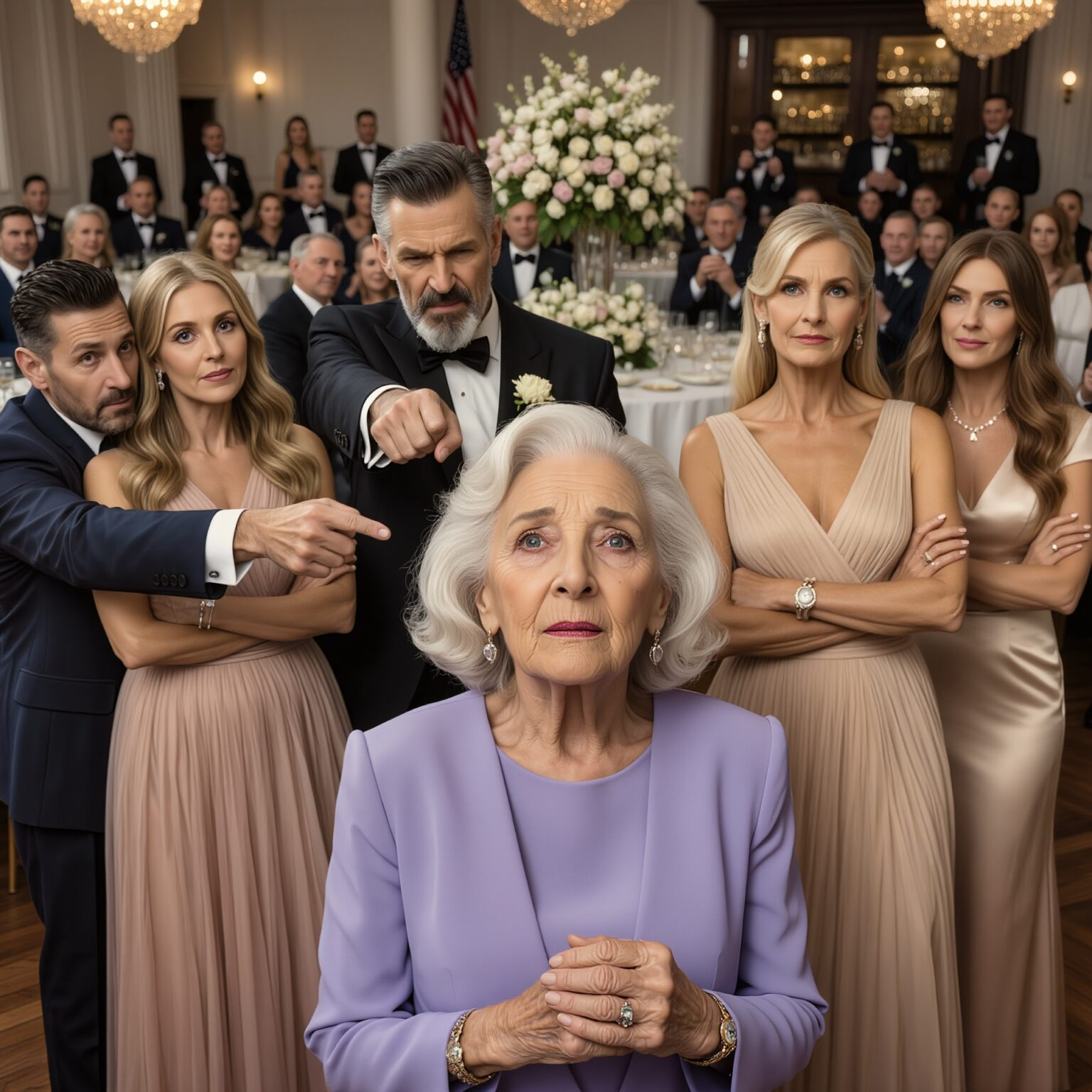
Without warning, he pointed at me — clear, deliberate — and with a voice loud enough for every expectant ear to hear, he announced, “She is not family. She’s only here to eat for free.” He snapped his fingers, and a waiter carrying trays of champagne stopped in mid-step. A ripple of shocked gasps spread across the reception. The bride’s smile flickered. Guests looked back and forth like they were watching a slow-motion accident they couldn’t look away from. Even the flowers seemed to droop, as though wilting under the weight of his words.
I didn’t flinch. I didn’t rise to his bait. I simply sat there — poised, calm, with nothing but the truth resting behind my eyes. For a moment, the world felt unbearably loud… and unbearably still all at once. My grandson — the boy I helped raise — paused mid-smile, confusion knitting his brow. The bride’s eyes widened, unsure. And somewhere in the crowded circle of onlookers, I could see the flicker of disbelief that something so cruel had been spoken on such a sacred day.
I didn’t speak. I didn’t shout. I didn’t make a scene. I just smiled. Not the strained “fake it till it’s over” smile — a quiet, confident smile that came from a deeper place inside me: dignity. I sat upright, hands folded gracefully in my lap, and looked around at the faces — all those friends and family who had come to witness something beautiful.
And then I stood.
Not in anger.
Not in pain.
But in clarity.
I walked slowly toward the open reception lawn where waiters had momentarily stopped serving, musicians paused mid-note, and guests watched like deer caught in headlights. My steps were measured, calm — not rushed, not emotional, but intentional. I felt the eyes on my back, the whisper of shock and judgment, the weight of two hundred curious glances. But I walked on, as though I owned not just that garden — but my dignity, my history, and my truth.
When I reached the microphone stand — the very one they planned to use for speeches after dinner — I paused, inhaled slowly, and addressed the crowd with a voice steady and warm.
“I am here for love,” I began. “I am here for family. And I am here to honor this couple.”
Murmurs drifted through the guests, soft but uncertain — like a breeze before a storm clears.
“I have laughed with this family, cried with them, stood by them in countless moments,” I continued. “I sat in a hospital waiting room when illness struck. I held babies at midnight. I cheered when dreams came true. And I stood right here when this young man first learned to walk.”
A hush settled — sincere, curious, respectful.
“What I am not,” I said, “is someone who comes to eat for free. I am someone who comes because I love deeply — and because love is why we are all gathered here.”
There was silence… and then something softer — a butterfly effect of understanding that spread through the crowd. A few eyes glistened. A couple of guests nodded. Aunts whispered quietly. Older relatives murmured in agreement. And then — the unexpected happened: my grandson rose from his seat, walked beside me, and stood before the microphone.
“Grandma,” he said, his voice clear and steady, “you are family. Blood or not — family is built with love. And you have loved us all my life.”
A ripple of applause began — hesitant at first, then growing louder and more confident. My son froze, his face turning an awkward shade, like someone had turned up a spotlight on his deepest regret.
I stayed at the microphone, not to confront him — but to show everyone there was a higher way to speak truth.
“Today,” I said softly, “is about beginnings, not endings. Today is about love — not division.”
I stepped down, and the applause followed me back to my seat — not triumphant, not vindictive, just warm, sincere, and deeply human.
Dinner resumed. The music swelled. And though some of the earlier sting of embarrassment still buzzed faintly in the air, it seemed to lessen with every smile that returned to people’s faces. People talked quietly among themselves about kindness, respect, dignity, and what true family really means.
My son didn’t apologize that night — not in words. Nothing that dramatic. But later, as the reception wound down and candlelight softened the crowd, he came over quietly. Not with anger, not with defense, but with something harder: vulnerability.
He stood near me, hesitant, eyes downcast. “I… I didn’t think,” he said, voice low and unsure. “I didn’t mean to hurt anyone.”
I didn’t answer him right away. I just looked at him — really looked — and in that stillness, I saw something shift. Not a miraculous transformation, not a dramatic epiphany, but a tiny, honest moment of self-reflection.
“What matters,” I told him gently, “is what we choose to be when everyone is watching — and when no one is. Today was a moment you can learn from.”
He nodded slowly, as though he was hearing a truth he had never quite understood before.
The next day, a few guests came to me — some older relatives, neighbors, even a cousin I hadn’t seen in years. They didn’t just offer condolences for how the moment had unfolded — they offered gratitude for the way I handled it: with calm strength, with grace, with wisdom. They didn’t see weakness. They saw clarity.
And most importantly — my grandson came to me again, hugging me tightly, whispering, “You’re family to me. I’m so glad you’re here.” His words mattered more than any awkward dinner moment.
What I learned in that moment — and what I want to share with you — is this: you have a right to be treated with respect, no matter what others choose to believe or say about you. Family isn’t just defined by blood — it’s defined by the love, devotion, and generosity you show through years of shared life.
I didn’t attack.
I didn’t humiliate.
I didn’t lower myself to match cruelty.
I stood in dignity.
I spoke in truth.
And in that grace, everything changed — not just for the wedding day, but for the understanding of what family means when love speaks louder than words meant to hurt.
And years from now, when my grandson tells the story of his wedding — he won’t remember the hurtful announcement.
He’ll remember the woman who stood for love in a moment everyone needed to see.
Because strength isn’t loud. Strength is calm, steady, and rooted in who you are — not in who others think you should be.