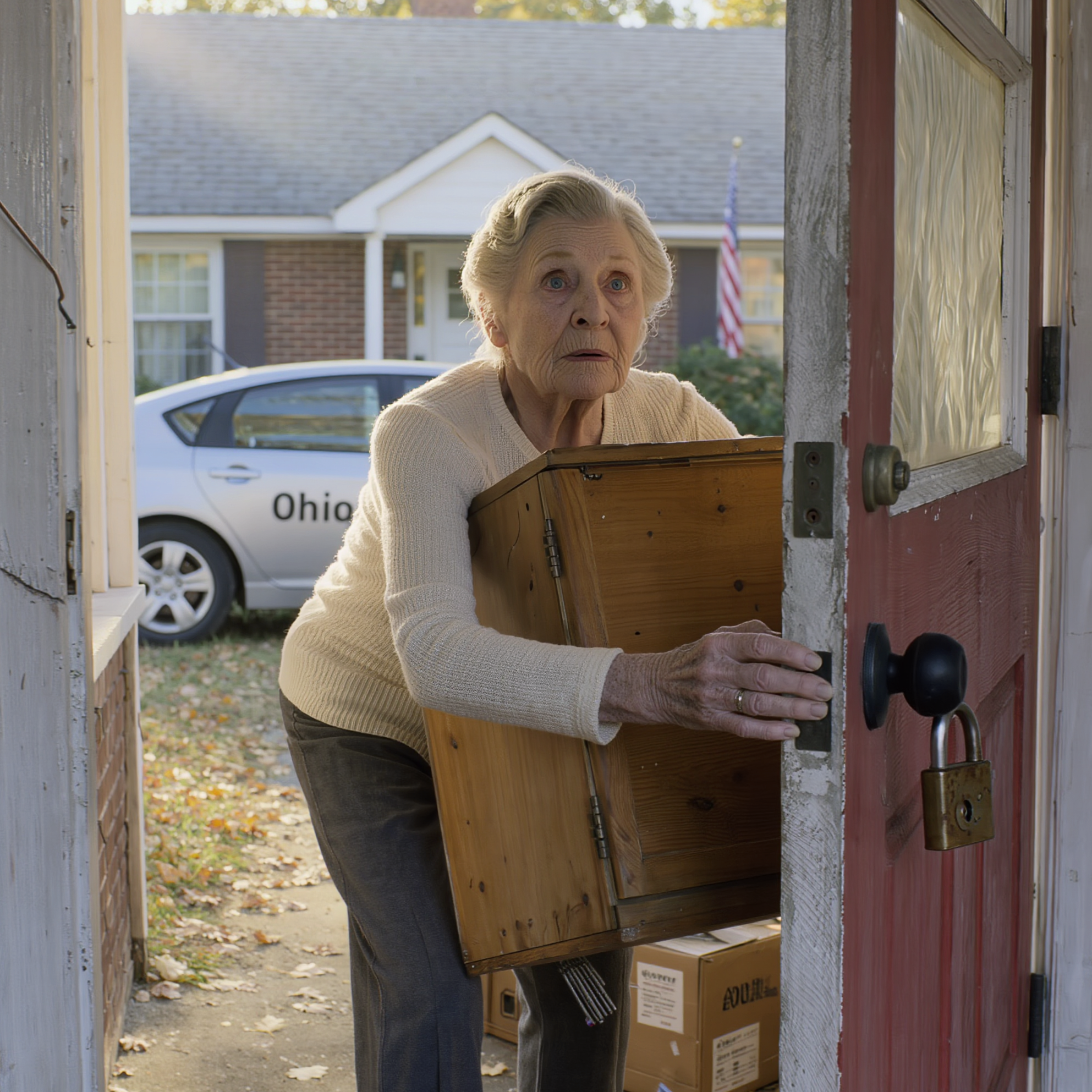
The Burden of an Unwanted Legacy
For forty years, my husband, Arthur, was a man of quiet, rhythmic habits. He worked as a clockmaker in our small town in Vermont, a trade that required a level of patience and precision most people today can’t even fathom. He was a man of few words, but his hands were always busy, either repairing the delicate gears of a grandfather clock or tinkering in the oversized, rusted storage shed at the back of our property. After he passed away last winter, the silence he left behind was deafening. Along with the silence, he left me the house, a modest savings account, and that old shed—a corrugated metal eyesore that sat at the edge of the woods, overgrown with ivy and forgotten by time.
My son, Leo, didn’t share his father’s sentimentality or his patience. Leo lived in the city, working in “digital acquisitions,” a job that seemed to involve a lot of shouting into headsets and staring at flickering spreadsheets. From the moment the funeral was over, Leo’s focus shifted to the liquidation of Arthur’s estate. He didn’t see a father’s workshop; he saw a liability. “Mom, honestly, that shed is a deathtrap,” Leo said during one of his rare weekend visits, his eyes darting around the yard. “It’s taking up valuable square footage. I’ve already talked to a scrap metal guy. He’ll give you a few hundred bucks to haul it away. It’s just junk, Mom. Arthur was a hoarder of old parts and dust. Let it go.”
I felt a sharp pang of resentment. Arthur wasn’t a hoarder; he was a craftsman. But looking at the shed, with its sagging roof and rusted hinges, I began to wonder if Leo was right. My joints were aching more with each passing season, and the idea of maintaining a property that was slowly being reclaimed by the forest was becoming overwhelming. I told Leo I’d think about it, but a part of me felt like selling that shed was like selling a piece of Arthur’s soul. One Tuesday afternoon, armed with a heavy flashlight and the rusted key Arthur had always kept on his belt, I decided to conduct one final walkthrough before calling the scrap man.
The Cabinet That Guarded a Ghost
The interior of the shed smelled of oil, cedar, and old paper—the scent of my husband. It was filled with boxes of clock springs, jars of tiny brass screws, and stacks of weathered blueprints. In the center of the room sat a massive, oak tool cabinet that Arthur had built himself. It was a beautiful piece of furniture, out of place in such a rugged environment, but it was too heavy for me to move. It sat flush against the back wall, immovable and stoic. As I poked through the drawers, I noticed something strange. The floorboards beneath the cabinet were clean, while the rest of the floor was covered in decades of sawdust and grime.
I leaned against the cabinet, trying to catch my breath, and felt a slight give. I pushed harder, and to my absolute astonishment, the entire unit slid smoothly to the right on a set of hidden, well-oiled tracks. Behind where the cabinet had stood was a door—a heavy, steel-reinforced door with a modern keypad. My heart hammered against my ribs. Arthur had never mentioned a keypad. He had never mentioned a hidden room. I stared at the blinking red light of the lock, my mind racing. I tried the most obvious combination: our anniversary. Nothing. I tried Leo’s birthday. Nothing. Then, I remembered the serial number Arthur had tattooed on the inside of his favorite pocket watch—the date he finally finished his apprenticeship. I punched in the numbers, and with a soft, mechanical click, the door swung inward.
The room beyond was nothing like the dusty chaos of the shed. It was a climate-controlled sanctuary, lit by soft, recessed LED lights. There were no clock parts here. Instead, the walls were lined with meticulously organized filing cabinets and several large, fireproof safes. In the center of the room was a desk with a single envelope sitting on the blotter. My name, Elena, was written on it in Arthur’s precise, elegant script. With trembling hands, I opened it.
The Architect of a Secret Empire
“Elena,” the letter began, “if you are reading this, it means I am no longer there to protect you. For forty years, you knew me as a clockmaker. And I was. but I was also an investor in the very technologies that were making my trade obsolete. I didn’t tell you or Leo because I wanted our life to be simple. I wanted Leo to grow up knowing the value of work, not the comfort of wealth. But I saw the way he was changing. I saw the greed taking root in him, and I knew I couldn’t leave him in charge of our future.”
The letter detailed a portfolio of patents and early-stage investments in micro-engineering companies—companies that now dominated the global market. Arthur hadn’t been “tinkering” in the shed; he had been managing a multi-million dollar estate that he had kept entirely separate from our daily lives. He had set up a private foundation in my name, ensuring that I would never want for anything, but he had added a very specific clause regarding Leo. The wealth was only accessible to me, and it could only be passed down if Leo demonstrated “the character of a builder, not a liquidator.”
I sat in the silence of that high-tech room, surrounded by the evidence of my husband’s hidden genius. He had spent his life acting like a simple craftsman while quietly building a fortress for me. He had seen the man Leo was becoming long before I was willing to admit it. Arthur knew that if Leo found out about the money, he would spend it on “acquisitions” and “growth” until there was nothing left of our family’s peace. The shed wasn’t “junk”; it was the vault that held my freedom.
The Reckoning of the Liquidator
I didn’t tell Leo about the room. I wanted to see if he would prove his father wrong. A week later, Leo called, his voice tight with impatience. “So, did you call the scrap guy? I told him he could come by Thursday. I’ve already contacted a realtor about the house, too. We can get you into a nice condo by next month. It’s time to cash out, Mom.”
I stood in the backyard, looking at the shed that held a secret more valuable than any “cash out” Leo could imagine. “Leo,” I said, my voice steadier than it had been in years, “I’ve decided not to sell the shed. Or the house. In fact, I’m going to spend some time in the shed, looking through your father’s things. There’s a lot of history there.”
Leo scoffed, a sound of pure condescension. “History doesn’t pay the bills, Mom. You’re being delusional. You’re holding onto trash while the world moves on. If you don’t sell it, I’m not going to keep coming up there to help you fix things. You’re on your own.”
“I know I am, Leo,” I replied. “And for the first time, I’m perfectly fine with that.” I hung up the phone and walked back toward the shed. I spent the afternoon in the hidden room, learning about the foundation Arthur had built. I realized that the “junk” my son wanted to haul away was the very thing that would allow me to live out my days in luxury, while Leo would have to finally learn the lesson his father had been trying to teach him for decades.
The Legacy of the Clockmaker
I eventually sold the main house, but only to move into a custom-built home on a piece of land Arthur had bought years ago—a home that was funded entirely by the foundation. I kept the shed, moving it piece by piece to my new property. It remains a reminder that the most valuable things in life are often hidden beneath a layer of dust and rust. Leo eventually found out about the foundation when he tried to sue for a larger share of the estate, only to be met by a legal team Arthur had retained twenty years ago. The “Liquidator” found out that he couldn’t touch a cent because he had failed the only test that mattered: the test of character.
I sit on my new porch now, watching the Vermont sunset, and I listen to the steady, rhythmic ticking of one of Arthur’s favorite clocks. My son thinks I’m a “poor old woman” who got lucky with a hidden room, but I know better. I am the guardian of a clockmaker’s greatest masterpiece—a life built on precision, patience, and the secret knowledge that some things are far too precious to ever be sold for scrap.