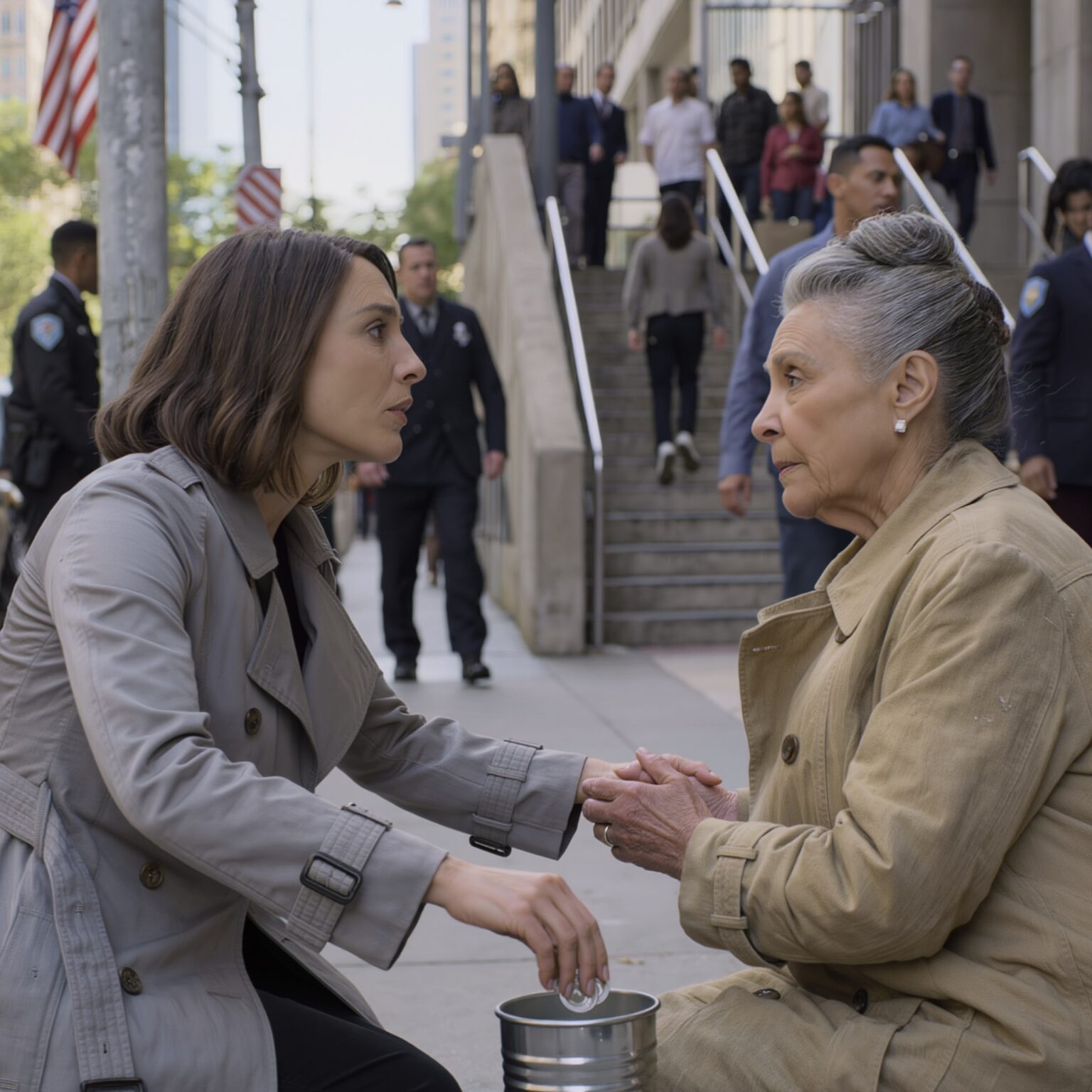
After my divorce, every morning felt like a small unraveling, as though a part of me had been pulled loose and never quite stitched back together. I woke up early, drove the silent streets to my new job at a bookstore, and tried to be just another face behind the counter who smiled and recommended novels without revealing too much of the scar tissue underneath. The first few weeks, I carried a sadness in my chest like a familiar coat — heavy, predictable, oddly comforting simply because I recognized its weight. And then, on my walk to work each day, I began noticing her: an frail old woman who sat quietly outside the storefront across the street, her back bent from years that had worn her posture thin, her eyes soft but watchful, and a small, faded cup at her feet with only a few coins nestled inside. Something about her stillness and quiet presence felt strangely grounding — like she, too, carried an invisible story etched into her bones.
At first, I did nothing except notice. But as days passed and my own heartbreak ebbed and flowed like a slow tide, I found myself slipping a few coins into her cup each morning — just loose change, a couple of quarters, a dollar here and there. I never approached her. I never spoke a word. I just left the coins and walked into work, letting the gesture feel like a small offering of humanity in my own fractured world. Some mornings she was asleep, leaning slightly forward with a threadbare shawl over her shoulders. Other days she was awake, eyes tracking me briefly before returning to whatever distant place her gaze always seemed to carry. I couldn’t read her expression — not sadness, not joy, just a quiet awareness that made me feel less alone in a time when I felt none of the support I once had.
Then one morning, after a particularly rough night — the kind where memories and regrets tangle together like thorny vines — I bent down as usual to leave the coins, and she looked up at me directly for the first time. Her eyes were gray and gentle, but they held something clear and knowing, like she had been waiting to say the words I didn’t yet know I needed to hear. “You don’t have to give me your coins,” she said, her voice soft but steady, like wind through treetops. “You can keep them for yourself.”
It took me a moment to register what she had said, because no one had ever spoken to me with such honesty and simplicity. I hovered there, hand buried in the lining of my coat pocket where the coins used to rest, and she watched me with steady patience. “Why do you leave them?” she asked — not accusatory, just curious, like someone comfortable in silence but unafraid of truth.
I wasn’t expecting a conversation. I wasn’t prepared for words that might expose the fragile places inside me. But I found myself answering anyway, perhaps because there was something about her presence that felt like forgiveness before apology — a quiet space where broken things could be spoken aloud without fear.
“I used to have someone,” I said, my voice light but certain at first, then slowing like a breath released after holding it too long. “He was my husband. And after we… parted ways… I felt like I was walking through the world without much purpose. Leaving the coins here… it felt like a small act of kindness — something real I could do when nothing else seemed certain anymore.”
She nodded, her eyes softening like a gentle wave rolling onto a quiet shore. “Kindness matters,” she said simply. “Especially when people forget it matters to themselves.”
And in that one moment of unexpected clarity — standing there on the sidewalk with leaves rustling behind us, the morning sun just beginning to warm the day — I realized that my daily ritual had never really been about charity in the usual sense. It had been about connection: the intangible exchange between two imperfect humans who, in their own ways, were trying to patch together pieces of themselves that had frayed. I realized then that she wasn’t a background figure in my world, just another face on the street. She was a mirror — someone who had survived winters I can’t imagine, someone whose quiet presence was not a plea but a testament to endurance.
From that day forward, I didn’t leave money without speaking. I stopped as I passed her and said, “Good morning.” Not rushed or breathless, just simple — a greeting that felt like acknowledging a life instead of a symbol. She smiled once, just once, and the movement changed her face like sunlight through a window.
Weeks later, she shared her own story — bits and pieces like threads pulled from a tapestry: once a nurse who cared for children, then a mother whose own children had moved far away, then someone whose heart had learned to make peace with solitude rather than panic at its edges. I listened, and as I listened, something inside me softened — not in a sentimental way, but with a kind of honest ease that comes when two souls share truth without pretense.
I didn’t need a new husband or even reconciliation with the life I had lost. I simply needed someone to remind me that purpose doesn’t always arrive in grand affirmations — sometimes it appears in small shared moments between unlikely companions. The old woman and I continued our morning ritual, not of coins and silence, but of greetings and conversations about weather and small joys and the way time moves differently when we choose to really encounter another person.
One day she looked at me and said, “You’re healing.” I blinked, unsure how someone could see that in me when I still felt incomplete, but she didn’t need explanation. She simply smiled and said, “Kindness heals what time sometimes cannot reach on its own.”
That afternoon, as I walked into the bookstore where I work — the one that welcomed me when I felt adrift — I felt lighter than I had in months. The divorce still echoed in moments of quiet, but the sharpness of it no longer felt like a blindfold; it felt like an invitation to rediscover life from a new angle. I had lost companionship, yes, but I had stumbled upon connection I never expected — a reminder that even broken mornings can lead to healing conversations.
And every now and then, when the morning light falls just right and the wind carries the promise of a new beginning, I remember her words: Kindness matters. Not because it changes the world all at once, but because it changes one heart at a time — sometimes starting with my own.