I still remember the moment I saw the lock on the pantry door. It wasn’t just any cupboard — it was the heart of their kitchen, the old wooden pantry that had held jars of jam I canned every summer, bags of flour for cookies I baked with my grandson, and that big container of coffee beans my son loved. When they moved me in after I fell and broke my hip, I never thought anything in the house would feel off-limits. Not to me. Not to anyone who considered this place family. But there it was — a shiny new padlock with a bold brass key hanging on the hook beside it, as though announcing, quite proudly, that I was no longer welcome to open it.
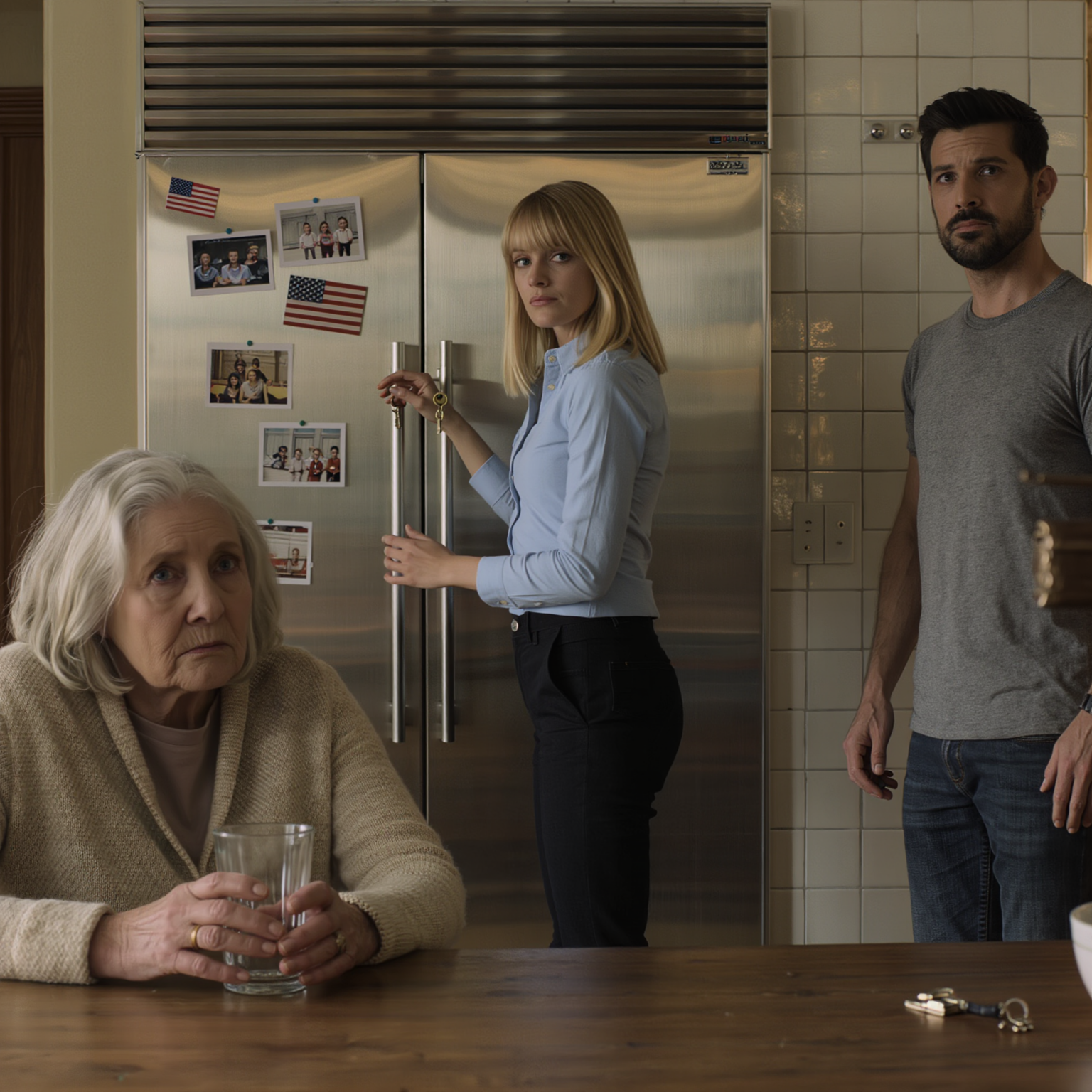
I stood in the kitchen, the morning light filtering through the curtains, and I didn’t shout. I didn’t complain. I didn’t even raise my voice. I just smiled — the kind of smile that lives in your chest, quiet and measured, like a slow breath before everything changes. My daughter-in-law, Tara, was in the living room, and she looked up through the archway of the doorway with that expression she always wore when she was irritated: eyes half-narrowed, jaw set subtly, the off-handed tilt of a person who believes they’re in total control. Behind her, my son, Michael, sat on the couch, staring at his phone like he didn’t notice anything unusual. Or maybe he just didn’t want to.
“Good morning,” I said serenely, as though the locked pantry was just another decorating choice.
Tara didn’t look at me. She pointed at the cabinet door with one slim finger and said, sharply, “That’s the new lock. We’re keeping it that way. Your things are on the top shelf of the fridge if you need anything. We just… don’t want our food touched.”
I nodded slowly, the smile still in place. “Thank you for letting me know,” I replied, my voice soft but calm. I didn’t argue. I didn’t protest. I didn’t make a scene. I simply walked out of the kitchen and sat at the little table by the window, watching the sunlight dance over the yellowed edges of a newspaper spread out in front of me. That day, nothing more was said. But in the silence of that locked pantry, something unspoken settled into my bones: this was not just about food.
Honestly, I didn’t know how long the lock would stay there. Hours? Days? Weeks? I didn’t press the issue, because sometimes dignity speaks louder than doors or arguments. Instead, I listened. I observed. I watched how Tara moved through the house, how she spoke to my son, how she spoke about other people as though she wasn’t afraid their thoughts might echo back to them. And gradually, over the course of a week, a pattern emerged — one that didn’t involve hunger or pantry snacks but something deeper: control.
Every morning, I woke before dawn. I washed up quietly, padded into the small living room with my coffee mug in hand, and listened to the household awaken. At first, it was just the hum of the refrigerator and the distant caw of birds outside the window. Then I heard voices — not loud, not overt, just low and indistinct, like two people carrying on with their own lives without noticing the world beyond their own script.
I didn’t eavesdrop. I just listened.
And then, one morning before the sun cracked the horizon, I heard something unusual — the unmistakable sound of the pantry lock clicking open. Not keys turning. Not footsteps approaching to fetch breakfast. It was that slow, stubborn click that happens when someone is trying their best to be silent but isn’t very good at it. My ears pricked up. I set my mug down and walked over to the kitchen, stopping just outside the pantry. The door was slightly ajar, and a faint sliver of light seeped out from behind it.
Inside, I saw the familiar shapes of their food — bread, jars, cereal boxes — but tucked behind them, at the very back of the shelves, were stacks of unopened packages and cans I had no memory of seeing before. New bags of pasta, bottles of olive oil, boxes of fancy crackers, tins of expensive coffee — things I couldn’t remember being there. For a moment I just stood still, breathing slowly, listening as the bedroom door upstairs opened and footsteps descended.
I walked away from the pantry, my mind quietly turning over the unexpected discovery. When Michael and Tara entered the room moments later, I was already at the table, coffee in hand, serene as ever.
“Good morning,” I said, smiling.
Their reactions were immediate — a flicker of guilt, a half-second too slow to cover, followed by forced casualness.
“Morning,” Michael mumbled, avoiding my eyes.
Tara cleared her throat and looked at her phone. “I made breakfast. If you want eggs, they’re on the stove.”
I didn’t mention the pantry. I didn’t accuse them. I simply poured another cup of coffee and waited, because sometimes the truth isn’t revealed in confrontation — it’s revealed in what people choose not to say.
Days passed, and the pantry stayed locked. The extra food stayed hidden. And the atmosphere in the house — once warm, once filled with laughter and chatter — became thinner, like fog bleeding out under the morning sun. I watched quietly, visited neighbors, took small walks in the park, and continued my internal experiment in patience and dignity. I didn’t want confrontation; I wanted observation. And more than anything, I wanted clarity.
A week later, at dawn again, I heard voices — but not the usual ones. This time, they were hushed and sharp, the kind of voices that crack under pressure when someone is afraid they’re about to be found out. I walked softly into the kitchen without being noticed and stood three steps behind the pantry door just as Tara was closing it, a box of things shoved hastily inside.
Before I could say a word, she spun around, startled to see me. Her face froze — not with anger, but with fear. She looked past me, sensing that someone else might be present, and then back at me, eyes wide.
“What are you doing?” she asked, voice small, defenseless, as though my mere presence had undone her entire plan.
I didn’t answer right away. I just stood there, calm, steady, the morning light catching the edges of my hair like a halo.
“I wasn’t looking for food,” I finally said. “I was just seeing if you needed anything. I saw the lock and figured… maybe you wanted to tell me why it was there.”
She swallowed hard, her eyes darting away. There was no clever excuse ready, no practiced phrase, no attempt to deflect or charm her way out. And somehow, in that moment of silence, everything became clear.
“You didn’t want me to touch your things,” I said slowly. “But what you hid in the pantry wasn’t food you were afraid I’d eat… it was supplies you thought you didn’t have to share.”
Her face went red, not with anger but something worse — regret filtered through panic.
“I… thought…” she trailed off, clutching her own words like a lifeline she wasn’t sure how to hold.
I didn’t shout. I didn’t scold. I just smiled again — that quiet, patient smile — and walked out of the kitchen.
Later that same afternoon, Michael came into the living room and sat across from me, his expression softer, more uncertain than it had been all week.
“Mom,” he began, voice almost a whisper, “can we talk?”
I nodded.
And for the first time in days, the house didn’t feel cold.
We talked — not about the pantry lock, not about the food, not about who was right or wrong. We talked about how easy it is for fear to creep into love, how quickly generosity can be replaced by suspicion, and how kindness is something we give freely or risk losing entirely.
When I left that night for my own quiet apartment — smaller, humble, but mine — I carried no resentment. I carried only a clear heart and a lesson that family bonds aren’t measured by how much we hoard, but by how much we trust.
And years later, when the pantry lock was finally removed entirely, it became a symbol — not of exclusion, but of forgiveness.