I found my son just before dawn, when the world was still gray and undecided, that fragile hour where night hasn’t fully released its grip and morning hasn’t yet promised safety. I had been driving the back road toward his place after an unanswered call gnawed at me for hours, my stomach tight with a feeling I couldn’t explain but couldn’t ignore either. The fog sat low over the fields, and my headlights cut through it in narrow, trembling beams when I saw the car first — angled wrong, too neat in its damage, resting beside the road as if someone had placed it there rather than lost control of it. The driver’s door was open. No skid marks. No debris scattered the way accidents usually leave chaos behind. My heart began pounding before I even stopped the car, because nothing about the scene made sense.
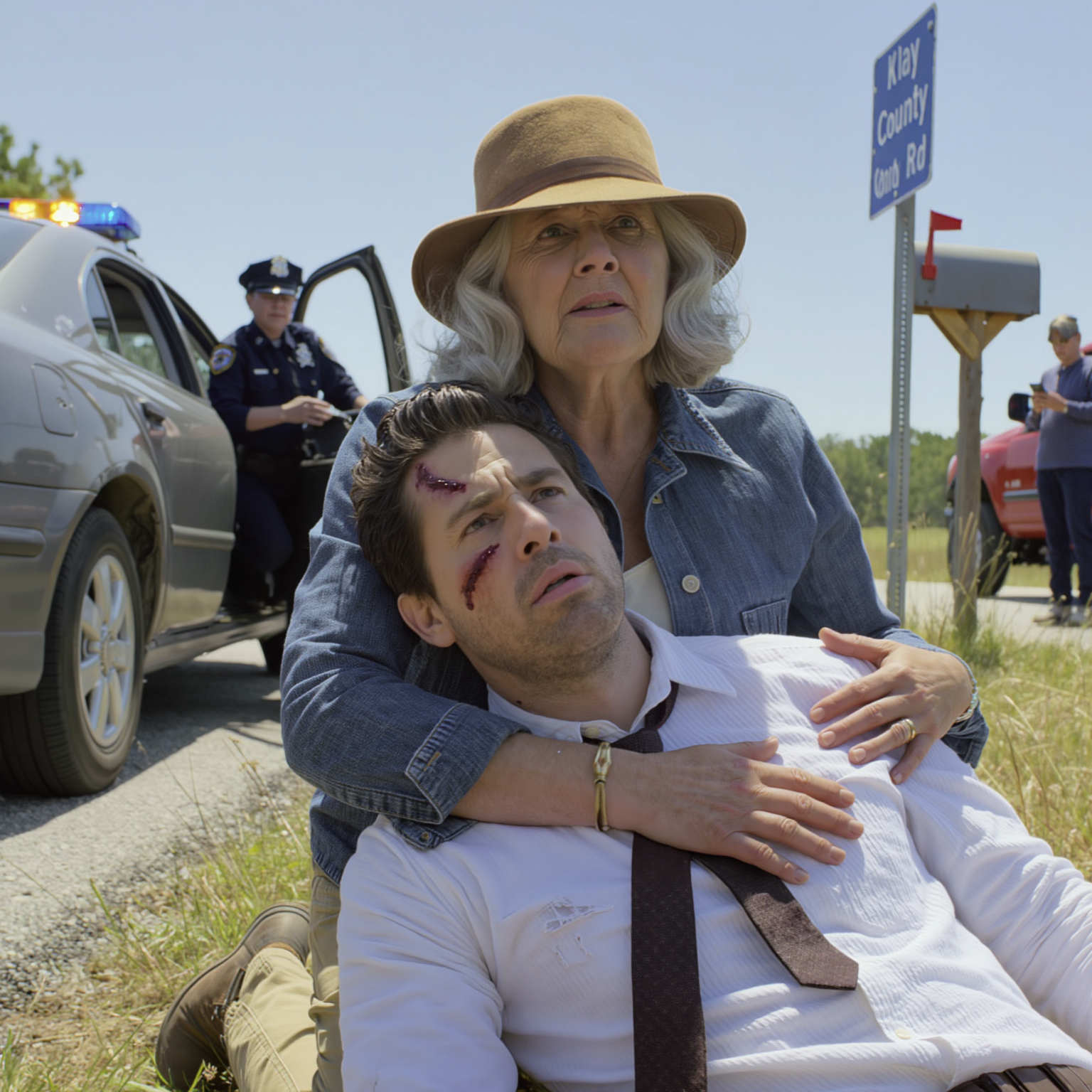
I saw him then — my son — lying in the shallow ditch beside the road, half-hidden by wet grass and mud, his body twisted unnaturally, one arm bent beneath him like it had given out mid-crawl. I ran to him without thinking, slipping in the mud, calling his name over and over until my voice cracked. His breathing was shallow, broken, each inhale a struggle like his chest was fighting itself. His face was pale, lips tinged blue, eyes fluttering open only long enough to prove he was still here. I dropped to my knees beside him, hands shaking as I checked for blood, for broken bones, for any sign that I was already too late.
“Stay with me,” I whispered, pressing my coat against his side, trying to keep him warm, trying to anchor him to the world. His eyes focused on me just enough to recognize my face, and in that moment, relief flickered across his features — followed immediately by fear. Not pain. Fear. His fingers gripped my sleeve weakly, and with a breath that sounded like it might be his last, he whispered words that froze me deeper than the cold ever could.
“Dad… it wasn’t an accident.”
I felt something inside me lock into place. Not panic. Not denial. Certainty. I looked back at the car again — the untouched windshield, the lack of impact damage consistent with a real crash, the way the scene looked staged, almost respectful in its placement. Someone had wanted it to look like an accident. Someone had wanted him found late — or not at all. I told him not to speak, told him help was coming, but he shook his head faintly, urgency forcing the words out anyway.
“They thought I was dead,” he whispered. “They left.”
I called emergency services with one hand while holding his wrist with the other, counting his pulse, refusing to let my voice shake as I gave directions. While we waited, I shielded him from the wind, my mind racing backward through the last few weeks — the strange tension in his voice during phone calls, the way he’d brushed off questions, the unfamiliar exhaustion in his eyes the last time I saw him. I had assumed it was work stress. Life pressure. I had trusted that if something was wrong, he’d tell me. Parents always want to believe that.
The ambulance arrived in a blur of lights and sound, and I watched them lift him onto the gurney, oxygen mask covering his face, IVs inserted with practiced speed. As they loaded him in, one of the paramedics glanced back at the car, then at me, his expression tightening just slightly. He didn’t say anything, but I saw it — the same realization I’d had. This scene didn’t add up.
At the hospital, I sat for hours under fluorescent lights that hummed too loudly, replaying every detail over and over again. When a doctor finally came out and told me my son would survive — that he had internal injuries, a concussion, severe bruising, but he was alive — my knees nearly gave out in relief. But relief didn’t erase the dread coiled tightly in my chest. Survival meant answers. And answers meant danger.
When he was awake enough to speak again, I leaned close, careful not to push him beyond his strength. “Who did this to you?” I asked quietly.
He hesitated, eyes darting toward the door, toward shadows only he could see. Then he swallowed and said a name — one I knew all too well. A business partner. A man I had shaken hands with, invited into my home, trusted because my son trusted him. The story spilled out in fragments — financial pressure, missing money, threats disguised as jokes, a meeting that was supposed to clear everything up. They had argued. Voices were raised. Then the road. The blow to his head. Being dragged from the car. The cold. The certainty that he might die there alone.
I listened without interrupting, my hands clenched tight enough to hurt, because rage in that moment would have done nothing but cloud the one thing my son needed from me — stability. “You did the right thing surviving,” I told him. “I’ll take care of the rest.”
And I did.
I contacted the police, provided everything I knew, pushed until the investigation went deeper than a routine accident report. I showed them the inconsistencies. The lack of skid marks. The staged damage. My son’s testimony once he was strong enough to give it formally. Slowly, methodically, the truth began to surface. The business accounts didn’t balance. The partner’s alibi cracked under scrutiny. Surveillance footage from a gas station down the road placed his car nearby that night, far later than he claimed.
Weeks later, an arrest was made.
My son healed slowly — physically first, emotionally later. Some nights he woke up shaking, reliving the cold mud, the darkness, the feeling of being discarded like something disposable. I stayed close, not hovering, but present. Healing, I learned, doesn’t come from forcing someone to forget — it comes from reminding them they didn’t face it alone.
Sometimes I still drive that road, even though I don’t need to anymore. I slow down at the ditch, now quiet and unremarkable, grass grown back as if nothing ever happened there. But I know better. That place will always be where instinct overruled logic, where a parent’s gut feeling saved a life, where the truth refused to stay buried.
Because accidents are chaotic.
This was calculated.
And the moment I saw my son barely breathing in that ditch, I knew — with a certainty that still chills me — that love had brought me there in time, and truth had refused to let the lie stand.