The Silent Tension of a Fractured Home
For most of my life, I lived by the philosophy that family was the ultimate sanctuary, a place where the world’s harshness couldn’t reach you. My home in the rolling hills of Pennsylvania was supposed to be the physical manifestation of that peace. After my husband, George, passed away three years ago, I invited our only son, Kevin, and his wife, Samantha, to move into the family estate. I was sixty-six, suffering from early-onset arthritis, and I thought having them there would be a blessing for all of us. I provided them with a rent-free existence, covered all the property taxes, and even funded Kevin’s struggling tech start-up. In exchange, I just wanted the comfort of their company and a little help around the house. I believed I was fostering a legacy of care and mutual support. I didn’t realize that by opening my doors, I was inviting a cold, calculated greed into my sanctuary. Kevin, once a sweet and attentive boy, had become a man obsessed with “scaling” his life at any cost. To him, I wasn’t a mother; I was a biological hurdle standing between him and the total liquidation of the family estate.
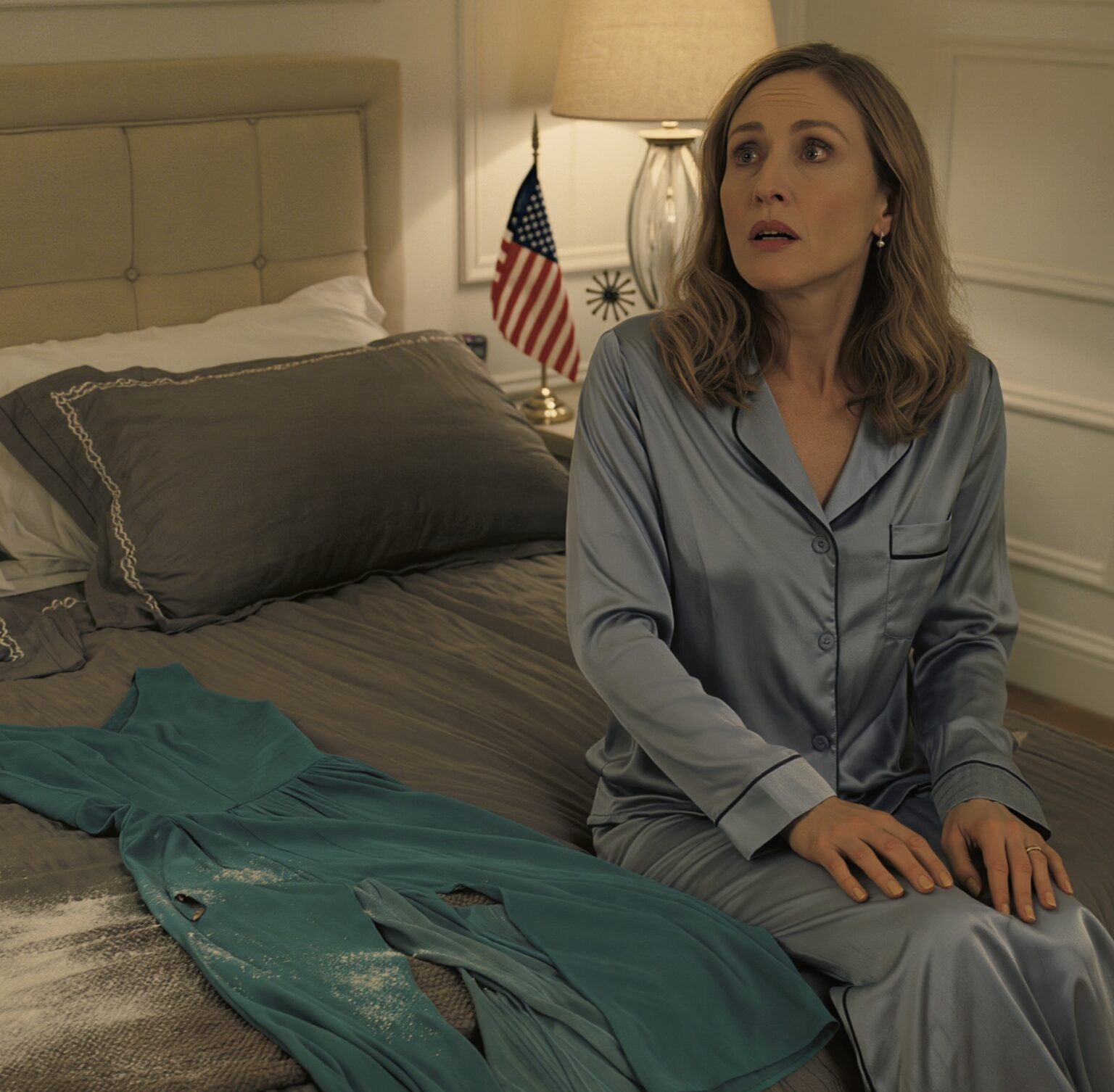
The atmosphere in the house shifted from warm to wintry over the span of six months. Samantha, a woman who viewed my antique furniture as “clutter” and my presence as a “nuisance,” began whispering in Kevin’s ear about the value of the land if it were sold to developers. They started pressuring me to sign over the deed to the “Family Trust,” which Kevin would control. When I refused, the “accidents” started. Small things at first—a rug left bunched up at the top of the landing, a spilled liquid on the kitchen tile that no one bothered to wipe up, or the “forgetting” of my evening medication. I felt a growing sense of unease, a primitive instinct telling me that the people I loved were waiting for me to break. I began to feel like a guest in a house that was slowly being rigged for my demise. I wasn’t paranoid; I was a woman who had spent forty years as a high school principal—I knew the difference between a mistake and a malicious intent.
On a Tuesday afternoon, the tension finally reached a boiling point. Kevin had come into my study, his face flushed with the kind of frantic desperation that usually preceded a request for more money. He wanted $50,000 for a “pivotal” software update, and when I told him the well had run dry, he didn’t storm out like usual. He went quiet. A cold, terrifyingly still kind of quiet. He followed me out toward the grand staircase, his footsteps heavy and rhythmic behind me. I felt a sudden, sharp prickle of fear on the back of my neck. My hand went into my cardigan pocket, and my thumb found the small digital recorder I had started carrying after the last “near-miss” in the kitchen. I clicked the side button, the tiny red light glowing unseen in the dark fabric of my pocket. I didn’t know if I was being dramatic, but I knew I needed a witness to whatever was coming next.
The Two Minutes Before the Fall
The recorder captured everything. First, there was the sound of my own heavy breathing and the creak of the floorboards. Then, Kevin’s voice, low and trembling with a rage he could no longer contain. “You’re being selfish, Mom. Dad would have wanted me to have that money. You’re just sitting on a mountain of gold while I struggle to build something. You’re sixty-six, you’re frail… you don’t even need this house anymore. If you won’t sign the papers, maybe you shouldn’t be the one making the decisions.” I stopped at the very edge of the stairs, my hand gripping the mahogany banister. “Kevin, you’re talking about my life’s work,” I said, my voice recorded with a clarity that would later haunt me. “I won’t let you gamble away this home. And if you ever speak to me like that again, I’ll ask you and Samantha to leave.”
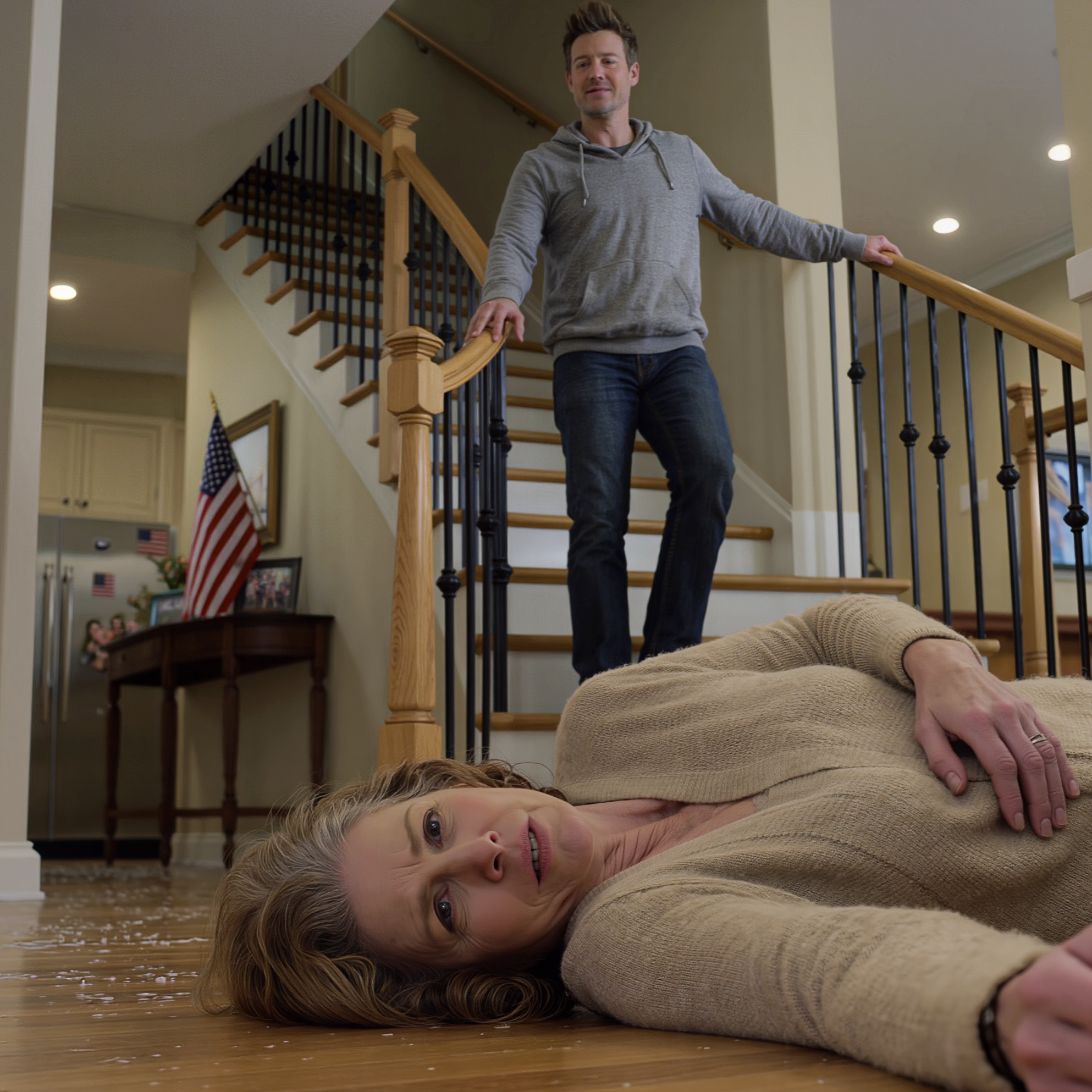
The response wasn’t a verbal one. I heard the scuff of his sneakers on the wood. I felt the sudden, violent impact of two hands slamming into the center of my back. There was no stumble, no accidental slip. It was a deliberate, powerful shove intended to launch me into the air. I remember the sickening feeling of weightlessness, the sight of the foyer floor rushing up to meet me, and then a deafening, bone-shaking crack as my body connected with the middle landing. The recorder, tucked securely in my buttoned pocket, continued to run. It captured the sound of my own strangled cry, the thud of my body, and then—chillingly—the silence. Not a sound of a son rushing to his mother’s side. Just the steady, retreating footsteps of Kevin walking back into the hallway, and then the muffled sound of him calling Samantha. “It’s done,” he whispered, just loud enough for the microphone to catch. “She fell. Call 911. Make sure you sound hysterical.”
The Hospital Masquerade
By the time the paramedics arrived, Kevin and Samantha were a portrait of grief. When I woke up in the ICU two days later, my body a map of bruises and a shattered hip, I saw Kevin standing by the bed, his eyes red-rimmed and his voice thick with a fake, practiced tremor. He was telling the doctors about my “failing balance” and how he had tried to catch me but was “just a second too late.” He was already talking about “long-term care facilities” and “power of attorney” because I was clearly no longer capable of navigating my own home. “Mom fell down the stairs!” he shouted at a visiting specialist, his voice loud enough for the entire ward to hear. “She’s been having these dizzy spells for weeks. It’s a miracle she’s even alive. We need to get her into a secure environment immediately.”
I lay there, unable to speak due to the intubation, but my mind was a razor. I felt the weight of the cardigan I had been wearing—the nurses had placed my personal effects in a plastic bag in the bedside drawer. I knew the recorder was in there. I knew the truth was sitting six inches away from my hand, trapped in a small plastic device. I watched Kevin play the role of the devoted son, leaning over me to whisper, “Just sign the papers when you’re better, Mom. It’ll be easier for everyone. You don’t want another accident, do you?” He thought he had won. He thought the silence of the staircase was his greatest ally. He didn’t realize that in the digital age, silence can be unmade with the push of a button.
The Digital Reclamation of Justice
Three days later, the tubes were out and I was alone in the room with a nurse I had grown to trust—a woman named Sarah who had seen enough “family accidents” to be suspicious of Kevin’s over-the-top performances. “Sarah,” I whispered, my voice a dry rasp, “the bag in the drawer. The blue cardigan. There is a recorder in the pocket. I need you to listen to it with me. And I need you to call the hospital ombudsman.” We sat in the dim light of the recovery room as the audio played. The nurse’s face went from professional calm to absolute horror as she heard the shove, the “it’s done,” and the cold calculation of my son’s voice. She didn’t hesitate. She called the police and the hospital security team immediately.
The reckoning happened an hour later. Kevin and Samantha arrived for their “afternoon visit,” carrying flowers and a fresh set of “management documents” for me to sign. They walked into the room, smiling their predatory smiles, only to find two detectives and the hospital’s legal counsel waiting for them. “We’re just here to see my mother,” Kevin said, his bravado beginning to crack. “She’s had a terrible fall.” The detective didn’t say a word; he simply pressed ‘Play’ on the recorder. As Kevin’s own voice filled the room, detailing the shove and the plan, the color drained from his face until he was the color of the hospital sheets. He tried to claim it was “out of context,” but the audio was a literal blueprint of an attempted murder.
The Silence of a New Beginning
Kevin and Samantha were arrested on the spot, charged with aggravated assault and elder abuse. Because the recording proved premeditation, the judge denied bail. I spent the next two months in a rehabilitation center, rebuilding my strength and my life. I used my recovery time to permanently remove Kevin from the trust and filed a permanent restraining order. I sold the family estate—not to developers, but to a foundation that creates homes for foster children. I realized that a “home” isn’t built of wood and stone; it’s built of truth. I live in a quiet, sun-drenched condo now, with a state-of-the-art security system and a circle of friends who actually care if I’m breathing. Kevin is serving a ten-year sentence, and Samantha has long since vanished, her “loyalty” disappearing the moment the money did. I still have the recorder on my nightstand—a small, plastic reminder that while a son can try to push you down, the truth will always help you stand back up.