The 21-Day Erasure of a Life
For twenty-five years, the red-brick house on Elm Street was my fortress. My late husband and I had spent our youth paying off the mortgage, dollar by dollar, during years when we ate cabbage soup just to make the final payments. After he passed, that house became my only anchor. My son, Kevin, and his wife, Samantha, lived across town in a rental they could barely afford. I had always been generous—paying for their car repairs, buying my grandchildren’s clothes, and even letting them use my credit cards for “emergencies.” I thought I was being a supportive mother. I didn’t realize I was feeding a pair of sharks who were simply waiting for a drop of blood in the water. That blood came in the form of a severe bout of pneumonia that landed me in the ICU for twenty-one grueling days. I was intubated, drifting in and out of consciousness, fighting for every breath. While I was fighting to survive, my son was fighting to ensure I had nothing to come home to.
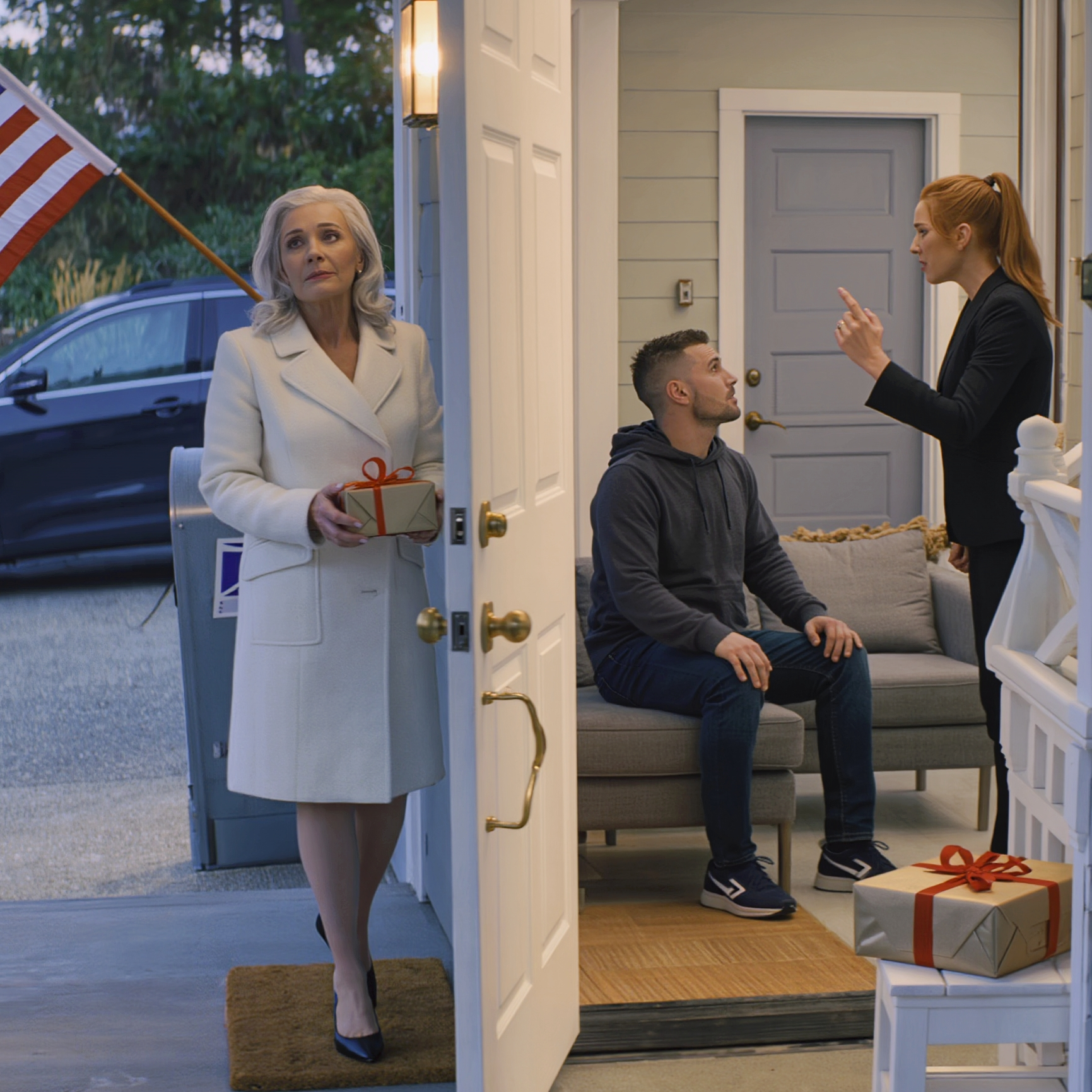
When I was finally discharged, weak and leaning heavily on a walker, I took a taxi home, dreaming of my own bed and a cup of tea. But when I reached my front porch, the locks had been changed. Before I could even reach for my spare key, the door swung open. Kevin stood there, flanked by his father-in-law, a man named Gerald who had always looked at my property with hungry eyes. Kevin didn’t offer a hug or a hand to help me up the steps. He stayed firmly in the doorway, blocking my path. “What’s going on, Kevin? I can’t get in,” I whispered, my voice still raspy from the ventilator. He looked at me with a coldness that froze my blood. “You don’t get in because you don’t live here, Mom. While you were ‘away,’ we realized you weren’t fit to manage your affairs. We’ve transferred the deed to Gerald’s name as part of a private sale to cover your ‘future care costs.’ This house isn’t yours anymore. You should probably go find a shelter or a low-income home. We’ve already moved your things to a storage unit.”
The Shadow of the Power of Attorney
I sat on my walker in the driveway, watching as Samantha pulled the curtains—my curtains—closed. They had used a “Durable Power of Attorney” I had signed years ago during a minor surgery, one I had forgotten to revoke. They had waited until I was literally unable to speak for myself, then used that document to “sell” my home to Samantha’s father for a single dollar. It was a brazen, disgusting act of theft disguised as a legal transfer. They thought they had won because they had the paperwork and I was a frail old woman with no one to turn to. What they forgot was that before I retired, I spent thirty years as a senior title clerk for the county’s land records office. I knew every loophole, every filing requirement, and every “Red Flag” law in the state. They had the deed, but I had the knowledge of how that deed was forged in the fires of fraud.
I didn’t argue. I didn’t cry. I asked the taxi driver to take me to a motel. As I sat in that sterile room, I felt a rage that gave me more strength than any hospital IV. I realized that my son hadn’t just stolen my house; he had attempted to delete my existence. He had calculated that I was too weak to fight and too embarrassed to call the police on my own child. He was wrong on both counts. I spent the next forty-eight hours on my laptop, pulling the digital signatures of the transfer and cross-referencing them with my hospital records. The “sale” had been notarized on the 14th day of my hospitalization—a day when medical records clearly showed I was under heavy sedation and physically incapable of consenting to a legal transaction, Power of Attorney or not.
The Architect of a Legal Storm
The next morning, I wasn’t a victim; I was a plaintiff. I met with a former colleague, a high-powered real estate attorney named Marcus. When I showed him the timeline, his jaw dropped. “They did this while you were intubated?” he asked. “They didn’t just steal a house, Diane; they committed felony exploitation of the elderly and several counts of notary fraud.” We didn’t just file a lawsuit; we filed a Lis Pendens, a legal notice that “freezes” the property so it cannot be sold, mortgaged, or altered. I also contacted the Secretary of State regarding the notary who had authorized the signature. It turns out the notary was a close friend of Samantha’s who had “witnessed” my signature in a hospital room she never actually entered.
The beauty of their greed was their impatience. They had already moved Samantha’s parents into the house, thinking they were safe. They had started tearing out my garden to put in a deck. They were acting like owners before the ink on their fraud was even dry. We waited until Friday afternoon—the time when it’s hardest to get a judge to stay an order—and we served them. Not just with a lawsuit, but with an emergency “Writ of Re-Entry” and a criminal summons for Kevin, Samantha, and Gerald.
The Eviction of the Thieves
The scene at the house was something I will never forget. I arrived with the Sheriff and Marcus. Kevin came to the door, still smug, holding a beer. “I told you to leave, Mom. Call whoever you want, the deed is in Gerald’s name.” The Sheriff didn’t say a word; he simply handed Kevin the court order. “Actually, sir, the deed has been flagged as a fraudulent instrument. The notary has already confessed to a felony. This house is being returned to its rightful owner immediately. You and the ‘current’ occupants have thirty minutes to vacate. Anything left behind becomes the property of the homeowner.”
Samantha’s father, Gerald, came out screaming about “his rights,” but the Sheriff informed him that he was currently being investigated for receiving stolen property. Watching them scramble to throw their belongings into trash bags was a moment of pure, crystalline justice. Kevin tried to approach me, his eyes wide with a sudden, fake desperation. “Mom, come on! We were just trying to protect your assets from the hospital bills! We didn’t mean it like that!” I didn’t even look at him. I looked at the house—my house. “You didn’t protect me, Kevin. You tried to bury me while I was still breathing. From now on, the only ‘care’ you need to worry about is the legal kind.”
The Quiet Victory of Elm Street
I moved back into my house that evening. The locks were changed again, this time by a professional locksmith who ensured no one else had a key. I revoked every Power of Attorney, every trust, and every will that mentioned Kevin’s name. I redirected my entire estate to a local hospice center—places that actually care for the sick, unlike the son I had raised. Kevin and Samantha are currently facing a series of legal battles that will likely leave them bankrupt and possibly incarcerated for fraud. Gerald lost his “investment” and his reputation in the community.
I sit on my porch now, watching the sunset. My lungs are clear, and my mind is sharper than ever. I learned that being a mother doesn’t mean you have to be a martyr. Sometimes, the best way to love yourself is to stand up to the people who were supposed to love you back. My house is quiet now, and for the first time in years, it feels truly mine. The red bricks are still there, the garden is being replanted, and the door is locked—not just against the world, but against the betrayal that tried to take my home.