The Architecture of a Mother’s Blindness
For thirty-five years, that four-bedroom Victorian in the heart of the suburbs wasn’t just a building; it was a sanctuary of memories. It was the place where I measured my son Leo’s height against the kitchen doorframe with a pencil that eventually faded into the wood. It was where my late husband, Arthur, and I hosted decades of Thanksgiving dinners, and where I fully expected to spend my quiet twilight years reading by the bay window. When Arthur passed away five years ago, the house felt far too large for one woman, but it was mine—fully paid for, meticulously maintained, and filled with the scent of lavender and old books. Leo was always what I called a “dreamer,” a gentle term I used to mask his chronic inability to manage a basic budget or hold a steady job for more than eighteen months. When he married Brenda, a woman who looked at the world as if it were a high-end catalog she was entitled to order from, his financial instability shifted from a nuisance to a crisis. I watched from the sidelines as they cycled through credit cards and luxury leases, occasionally writing small checks for “car repairs” or “unexpected medical bills,” never wanting to see my only child struggle. I believed that my role as a mother was to be the ultimate safety net, the one person in the world who would never say “no” when the chips were down. I didn’t realize that by being a safety net, I was simply allowing them to jump from higher and higher heights without any fear of the fall.
The “emergency” happened on a rainy Tuesday evening that I will remember for the rest of my life. Leo arrived at my door without calling first, looking like a man who hadn’t slept or showered in a week. He sat at my kitchen table, his hands shaking so violently that he could barely grip the mug of tea I poured for him. “Mom, we’re in real trouble this time,” he whispered, his voice cracking with a practiced desperation that I now realize was carefully rehearsed. “Brenda and I… we made some bad investments in a private equity firm that turned out to be a total scam. The bank is looking at our personal accounts now, and they’ve frozen our assets. If we don’t come up with $200,000 by the end of the month to satisfy a margin call, we’re going to lose everything. They might even come after our professional licenses for ‘financial instability.’ I wouldn’t ask if it weren’t a matter of life and death, Mom. You’re the only one who can save our future. Please, don’t let us lose our home.” I looked around my beautiful, quiet house—at the crown molding Arthur had installed with his own hands and the rose garden I had spent years tending. I felt a surge of maternal terror. I didn’t ask for bank statements or legal documents; I saw my son’s tears and my heart overrode my brain. I agreed to sell the house. I contacted a fast-cash real estate investor the next day, settled for a price well below market value to ensure a three-week closing, and signed away my life’s work. Within twenty-one days, I was moving my few remaining possessions into a cramped, one-bedroom apartment on the loud side of town, while $250,000 was wired directly into Leo’s “emergency” account.
The Instagram Post That Shattered My World
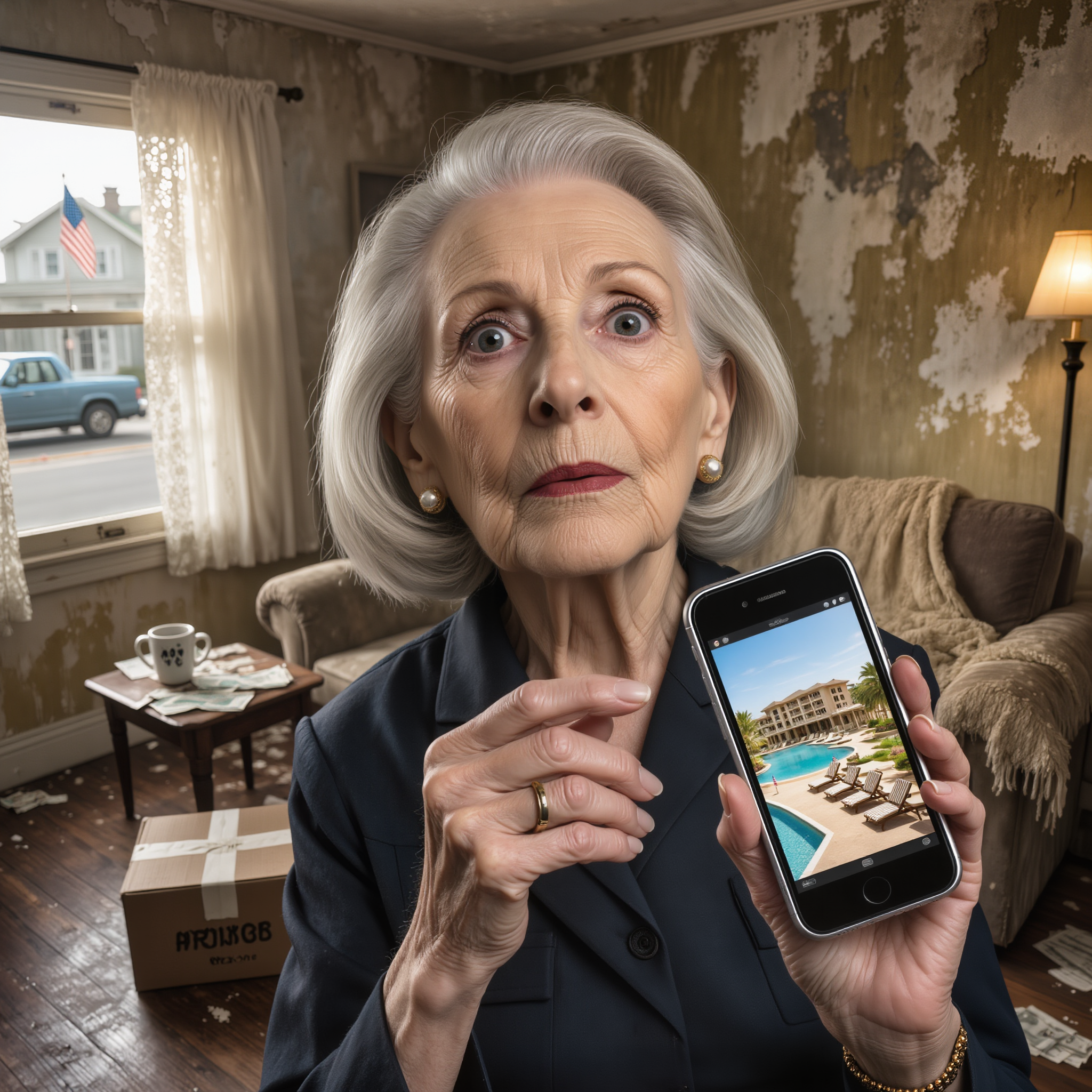
Living in the apartment was a brutal, soul-crushing adjustment. The walls were paper-thin, the elevator was constantly broken, and I missed the morning light hitting my rose bushes more than I could put into words. Every time a siren blared outside my window, I felt a pang of regret, but I comforted myself with the thought that I had saved my son from total ruin. I spent my days in a strange, hollow silence, waiting for Leo to call and tell me the “crisis” had been averted. He had been strangely quiet since the wire transfer went through, barely answering my texts and claiming he was “completely buried in legal paperwork” to fix the mess. I told myself he was just stressed and ashamed of what he had put me through. That fragile illusion lasted exactly seven days. I was sitting on my small, concrete balcony, scrolling through social media to distract myself from the heat of the city, when I saw a post from Brenda. It was a high-definition photo of her standing in a lush, private driveway—not their driveway, but the one at a luxury European dealership. Behind her sat a sleek, metallic-blue Porsche 911 Turbo, its price tag easily exceeding $150,000.
The caption was a jagged shard of glass to my soul: “New season, new wings! 🦋 Life is too short to drive boring cars. Huge thanks to my amazing hubby for making my dreams come true! Truly blessed for this upgrade! #Blessed #LuxuryLiving #PorscheLife #NewBeginnings.” I froze, my thumb hovering over the screen as the world seemed to tilt on its axis. I looked at the date of the post—it was timestamped just forty-eight hours after my house money had cleared. There was no mention of a debt. There was no mention of a legal crisis or a margin call. There was only the shiny, polished evidence of a cold-blooded heist. I went to Leo’s profile and saw him commenting under the photo: “You deserve the best, baby. Only the best for my queen. Hard work pays off!” I felt a physical sickness rise in my throat, a deep, churning nausea that left me lightheaded. I had uprooted my entire life, sold my history, and moved into a shoebox so that my daughter-in-law could have a status symbol. I realized then that the “bad investments” Leo mentioned weren’t financial—they were me. I was the investment they had decided to liquidate for a toy.
The Cold Calculation of a Scorned Mother
I am seventy years old, and for most of those years, I have been known as a “gentle” and “accommodating” woman. But people often mistake gentleness for weakness, and they forget that the same woman who can soothe a crying child can also navigate the complexities of estate law and property titles when she is pushed to the brink. I didn’t call Leo to scream. I didn’t comment on Brenda’s post with angry emojis. Instead, I spent the next forty-eight hours gathering every scrap of evidence I had. I printed every text message where Leo begged for the money, every email where he described the “fake” bank crisis, and the recorded voicemail where he explicitly stated the money was for a “life or death emergency.” I then contacted my late husband’s old business attorney, a man named Silas who had the temperament of a shark and a very long memory. I sat in his office and showed him the Porsche. “Silas,” I said, my voice as cold and hard as a Cleveland winter, “my son committed wire fraud and theft by deception. He used a fabricated crisis to induce me to sell my primary residence. I want it back. All of it. I want to burn their playhouse down.”
Silas looked at the Instagram photos and the bank transfer records with a grim nod. “He was incredibly sloppy, Martha. He didn’t even wait for the ink to dry on your apartment lease before he spent the stolen funds on a depreciating asset. We can file for a constructive trust and an immediate freeze on their assets. Since the money can be directly traced from the sale of your home to the dealership’s invoice, we can argue ‘unjust enrichment’ and fraud in the inducement. We can take the car, their house, and every cent they have left in their joint accounts.” I sat back in the hard plastic chair of my apartment a few hours later, looking at the peeling wallpaper and the stained carpet. “Do it,” I told him via phone. “And don’t give them a warning. I want them to feel exactly as surprised as I was when I saw that blue car.”
The Midnight Repo and the Fall from Grace
The reckoning happened on a Friday night, during a time when Leo and Brenda were hosting a small “car warming” party for their equally vapid social circle. The sheriff arrived with a court order while the champagne was still flowing. Because the Porsche had been purchased with funds obtained through documented fraud, it was seized as evidence and towed away right in front of their horrified guests. Simultaneously, their personal bank accounts were frozen by a temporary restraining order. The “queen” was suddenly left without her wings, and Leo was left with a mountain of legal fees he couldn’t even begin to pay. By Saturday morning, my phone was ringing incessantly. It was Leo, crying—real tears this time, fueled by the terror of actual ruin. “Mom! What did you do? The police took the car! Our accounts are locked! We can’t even buy groceries! Please, you have to tell them it was a gift! You’re going to put your own son in jail over a car!”
“A gift, Leo?” I asked, my voice devoid of the warmth he had exploited for his entire adult life. “You told me it was a matter of life or death. You told me you were going to lose your professional licenses. You lied to your mother to steal her home. I didn’t put you in this position; your own greed and your wife’s vanity did. I’m not the safety net anymore, Leo. I’m the floor. And you’ve finally hit it. I hope the Porsche was worth the view from the bottom.” I instructed Silas to push for the maximum settlement. We forced a private sale of the Porsche and filed a massive lien against their own home to recoup the remainder of the $250,000. Brenda, predictably, filed for divorce the moment the luxury lifestyle evaporated, leaving Leo alone in the mess they had co-authored.
The Return to Sunlight
It took six months of grueling legal battles, but I eventually recovered nearly every single penny from the house sale. I didn’t buy my old Victorian back—it had too much “poverty of spirit” and betrayal attached to it now. Instead, I bought a beautiful, modern cottage by the lake, with a garden twice the size of my old one and a high-end security system that keeps out anyone I haven’t explicitly invited. I live there alone, and for the first time in my life, the silence doesn’t feel lonely; it feels like a hard-won victory. Leo is currently working a low-level warehouse job and living in a studio apartment much worse than the one he forced me into. He sends me letters every week begging for a second chance, but I haven’t opened a single one. I’ve learned that a mother’s love is a powerful thing, but it is not a blank check for abuse. I spent my life building a home for a son who didn’t deserve it; now, I’m spending my life enjoying a home that I finally earned by standing up for myself.