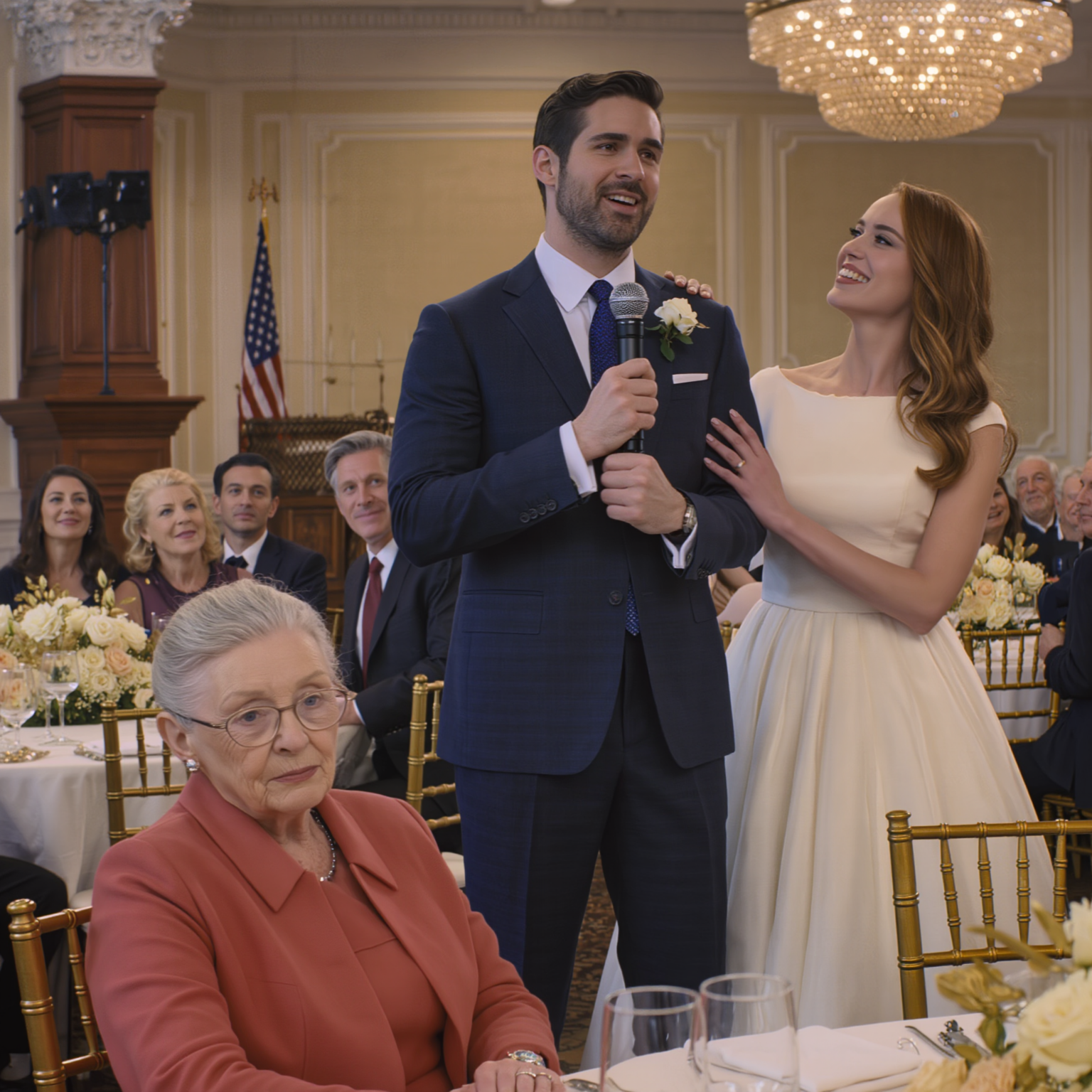
I will never forget the way the air inside that ballroom tightened when my son lifted the microphone, paused, smiled under the chandeliers, and then thanked his “real mother.”
Not me.
Not the woman who gave him life, who scrubbed floors, stretched paychecks, sold jewelry, and went without so he could have shoes that fit and textbooks that weren’t secondhand.
But her.
The woman in gold.
The mother of his bride—adorned like a royal coronation, shoulders shimmering in metallic pride, the applause ready to break before the words even left his mouth.
I stood there, a lavender dress that suddenly felt too soft, too quiet, too invisible. I didn’t cry, didn’t gasp, didn’t crumble aloud. I simply felt the world tilt just enough to bruise. The crowd rose around them—hands clapping, cameras flashing—and my son’s voice, warm and confident, praised the woman who had known him for four years, not the woman who had raised him for a lifetime.
I remembered the invoice still sitting on my kitchen counter at home. The one with the number that had taken my breath before he even walked down an aisle.
$19,000.
The deposit.
Just the deposit.
Money that was meant for my retirement, for quiet mornings, for groceries that didn’t require coupons and budgets that didn’t bend. But he had called me that afternoon with the kind of excitement only sons can wield without guilt:
“Mom, we finally found the perfect venue. But… the deposit is a bit steep.”
Steep didn’t cover it. Steep meant a hill. That number was a mountain. But I transferred it without hesitation, whispering into the phone, “Of course, sweetheart. It’s your wedding.”
Not hers.
Not mine.
Theirs.
Two weeks before the ceremony, I stood at the fitting appointment. I had chosen a simple lavender gown—gentle, dignified, and quiet. But when his bride’s mother entered, wrapped in a fabric so gold it seemed forged, she paused, blinked at me, and smiled that kind of smile women use when they want you to feel small without ever speaking cruelty aloud.
“Oh… you chose something… understated,” she said, her voice dipped in polite venom.
My son nodded—not to me, not to reassure, but to align. “Just don’t stand out too much, Mom. It’s her day.”
I swallowed the sentence I wanted to speak.
I didn’t want a spotlight.
I didn’t want applause.
I simply wanted existence.
The seating chart arrived days later. Her family filled the front row, their names marked in bold. Her mother’s seat centered, angled perfectly for photographs, speeches, and bridal illumination. My place?
Extended family section.
Extended.
A title that stretched like a slap.
Not biological mother.
Not single mother who raised him alone.
Not the woman who worked double shifts to keep heat and lights on.
Extended.
By the time the harpists began to play and the wine moved through glasses like liquid silk, I already understood my role. Not guest of honor. Not mother of the groom. Just a quiet, peripheral shadow in lavender.
But still, nothing prepared me for the moment he lifted the crystal microphone, stared out at hundreds of faces lit by chandeliers, and pronounced:
“I want to thank my REAL mother…”
The crowd gasped—soft, delighted, unaware that behind them my heart fell through its own floor. He turned toward her, toward gold, toward curated motherhood, and continued:
“Thank you for embracing me like your own, for stepping in when I needed a mother most.”
I didn’t move.
Didn’t blink.
Didn’t breathe.
He didn’t whisper thank you to the woman who skipped meals so he could eat, who worked Christmas shifts so his gifts weren’t used or discounted. He thanked someone who never spent a night in an ER waiting room, never held him through fevers, never stitched hems on uniforms at 2 a.m. under kitchen light.
I stood at the back, clapping with a steadiness that felt surgical. If they saw tears, if they sensed hurt—it would become gossip, interpretation, spectacle. A mother isn’t allowed the luxury of pain.
I approached him after the sparkles faded.
“That hurt,” I said softly.
He smiled, dismissive, easy. “Mom, don’t make it dramatic. She deserves recognition. It was her night too.”
Her night.
Paid by me.
Funded by the woman who didn’t deserve mention.
Days later, when the noise died and floral arrangements browned, I submitted documentation for the wedding insurance clause the planner insisted upon:
Full refund if emotional harm is documented.
Three weeks later, the amount returned.
Not to my son.
Not to gold-plated royalty.
To me.
To the invisible mother no crowd applauded.
Months passed. The marriage unraveled with the same dramatic glitter that had built it. The golden mother no longer answered calls. The pedestal cracked. Secrets surfaced like rot beneath marble.
My son knocked on my door in a rain-soaked evening, suit wrinkled, face crumpled.
“Mom… I made a terrible mistake.”
I didn’t gloat.
Didn’t spit truth.
Didn’t rehearse the speech betrayal teaches.
I brewed tea.
Because real mothers do not need microphones.
We do not need chandeliers, scripted speeches, standing ovations, or gold gowns.
We exist in the unseen sacrifices,
in the deposits,
in the back-row seats,
in the lavender dresses that never needed to shine.
He apologized until the room trembled with it.
I forgave—not because I forgot, not because it didn’t split marrow, but because motherhood is not performance. It is endurance. And I will endure long after gold fades and applause dies.
He will remarry one day, maybe.
There may be another aisle, another bouquet, another speech.
But this time, if I am invited, I will sit where placed, smile if called, witness if needed.
I will not fund a single rose petal.
And whether thanked or silenced, applauded or erased, I will know a truth that no chandelier spotlight could ever define:
I was always the real mother.
All along.