I had rehearsed this moment for twelve months. Twelve months of unanswered calls, silent birthdays, returned letters, ignored voicemails, social media darkness, and a daughter who had vanished so thoroughly that people began to look at me with pity, then curiosity, then quiet suspicion. A year earlier she had screamed that she was done with the house, done with family expectations, done with rules, done with me. Then she walked out with two suitcases and eyes that looked like they no longer belonged to anyone I had ever raised. That night I waited at the door until sunrise, staring at the empty driveway, hoping each car passing in the dark was her changing her mind. None were.
So when the anonymous letter arrived, no return address, no signature, no explanation—just an address written in rushed ink, blotched like tears—I didn’t hesitate. I booked flights, packed nothing but essentials, and carried the envelope like a relic of resurrection. The address led to an isolated road lined with tall eucalyptus trees and iron gates that opened silently when I approached, as if they already knew my tires, my heartbeat, and my desperation.
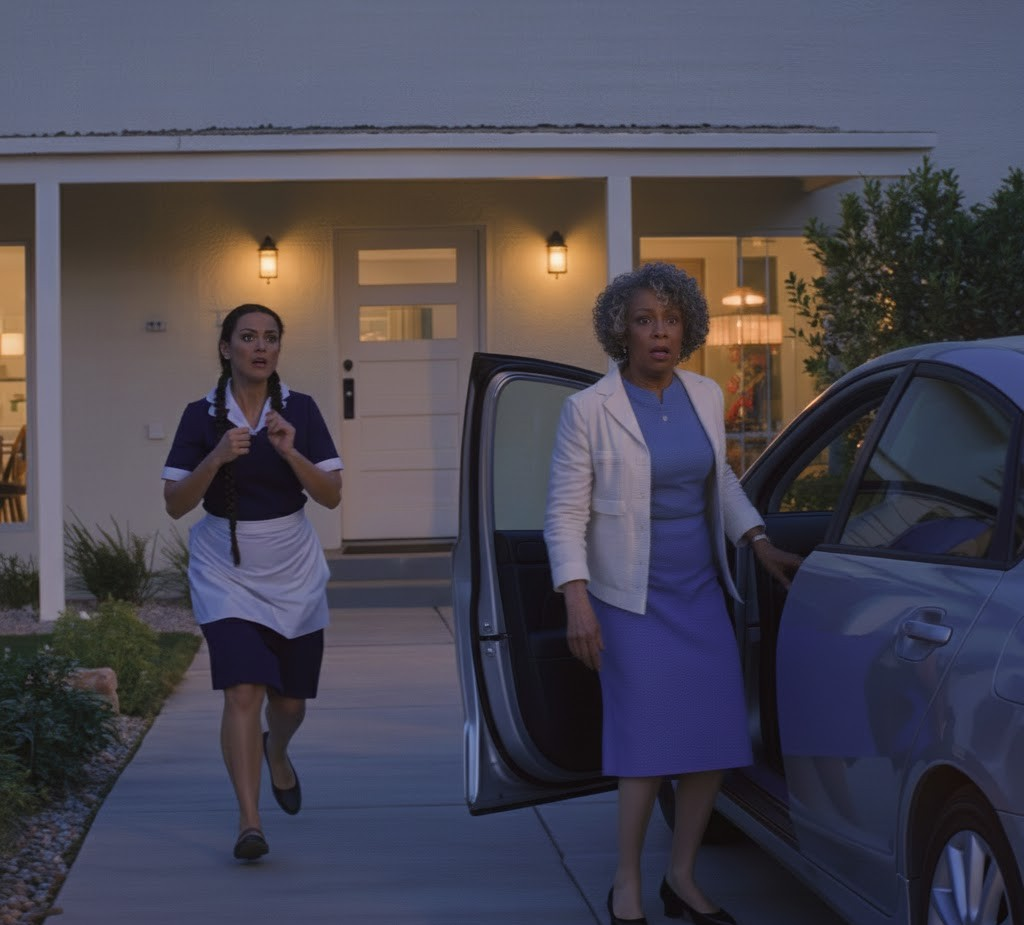
The mansion was too large, too quiet, its windows dark against the moon. As I stepped out of the car, the wind cut the night and something in me—motherhood or instinct or the part of the soul that knows danger before logic—paused. I rang the bell. Before it finished its chime, a woman burst out from behind the door with frantic hair and shaking hands. Her apron was stained, her throat raw, and her eyes so wide that grief or terror had turned them into mirrors.
“DON’T GO IN—LEAVE RIGHT NOW!” she screamed. Not warned. Not whispered. Screamed. The sound ricocheted across stone pillars, scattering birds from high branches.
I froze. The housekeeper grabbed my wrist with a force that belonged to people who have seen too much and outlived too many truths. She dragged me back down the steps so quickly I almost fell. She whispered once, voice cracking on the syllables: “They’re not expecting YOU. If you love her, leave before they see you.”
Before I could ask who they were, or why the house felt like a mausoleum draped in ivy, she shoved me toward the car and shut the door with shaking fingers. I didn’t start the engine. I didn’t drive away. I simply turned off the cabin lights and watched through the windshield as the woman disappeared back inside, sealing the door, sealing the night, sealing whatever horror swallowed her days here.
The property whispered secrets through its hedges. No sound of music, no laughter, no lights, no life. Yet I could smell something—smoke, jasmine, and a perfume I knew too well. My daughter’s. She used to drown herself in it, insisting it smelled like independence.
I waited. Minutes bled into hours. At 2:13 a.m., it happened. A black SUV rolled up the back path, tires silent on gravel that looked too meticulously groomed for mere household staff. Two men exited, tall, composed, moving like bodyguards or soldiers who no longer required uniforms. They didn’t knock, didn’t ring. They used a key. And behind them, stepping out of the car like she belonged to no one and nothing but empire, was my daughter.
She wasn’t the girl who ran away. She wasn’t fragile, loud, impulsive, mascara-smudged rebellion. She was silk. Controlled. Hair pinned in precision. Diamonds without apology. A woman who looked paid for, or loved by power, or swallowed whole by something that promised more than home ever did.
She walked inside without glancing at any window or hedge, as if she knew the housekeeper’s warning had not been enough to stop the inevitable arrival of a mother who refused extinction.
I waited until the men vanished into the west wing before I slipped from the car and approached the side garden, remaining in the shadows where roses grew too perfectly, as though trimmed by someone who feared disorder. I pressed my palm to the cold glass of the back window, peering through a gap in velvet curtains, and there she was—my daughter—pouring champagne beside a man twice her age, laughing a laugh that was rehearsed, mechanical, survival-based.
He leaned too close. Too comfortable. Too proprietary.
My heart cracked in the darkness. Not because she had changed. But because she had been claimed.
The housekeeper appeared briefly in the doorway of the room, her face pale, her lips tight with the kind of silent plea only seen on hostages. When she noticed me watching, she shook her head so slowly that even the moon seemed to hold still. Then she lifted a finger—not pointing at me, but pressing to her own lips: silence.
I stepped back. The night pressed around me like curtains closing on the first act of a tragedy that had already been written without my consent.
I returned to the car, but I didn’t leave. I locked the doors, folded into the seat, and waited. I needed to see who my daughter had become, and more importantly, what she had become entangled with.
The night deepened, thickened. At 3:44 a.m., movement again. A man in a slate-gray suit, shoes polished to the point of reflection, stepped onto the balcony above the garden. He held a phone, speaking in a language I couldn’t identify, clipped vowels and guttural endings. Then, as if summoned by the call, two more vehicles arrived—women stepping out in gowns, not party dresses but high-society, holographic silk, diplomatic-level evening wear.
The mansion did not house a girl who ran away to escape chores and curfews. It housed transactions, alliances, secrets, the kind that required silence from staff and disappearance from daughters.
Rooms lit up in sections like controlled pulses: east corridor, upper study, grand hall, then darkness again, each light revealing silhouettes before swallowing them whole. I saw my daughter again near the staircase, holding a velvet box. She opened it, and even from the distance, even through tinted glass, I recognized the glint of jewels that belonged not to fashion, but to inheritance of power.
She spoke to the man who hovered near her shoulder, a shadow too devoted to merely be security. They weren’t lovers. They weren’t relatives. They were something curated, transactional, mutually beneficial. A contract with oxygen built in.
The housekeeper was right. My presence was not expected, not allowed, not safe.
But motherhood dissolves the edges of fear.
I stepped out again. Quiet. Controlled. I reached the side servant’s entrance. I knew old houses—service doors were never alarmed like front gates. The knob was old brass, and with minimal pressure, it turned.
Inside the corridor smelled of polish, lilies, and secrecy. I moved past portraits of strangers and chandeliers hung like inverted frozen tears. I listened. Voices drifted from the main hall: laughter, glasses touching, not joy but celebratory tension.
I followed the scent—jasmine and ambition—to the guest lounge. My daughter stood in front of a mirror, alone, adjusting an emerald necklace so heavy it bowed her collarbones. She looked through her reflection directly into my eyes without turning.
“You weren’t supposed to come,” she said. Not angry. Not relieved. Just… stated.
I stepped forward, every tile echoing a year of mourning.
“You disappeared,” I said.
She smoothed her dress. “I upgraded.”
Before I could respond, before the ache in my throat could take shape, the man in slate re-entered, saw me, and froze—not in shock, but calculation. His expression was not fear of intrusion but irritation at breach of programming.
The housekeeper suddenly appeared behind him, and in that split second her eyes begged forgiveness—not from me, but for the world that had swallowed my daughter whole.
My daughter lifted her chin, reclaiming authority no girl her age should possess unless she’d traded pieces of herself to earn it.
“She stays,” she told him.
Those two words detonated the air.
He stepped aside. Not in respect. In obedience.
What followed is not easily shaped into sentences. Hours of unraveling truth about where she had gone, who had funded her disappearance, why she had sent the address after a year of silence. Deals, families with names that require no mention, alliances that move nations not households. Her new life was not of glamour but of necessity. She was not kidnapped. She was not coerced. She was positioned.
She told me I could stay until sunrise, but not a minute after. The organization had rules. The estate had guardians. My knowledge had limits.
I watched my daughter speak with diplomacy, power, and terrifying calm. The girl who once wept over failing exams now discussed trade networks and private influence like someone twice her age.
At dawn, the housekeeper led me to the servant door again. Her lips trembled. “You saw enough to understand. Not enough to return.”
When I reached my car, my daughter stood on the balcony, still flawless, still unreachable. She didn’t wave. She didn’t smile. She simply placed her hand on the railing, as if she too felt the last filament of childhood snap.
I drove away slowly, the mansion shrinking in the rearview mirror like a fortress that raises daughters not to love, but to rule.
And though the sun rose gentle and warm, I knew the world she lived in would never allow softness again.