The city had dressed itself in white that morning—white marble sidewalks after rain, white ribbons tied around lampposts announcing celebration to strangers who didn’t know the story behind the glossy shine. I arrived early on purpose, not because I feared being late or ignored, but because I refused to enter like an afterthought into a story I had been building for thirty-three years. The cathedral loomed above me, tall, gold-gilded, its doors carved with angels who had probably seen too many weddings and too many false smiles to care anymore. I paused at the top of the stairs, took in the chiffon draped across pillars, and allowed myself a rare smile. This was my son’s day. My only child. The little boy who once cried when bees landed on sunflowers, who asked if love lasted forever, who learned to tie his shoelaces while I held the ends of the knot with patience only a mother could have. I wore navy blue, deep and enduring, the kind of color that never needs to shout to be seen. The pearl necklace settled against my collarbone like an old friend, my late husband’s last gift before time took him too far for me to reach. I said nothing to the usher who glanced past me to wealthier silhouettes behind me. I signed the guest book with steady fingers: “Mother of the groom.” The pen hesitated only once, not out of doubt but memory.
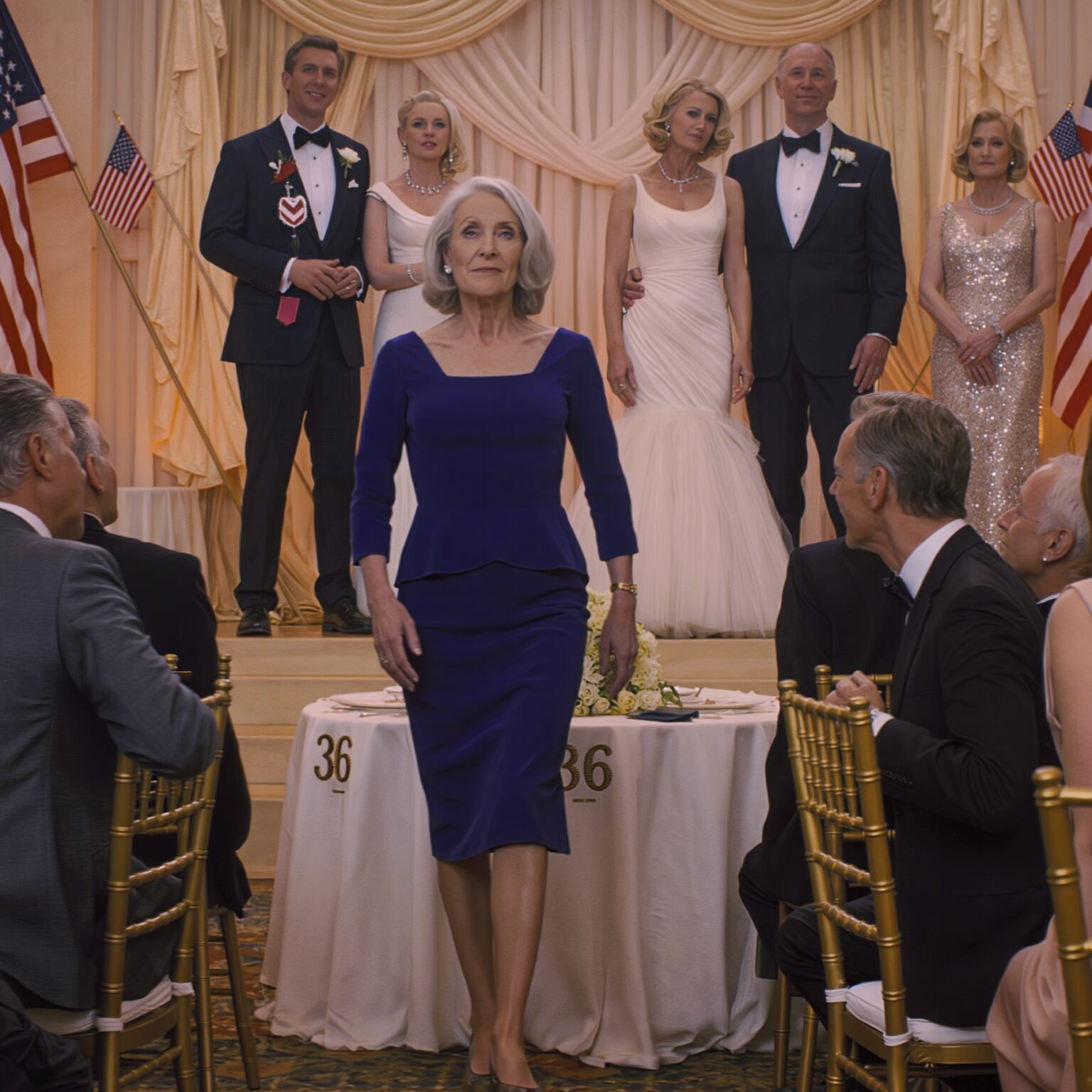
The bride’s family arrived like a choreographed ballet of jewels and entitlement—five black cars, synchronized footsteps, silk swishing like expensive waterfalls. They walked not into the building but into attention. The mother of the bride wore rose-gold sequins that reflected bursts of light the way a disco ball does, almost aggressively. The father, in a white suit that spoke louder than the church bells, surveyed the entrance like he owned the air inside it. Their eyes landed on me, not with recognition, not even with polite curiosity, but with the sort of passive dismissal wealthy people perfect after years of rooms opening automatically for them. When the bride’s mother spoke, her voice was warm tea over ice. “Vendors go through the side, please. We can’t have clutter in the main aisle before photography begins.” Vendors. Clutter. Like I was a misplaced lantern, a delivery woman, a background element. I didn’t answer, because silence is sometimes sharper than rebuttal. But when she realized I wasn’t moving, her brows pinched inward like she had discovered a glitch in her carefully ironed universe. “Who are you here with?” she asked, slow, deliberate, as though I were a language she didn’t know how to read. I held her gaze. “I’m not here with anyone. I am the groom’s mother.” Her lips parted—not in apology, not in adjustment, but in irritation, as though I had stolen a title she meant to erase.
Inside, the cathedral was being prepped for royal presentation. White roses tall enough to hold conversation with saints lined both sides of the aisle. Candlelight flickered through glass and gold. The wedding planner buzzed around like a frantic bee drunk on nectar and deadlines, but even she froze momentarily at the bride’s mother’s gesture that seemed to communicate in one flick: remove her, reposition her, minimize her. I took my seat in the front row anyway, the row meant for me, the row no one could legitimately deny my presence in. The bride’s father leaned to a cluster of elite guests behind him, whispering with just enough volume to stain the air, “She doesn’t belong to this side. She’s not what we expected for our son-in-law’s family.” Expected. As if my existence needed their approval to carry weight.
The ceremony began with violins that soared too high for the humility of vows. The bride entered like a floating crown, all lace and promise. My son’s eyes lifted immediately—not searching for the flowers, not for his bride, but for me. That is the thing about children; no matter how the world dresses them, teaches them, polishes them, they search for the origin of their breathing before they look at anyone else. When he found me, sitting exactly where I should, his shoulders softened, his smile deepened, and for a moment no orchestral triumph could mute the truth that love begins long before weddings do.
When they said their vows—hers practiced, his trembling—the bride’s family looked at her, not at him, as though their daughter were ascending a throne rather than forming a union. They clapped before the officiant even finished sealing the moment. When he declared them husband and wife, my clapping was softer, deeper, an echo not of performance but of decades. They moved to photos outside the cathedral, where light bounced off diamonds like applause only for one side. The photographer began arranging poses with military efficiency. The bride’s mother repeatedly stepped between me and my son, blocking me with her torso, adjusting her daughter’s veil so loudly it drowned my attempts to stand near him. When I tried again, she reached out and pinched my elbow, the grip hidden by camera flash but unmistakably territorial. “Let’s not confuse positions,” she whispered, smile frozen for the camera. “This is a portrait of family.” I lifted her hand from me gently, deliberately. “Yes,” I agreed. “Family.”
The reception hall was a palace: chandeliers dripping crystals, tables heavy with silk runners, champagne towers waiting to break into golden applause. Their speeches began before I was even offered a glass of water. “Our daughter comes from a lineage of excellence,” the bride’s father announced. “This union elevates tradition.” Tradition. Elevates. Each word a pedestal meant to crush anything beneath it. When he toasted, glasses raised like a coronation. Then the bride’s mother: “We are grateful for the beautiful, refined upbringing our daughter has enjoyed. Today is proof of legacy.” Not one nod to the groom’s upbringing except the silent implication that it now benefited by joining theirs. My napkin felt heavier in my hand than any diamond in the room.
When my turn came, I did not stand with a glass. I stood with a framed photograph I had carried in a velvet pouch. My husband holding our son on the day of birth, soft hospital light crowning them both, his eyes filled with a love no fortune could manufacture. I had asked the coordinator to prepare a slide in advance—not because I wanted spectacle, but because those who are erased need illumination. The photo appeared on the projector behind me, enlarging in slow clarity until even those pretending not to see were forced to face origin. The room silenced—not reverently, but uncomfortably, like truth had walked in without knocking. I spoke quietly: “This is the man who raised him. This is the love that shaped him long before today’s celebration.” My son stood up first. No hesitation. No calculation. He hugged me not like a groom hugging a visitor, but a son hugging his source. Then he turned to her family. “She is my mother. She is not a guest in my life. She is the foundation.” His voice did not tremble. The bride looked at me—not like a princess, but like a woman realizing she had participated in someone else’s erasure.
Throughout dinner, my son sat beside me, not beside the throne they had built for themselves. He ate, laughed, asked me if the steak was overdone, if my shoes were comfortable. Normal things. Human things. Not curated things. The bride joined us eventually, quiet and blushed, explaining in a whisper that she never intended any disrespect, that her parents wanted a presentation they could control. I nodded. Understanding does not erase harm, but it softens edges.
Music filled the room with the nostalgia of decades I had lived, loved, lost, endured. I watched my son dance with his bride, then his friends, and finally, he walked to me, hand extended. When we danced, his breath close to my ear, he whispered, “I thought they might do something today. I should have stopped it sooner.” I answered, “Your life is bigger than today. People see what they choose. Love sees what it knows.”
The bride’s mother approached after hours had softened the glitter. Her face no longer carried the armor of entitlement. She looked almost human. “I misjudged,” she admitted. “I thought you would make us look… less.” I didn’t respond immediately, not because I needed triumph, but because I needed sincerity. “Family is not an accessory,” I said. “It doesn’t match fabric or wealth. It matches heart.” She nodded, retreating with a dignity she had not displayed earlier, fragile but present.
By the end of the night, candles burned low, chandeliers exhaled their light, and shoes clicked slower as celebration became fatigue. My son kissed my cheek before leaving in a shower of petals and flash photography. “Thank you for claiming your place,” he said. “I was never unsure,” I answered. “Only quiet.” The car doors closed, and they disappeared into the night, newlyweds but not rulers.
I stepped outside, heels in hand, cool air cleansing sequins and judgments from my lungs. The city was quieter now. The ribbons trembled less. Stars, small but persistent, blinked overhead. I knew then what the bride’s family had failed to understand: you cannot reduce someone who has carried life, grief, growth, and forgiveness in the same body. Exclusion does not shrink the excluded—it exposes the excluder.
I walked to the end of the block, pearls still warm against my skin, and whispered into the dark for my husband to hear, “He’s happy. That’s all that matters.” But I tasted something else on my tongue too—not bitterness, not triumph, not pride. Just truth. And truth is what remains when chandeliers dim, dresses unlace, and roles dissolve.
I had not been erased.
I had simply remained.