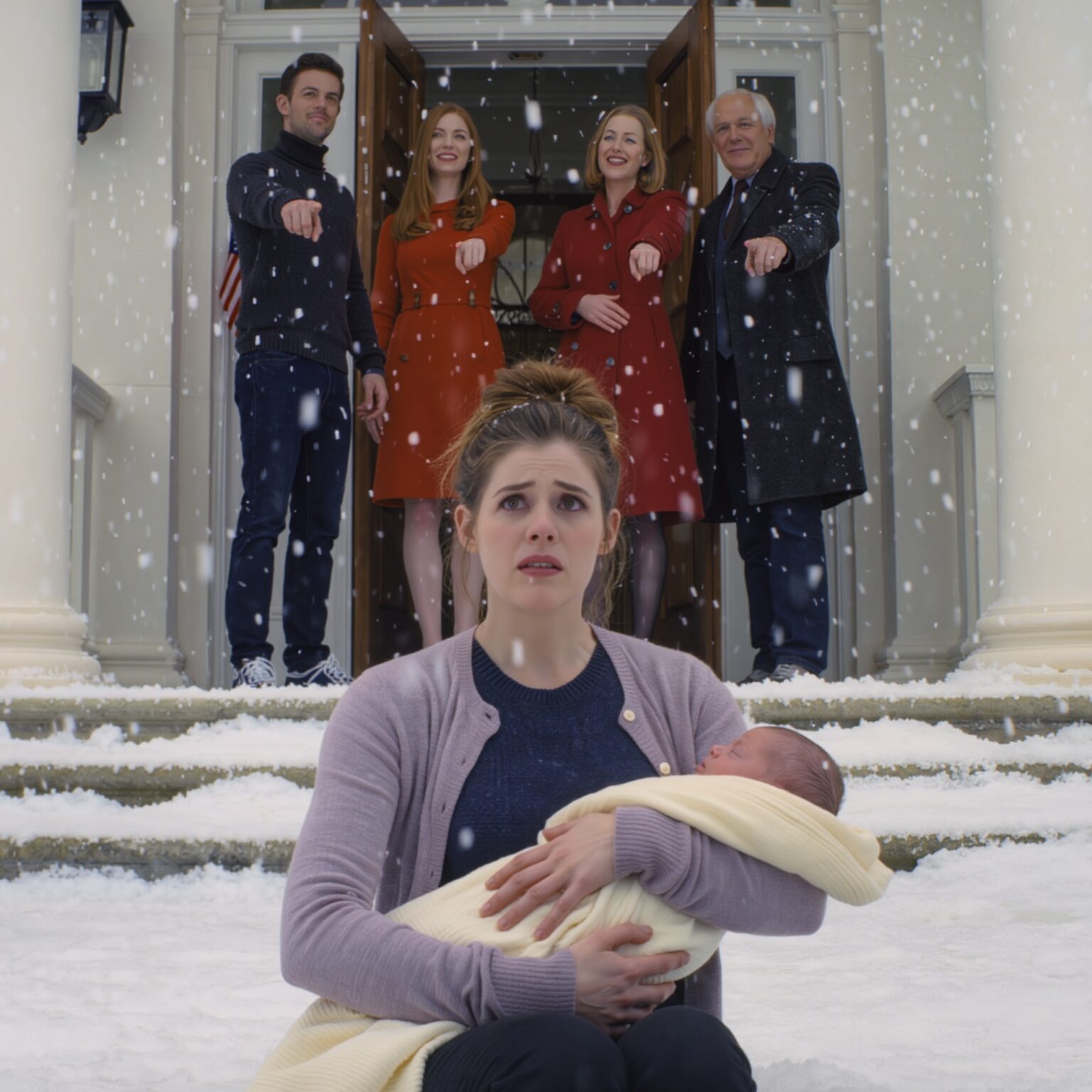
The snow was falling so thick that morning it felt as though the world was dissolving into white. Big, wet flakes dropped from a heavy gray sky, coating the ground in a cold hush — the kind of weather that makes your breath visible even indoors. My baby slept in his car seat in the driveway, bundled under a thick blanket I’d wrapped around him the night before, oblivious to the storm. I stood by the door, my hand trembling slightly on the knob, staring out at the swirling flakes like they were the universe’s way of telling me not to move. In the house behind me, my husband and his family were inside — warm, fed, seated — having just given me the cruelest ultimatum I had ever heard in my life: “You and the baby need to leave. Now. There’s no room for you here anymore.” And the reason? His new mistress had arrived two days earlier — young, polished, eager to be installed as the new lady of the house. A woman who cared nothing for the marriage that once existed, and everything for the status and comfort that came with it.
I remember the way my husband’s voice sounded — calm, almost rehearsed — as though dismissing me was merely another errand he needed to complete. My in-laws stood behind him, silent and impassive, like they had rehearsed this moment too, waiting for their cue to step aside so the next act in their carefully staged lives could begin. I didn’t argue. I didn’t shout. I didn’t cry — at least not in front of them. Instead, I did something they never expected: I smiled. A quiet smile — the kind that slips out when someone has nothing left to lose and everything left to prove. I thanked them. I gathered a few belongings. I lifted my baby into my arms, feeling the weight of his sleeping warmth against my chest, and walked out the door.
The snow was already several inches deep when I closed the door behind me. My boots sank into the cold, powdery surface with each step, and for a moment I felt like I was walking through grief itself — heavy, blinding, impossible to navigate. I pulled my coat tighter around me, clutching my baby close, feeling the soft rise and fall of his tiny chest, and I walked until the house disappeared behind the curtain of falling snow.
I didn’t have a plan. I didn’t have a car — they had taken the keys. I didn’t have money — my accounts were under joint control and now effectively inaccessible to me. All I had was a baby, a heavy coat, and that strange, fierce ember of something unexpected: calm. I walked for what felt like hours, boots crunching in the snow, until a single streetlamp glowed ahead, a small beacon in the vast white world. I found shelter at a 24-hour café — the kind of place where shift workers and lonely travelers sip coffee at all hours, faces half-hidden in steam. I ordered the cheapest thing on the menu — black coffee — and wrapped my baby in the extra napkins the server offered. I didn’t ask for help, and no one offered. The world went on. The snow fell.
That night, I slept in the backseat of a friend’s car — a woman I barely knew but whose kindness was absolute when I quietly asked for it. I didn’t tell her everything. I didn’t need to. She gave me an old blanket and a cup of warm tea and asked nothing more than where I wanted to go next. I didn’t have an answer.
And then, before dawn broke, I got a call that changed my life forever.
It was the executor of my grandfather’s estate — a man I hadn’t spoken to in years. I barely remembered my grandfather. He was a quiet philanthropist with a penchant for anonymity, a man who owned homes around the world but rarely made appearances, who slipped old-fashioned letters into my mailbox when I was a child, each sealed with a wax crest and filled with observations about life and quiet encouragements. I hadn’t seen him in years. In fact, I didn’t know he’d passed away until the call.
His voice on the phone that morning was brisk, polite, full of the kind of neutrality lawyers cultivate as a shield. “Ms. Everly,” he said, “I have good news regarding your grandfather’s estate. You are the primary heir. The inheritance is significant.”
The word inheritance sent a strange shock through my tired body. “How significant?” I asked, my voice quiet, careful.
There was a pause — a careful, measured one. “Two point three billion dollars.”
For a moment, nothing registered except that number — two point three billion. I repeated it in my mind like a mantra, like something I needed to hear several times before I truly believed it. Two point three billion dollars. The world felt like it shifted beneath me, the café walls breathing in slow motion. And then — right at that instant — the storm outside seemed to still, like the snow paused mid-fall, like the universe held its breath just to witness the moment my life decided to veer into a direction no one saw coming.
I didn’t jump. I didn’t scream. I didn’t cry. I just walked out of that café into the pale light of dawn with my baby in my arms, feeling the world change under my feet one quiet step at a time.
I took the next flight home — not to that house, not to the life that had rejected me, but to a small apartment I rented in the city with the inheritance my grandfather had freely given me. I collected my son’s documents. I set up new accounts. I paid off debts. I made a plan. And I kept one simple intention at the forefront of my mind: to live with integrity, strength, and kindness — not with revenge.
It wasn’t long before the news broke. Billionaire heiress returns home after mysterious family dispute. The tabloids had a field day. My phone rang nonstop. Lawyers, distant relatives, opportunists, people looking for a piece of me, a piece of my wealth, a piece of a story they could tell on late-night talk shows. I didn’t answer them. I let most calls go to voicemail. I lived quietly with my baby, walking in parks, feeding birds on sunny days, watching him grow in ways that were simple and pure because those were the only kinds of moments that truly mattered.
And then one day, my husband called. Not by text, not by his sister, not by someone else on his behalf — he called. His voice was thin, unsure, coated in apology that had “I’m scared to say this out loud” all over it. He began by saying he was sorry. Not immediately. First he explained his mistress. Then he explained his fear of change. Then he explained all the excuses humans make when they choose something new instead of honoring what they already had. I listened patiently, my son playing quietly in the background.
When he finally came to the apology — the raw, unvarnished “I’m sorry for what I did to you and to us,” — I didn’t cut him off. I didn’t yell. I didn’t slam the phone. I just said, “I wish you could have seen my worth before I walked out that door in the snow.” And then I paused.
He said, “I always thought you had strength, but not like this…”
I smiled — a slow, gentle smile — and said, “Strength isn’t shown when life is easy. Strength is shown when you walk into the storm with a baby in your arms, and refuse to let either of you be broken by it.”
He didn’t ask to come back.
He didn’t ask for money.
He didn’t ask for anything except forgiveness.
And I offered him this: I forgive you — not because you deserved it, but because I choose peace for me and my son.
He thanked me, and I hung up. Not with bitterness — but with closure.
The inheritance didn’t change who I was — it only gave me the means to live as I always hoped I would: free, respected, and upright. I donated a portion to causes my grandfather cared about — shelters for women and children, educational scholarships, community health programs. The rest I invested wisely. I bought a home near a quiet park, where laughter and sunshine filled the rooms.
My son grew up knowing kindness, dignity, and that real wealth isn’t the number in your bank account — it’s the depth of your courage when life tries to bury you in snow while the world watches.
And every year, when the snow starts to fall gently outside, I stand by the window and think of that day — the day I lost a house, but gained a destiny.
Because sometimes the storm isn’t the end of your life.
Sometimes it’s just the beginning of your strength.