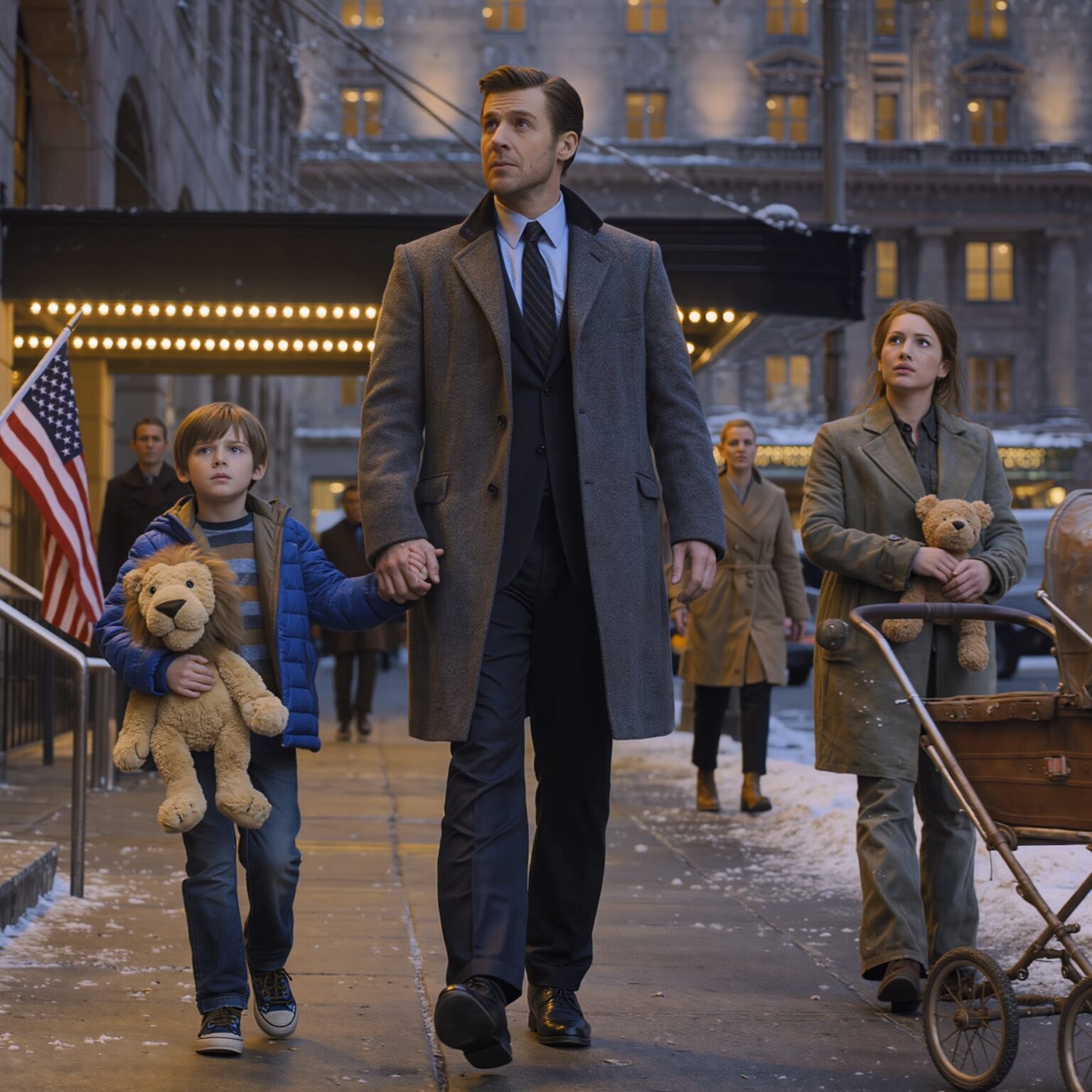
He had spent a lifetime building his success — late nights at the office, carefully negotiated deals, an elegant home that overlooked the city skyline, and a luxury car that gleamed under streetlights like a promise kept. He was the sort of man who measured value in balance sheets, investment returns, and perfectly tailored suits. So on that crisp afternoon when he pulled up at the stoplight on Main Street, he saw the beggar on the corner, wrapped in tattered layers and holding out a faded cup, and he did exactly what he had trained himself to do his whole life: he looked away. Not anger, not disgust, just indifference — the polished version of concern that wealthy people often wear when the world asks for empathy but practicality demands distance.
His son, Oliver — a curious boy of eight with eyes the color of early morning sky — sat in the backseat beside the window. He watched the scene unfold with that quiet intensity children have when they notice life without filtering it through assumptions of status. The car idled at the light, the hum of engines all around blending into the ordinary rhythm of traffic. Then the light turned green, and with a slight pull forward, the wealthy man began to drive on, leaving the beggar on the corner with nothing more than a turned head and a closed window between them.
Oliver didn’t sit quietly, though. He unbuckled his seatbelt, opened the door without waiting for permission, and stepped out onto the sidewalk before his father’s hand could even reach for the door handle. The wealthy man’s first thought was annoyance — traffic, the light, the delay, the inconvenience — but that cognitive buzz evaporated instantly when his son didn’t run back to the car. Instead, Oliver walked directly to the ragged figure on the corner, knelt down, and whispered something that cut through the business-like soundtrack of his father’s life like a blade through silence: “Dad… that’s Mom.”
Time didn’t freeze. Nothing in life ever stops for a sharp revelation. But it paused enough — just long enough for recognition to bloom like a sudden sunrise. The beggar, head bowed against the cold, lifted her face in that moment, and the wealthy man saw it: the woman he had loved, the partner he had once shared dreams with, the mother of his child. Not someone defined by circumstance or appearance, but someone whose worth had never been tied to her coat or her place on a street corner.
He watched as Oliver reached into his own small backpack — a child’s pack weighed down not by responsibility but by crayons, half-eaten snacks, and an uncomplicated heart — and pulled out a sandwich wrapped in wax paper. He placed it gently in the beggar’s hands with all the innocence of someone who sees human first, condition second. The woman’s eyes filled with surprise, then warmth, then something softer still — like memory being brushed gently back into focus.
Only then did the wealthy man see her fully. Not the tattered clothes. Not the unkempt hair. Not the world’s assumption of where someone “belongs.” He saw the laughter lines once etched deep from joy, the soft curve of her cheek he used to kiss goodnight, the way her eyes held steadiness even now — a resilience that no amount of money or status could manufacture.
He didn’t speak at first. He just stepped out of the car, closed the door so softly it sounded like reverence, and walked over with that slow, careful stride people use when they’ve realized they’ve lived half a life without the truest part of it. She saw him coming, eyes widening not in fear, but in the pure shock of recognition — as though decades of distance and hardship might finally be met by the person who mattered most.
There were no dramatic speeches.
No theatrical confessions.
Just the quiet inhale of a father’s realization
and a mother’s recognition that life had been hard,
but she had survived it with grace.
Oliver watched, standing between them like a bridge, like someone who knew that the world was bigger than money, bigger than pride, and that family — real family — is found in the shared moments of recognition, not the absence of suffering.
And when the woman — his wife once upon a lifetime — stood up on trembling legs to embrace her son, and then her husband, something in the wealthy man’s chest uncoiled like a long-held breath finally released. He saw not a beggar, but the person who had stood beside him through early mornings and late nights, the one he had misplaced in the pursuit of success, the person who mattered above spreadsheets and property and all of the accolades that had defined him for so long.
He reached out, hesitated — not out of doubt, but out of the awe that comes when truth lands with full force — and then gently took her hands in his, not to claim her, not to rescue her, but simply to recognize her. The world around them — the honking horns, the rushing cars, the ordinary flow of city life — fell away in that instant. What remained was clarity.
Family is not status.
Family is not convenience.
Family is not distance or pride or assumption.
Family is the eyes that look into yours
and still see you — even when the world has forgotten your name.
And sometimes it takes the eyes of a child
to remind us what we have lost
and what we must never lose again.
Oliver stood there grinning, unaware of the depth of what he had just healed, unaware that in two simple words — “That’s Mom” — he had realigned the orbit of two lives that had drifted far too long in the wrong direction. He just knew, as children know, that some truths are too simple to be anything but real: People matter. Love matters. Family matters.
And in that single moment — in the warmth of recognition and in the falling away of everything that once stood between them — something like home returned. Not as a house, not as a car, not as status — but as a heart remembered.