I had always believed that family was more than a collection of houses on a map — that it was warmth, presence, and the kind of quiet support you give without asking for anything in return. So when people began whispering — not unkindly, but with a kind of misguided certainty — “She’s 72 now; she should live less comfortably, stop expecting so much, learn to be quieter about her needs”… I listened, not in agreement, but with curiosity about how easily assumptions can settle into advice when people have never walked a day in your shoes. They didn’t know that comfort was never my ambition — connection was. I didn’t trace my worth in plush cushions or expensive vacations. I traced it in shared Sunday dinners, the smell of freshly baked lemon loaf, and the soft rhythms of daily life that once felt like love unspoken.
So on a Tuesday evening — I remember it clearly because the sky was that mix of purple and gold just before dusk fully gives way to night — I baked his favorite: lemon loaf with oscillating hints of sugar and tart zest that always made him smile wider than he expected. I didn’t bake it because I expected gratitude or applause. I baked it because I wanted a moment with my son. We hadn’t seen each other in months — birthdays missed, holidays skipped, phone calls shorter than once they were — and I thought that simple gesture might be the start of something gentle, something human.
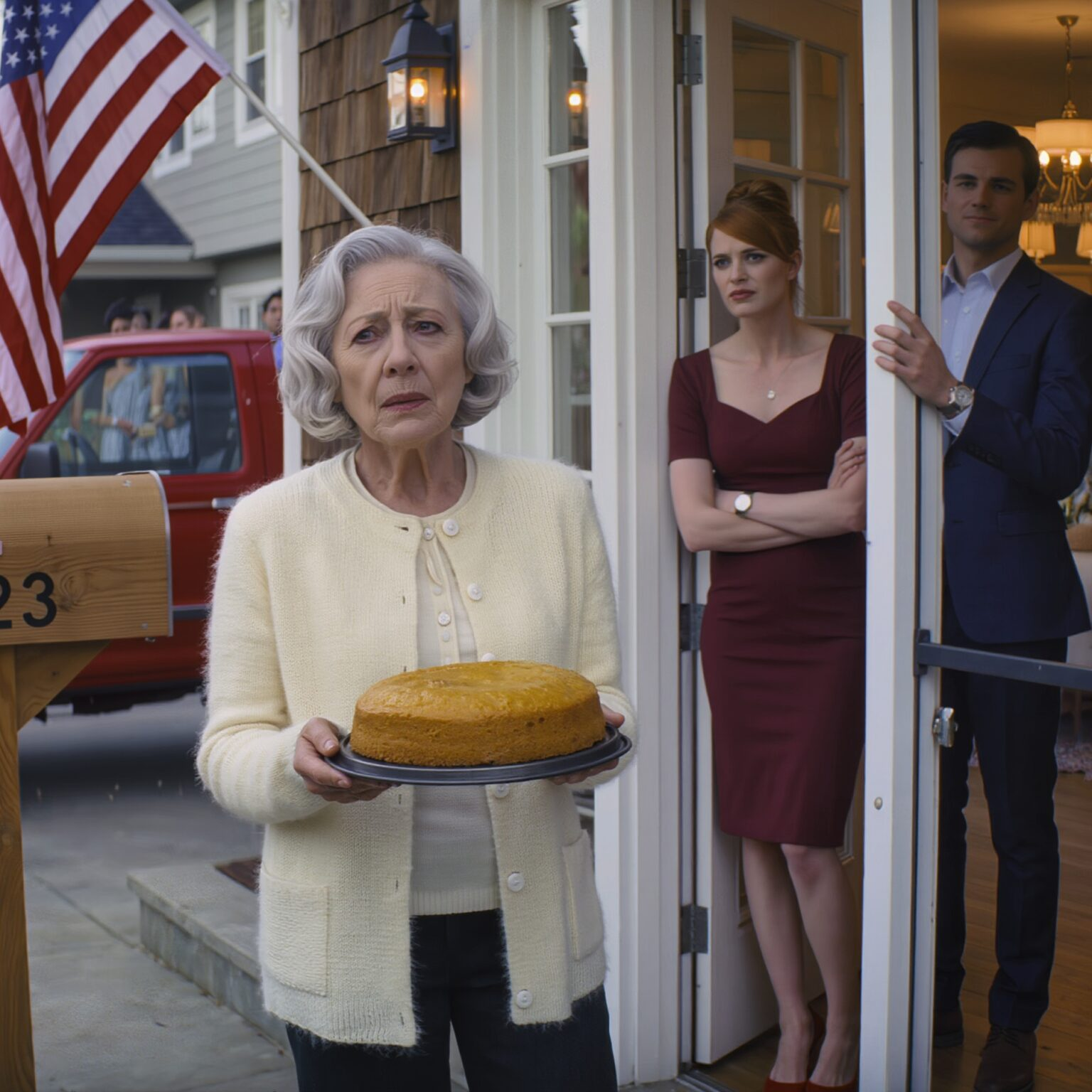
At 7 p.m. I stood on his suburban front porch with the loaf wrapped in wax paper and tied with a ribbon I thought looked cheerful yet respectful. The windows were lit with the warm glow of dinner hour, the kind of light that makes porches feel like invitations rather than thresholds of uncertainty. I rang the doorbell once — polite, deliberate — and took a breath that felt warmer than the evening air. I expected laughter, a hug, the sound of joy in recognition.
What I got instead was the slam of a door closing fiercely before even a greeting could form.
Not “hello, come in.”
Not “Mom, how are you?”
Not even silence with curiosity.
Just the sound of a door shutting.
Inside, I heard voices — him and his wife — but no footsteps toward the door. No hesitation. No “just a moment.” Just silence in movement on the other side of that door like an invisible boundary drawn with stubborn confidence.
I stood there for a long moment with the loaf in my hands, feeling the weight of rejection settle over the porch in a way that was heavier than any icy wind. I wasn’t cold — not physically — but I felt unwillingly familiar with loneliness in that moment, like someone who had learned too early how absence feels when it’s chosen rather than imposed by circumstance.
I didn’t yell.
I didn’t argue.
I didn’t drop the loaf or stomp away.
I just stood.
Not because I expected the door to reopen.
Not because I believed anger would change a mind.
Not because I lacked self-respect.
But because in that quiet stillness — porch light, bread in hand, shadows growing longer — I realized something deeper about how love and dignity intersect, and how people sometimes lose themselves in their own definitions of what family “should be.”
I walked back to my car slowly, not rushed, not embarrassed, just aware. Wrapped in my hands was the lemon loaf — now not just a gift, but a symbol of something else: that generosity is not measured by active acceptance, but by the willingness to offer without expectation. I realized then that the discomfort other people assumed I needed to have at my age — diminished relevance, quiet presence, lower expectations — was not truth. It was their projection shaped by assumptions about age, usefulness, and belonging. But age does not define worth, and especially not emotional presence.
When I reached my car, I didn’t open the loaf and eat it by myself with tears. I opened it with mindful reverence because that lemon loaf was still a gesture of warmth, not a relic of disappointment. And in that moment — simple, humble, quiet — I understood something essential about dignity: it isn’t found in who welcomes you through the door. It’s found in who you remain when the door stays closed.
Later that night, back at my own porch with a cup of tea and the sounds of crickets settling into the darkness, I thought about what had happened not through the lens of hurt, but clarity. I didn’t need my son to open the door to validate my gesture. What mattered was that I had shown up with kindness first, without fear of rejection. That is a form of courage many people never explore because they fear being shut out rather than embrace the strength it takes to show up in love anyway.
The world may tell you to shrink as you age.
It may tell you to settle.
It may assume that comfort means lowering your expectations.
But comfort is not ease alone.
Comfort is self-respect met with softness.
Yes, the door closed that evening.
Yes, the voices inside that house carried on without me.
But nothing in that moment closed my capacity to love with dignity,
nor did it diminish the warmth of a lemon loaf baked with intention,
or the simple truth that love — true, unguarded, generous love —
doesn’t end when a porch door shuts.
It continues in quiet courage.
And that — more than approval —
is what gives life its enduring sweetness.