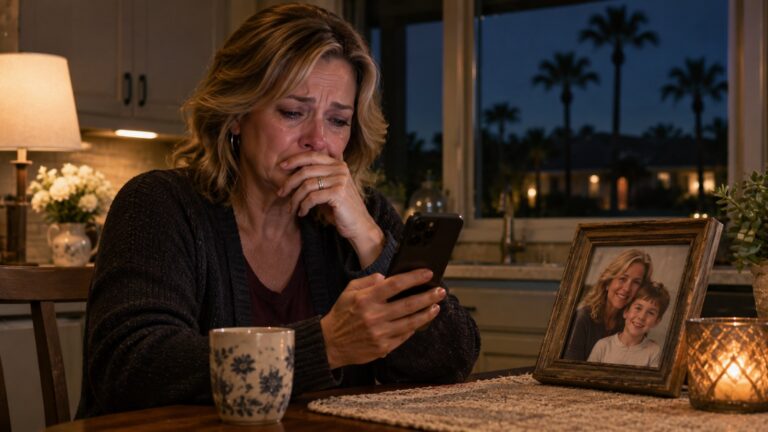
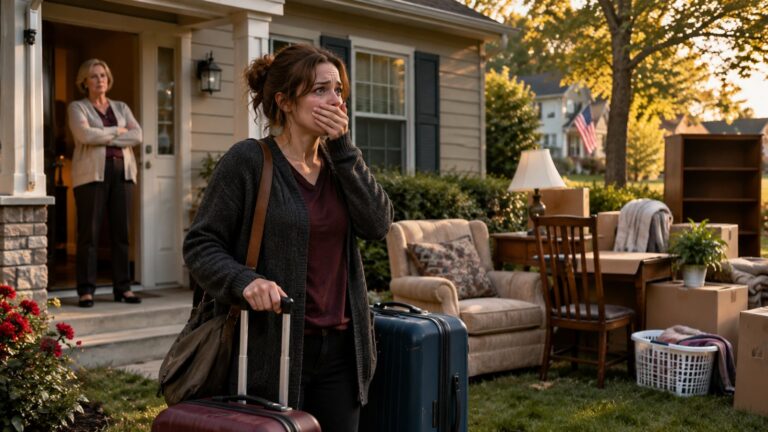
My Daughter’s Rich In-Laws Seated Me in the Kitchen With the Staff at Thanksgiving. Then Their Chef Walked Over and Said, “Mrs. Ruiz? You Saved My Life.”
“We’ve set you up in the kitchen, Rosa,” my daughter’s mother-in-law said with a big smile. “Overflow seating. You’ll be more comfortable there. It’s so much quieter.”
Behind her, through the double doors, I could see the dining room.
A table long enough to land a plane. Crystal glasses. Thirty-two guests in cashmere and pearls. Little gold name cards at every seat.
Mine was taped to a metal stool next to the dishwasher.
My name is Rosa Ruiz. I’m 64 years old. I’m a retired school bus driver from Bridgeport, Connecticut.
And that was the first Thanksgiving I spent with my daughter’s new family.
My daughter, Sofia, is the reason I worked double shifts for twenty years.
Her father left when she was two. It was just the two of us in a one-bedroom apartment over a laundromat. I drove the school bus from six to four, then cleaned offices from six to ten.
She did her homework at the laundromat counter. She studied for the SAT in the back of my bus.
She got a full scholarship to Yale.
That’s where she met Bennett Whitmore. Tall, polite, from Greenwich. His family owns a chain of investment firms. His mother, Caroline, has a house so big it has a name.
They got married last spring. Small ceremony, at Caroline’s insistence. I wasn’t asked to help plan anything.
When the Thanksgiving invitation came, Sofia called me crying with happiness.
“Mama, they want you there. They really want you there.”
I bought a new dress at Macy’s. Navy blue. I made my famous flan, the one Sofia used to ask for every birthday.
When I handed it to Caroline at the door, she passed it to a maid without looking at it.
I didn’t make a scene at the kitchen door. I didn’t want to embarrass Sofia.
She was across the dining room, laughing at something one of Bennett’s cousins said. She didn’t see where they’d put me.
So I sat down on my stool.
The kitchen was chaos. Six cooks in white jackets, steam everywhere, pans clanging. A young server dropped a tray of rolls and nearly cried.
I picked up a towel and helped her gather them without thinking. Old habits.
One of the cooks gave me a plate. Turkey, stuffing, green beans. It smelled wonderful.
I sat on my stool by the dishwasher and ate my Thanksgiving dinner alone.
Halfway through service, the head chef came in from the dining room. A tall man, maybe thirty, with tattoos on his forearms and a voice that made everyone in the kitchen move faster.
“Where’s the second round of gravy?” he called. “Let’s go, people.”
Then he turned and saw me.
He stopped.
He stared at me so long that the kitchen went quiet around him. The cooks looked at each other.
“Mrs. Ruiz?” he said slowly. “Bus number fourteen? Roosevelt Middle School?”
I squinted at him. And then I saw it. The same dark eyes. The same little scar through his left eyebrow.
“Andre?” I said. “Andre Lewis?”
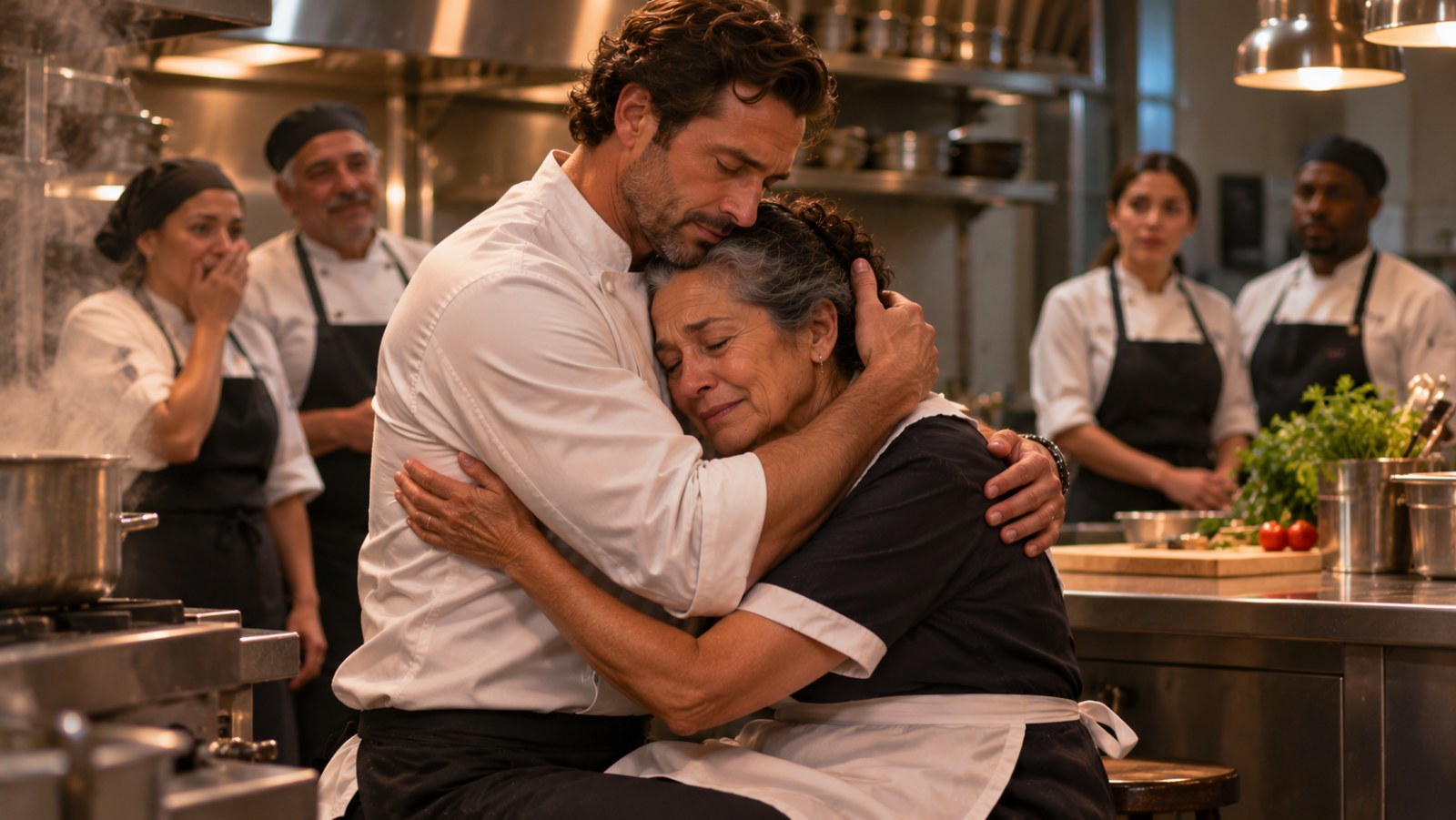
He put down the gravy boat. He walked across the kitchen. And this big, tattooed chef knelt down in front of my stool and threw his arms around me.
“You saved my life,” he said into my shoulder. “You saved my life, Mrs. Ruiz.”
I remembered him.
How could I forget?
Seventh grade. Skinny kid, always last on the bus in the morning, always the last one off in the afternoon. He never had a coat in winter. He never had lunch.
One day, I noticed he stayed on the bus at his stop. He just sat there, staring at his shoes.
“Andre,” I said, “this is your stop, honey.”
“I can’t go home,” he whispered. “My mom’s boyfriend is there.”
He had bruises on his arms.
I didn’t drive him home that day. I drove him straight to the school principal’s office and sat with him for three hours while they called social services. I gave a statement. I testified at the hearing.
He went to live with his grandmother in New Haven. I never saw him again.
But every morning for the rest of that year, I’d kept a granola bar and a juice box in my bag for him. Just in case.
Andre stood up. He turned to his whole kitchen staff.
“Everybody listen,” he said. “This woman is the reason I’m alive. When I was twelve years old, she was the only adult in my life who noticed. She drove me to the principal’s office instead of my house. She testified for me. She brought me breakfast every day for a year.”
The kitchen was dead silent.
“I became a chef,” he said, his voice cracking, “because every morning she handed me food like I was worth feeding.”
Then he looked down at my stool. At the name card taped to it.
His face changed.
“Why,” he said quietly, “are you sitting by my dishwasher?”
I didn’t have to answer. The double doors swung open.
It was Caroline, looking annoyed. “Chef, is there a problem? We’re waiting on the gravy.”
Andre turned around slowly.
“Mrs. Whitmore,” he said. “Is this woman a member of your family?”
Caroline blinked. “She’s my daughter-in-law’s mother. Why?”
“Then why,” Andre said, loud enough that the dining room went quiet behind her, “is she eating Thanksgiving dinner on a stool next to my dishwasher?”
Every head at the long table turned.
Including Sofia’s.
My daughter was out of her chair before anyone else moved.
She came through the kitchen doors, saw me on the stool, saw the name card, and her face crumpled.
“Mama,” she said. “Mama, why are you in here?”
“Overflow seating,” I said quietly.
Sofia turned to her mother-in-law. I’d never seen her so angry. Not even when she was a teenager.
“You put my mother in the kitchen,” she said. “The woman who drove a bus for twenty years so I could sit at tables like yours.”
Caroline opened her mouth. Nothing came out.
Then Bennett appeared behind his wife. He looked at me. He looked at his mother.
And he did something I’ll never forget.
He walked back into the dining room, picked up his own gold name card from the head of the table, carried it into the kitchen, and set it on the counter next to mine.
“If Rosa eats in the kitchen,” he said, “so do we.”
Nobody ate in the kitchen.
Within five minutes, a chair appeared at the head of the table, right next to Sofia. Andre brought my plate out himself and set it down with a flourish, like I was a queen.
And then he brought out my flan.
He’d found it in the walk-in refrigerator, where the maid had put it. He sliced it and served it to every guest at the table.
“This,” he announced, “was made by the best woman I know.”
Caroline took one bite. Then another.
Later that night, while everyone was having coffee, she sat down next to me. She didn’t apologize, exactly. Women like Caroline don’t know how.
But she said, “Rosa, would you teach me how to make this?”
It’s been two Thanksgivings since then.
I sit at the long table now. My name card is gold, like everyone else’s.
Andre has his own restaurant in New Haven. On the wall by the front door, there’s a framed photo of a yellow school bus. Number fourteen.
Under it, a small brass plate says:
“For Mrs. Ruiz, who fed a hungry kid every morning. Everyone eats here.”
THE END.
You never know who you’ll meet again — or what your kindness grew into. >> Would you have stayed quiet on that stool, or walked out? Tell us in the comments.