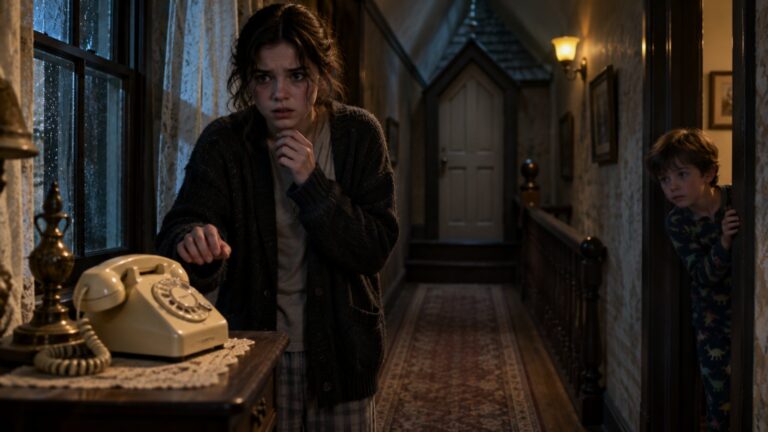
The Night Nurse Told Me, “Don’t Worry About Room 9’s Visitor.” Room 9 Had Been Empty Since 1998.
“Don’t worry about Room 9’s visitor,” the head nurse said, without looking up from her chart. “She’s harmless.”
I laughed, because I thought she was joking.
Room 9 didn’t have a patient. I’d checked the board twice.
My name is Kayla Morgan. I’m 26, and I’d just moved to Big Timber, Montana, for my first real nursing job at Sweet Grass Memorial — a hospital so small it had one hallway, eleven rooms, and a vending machine that only took quarters.
I’d been warned the night shift was quiet.
Nobody warned me about the woman in the yellow raincoat.
It was 2:40 a.m. on my third night. Rain was hammering the windows.
I was restocking gloves when I heard footsteps. Slow, wet footsteps on the linoleum.
I looked up and saw her at the far end of the hallway. Gray hair pinned up. Bright yellow raincoat, dripping. She was carrying a small bunch of daisies wrapped in newspaper.
“Ma’am?” I called. “Visiting hours ended at eight.”
She didn’t turn around.
She walked straight to Room 9, opened the door, and went inside.
I followed her. I was maybe ten seconds behind.
When I pushed the door open, the room was empty.
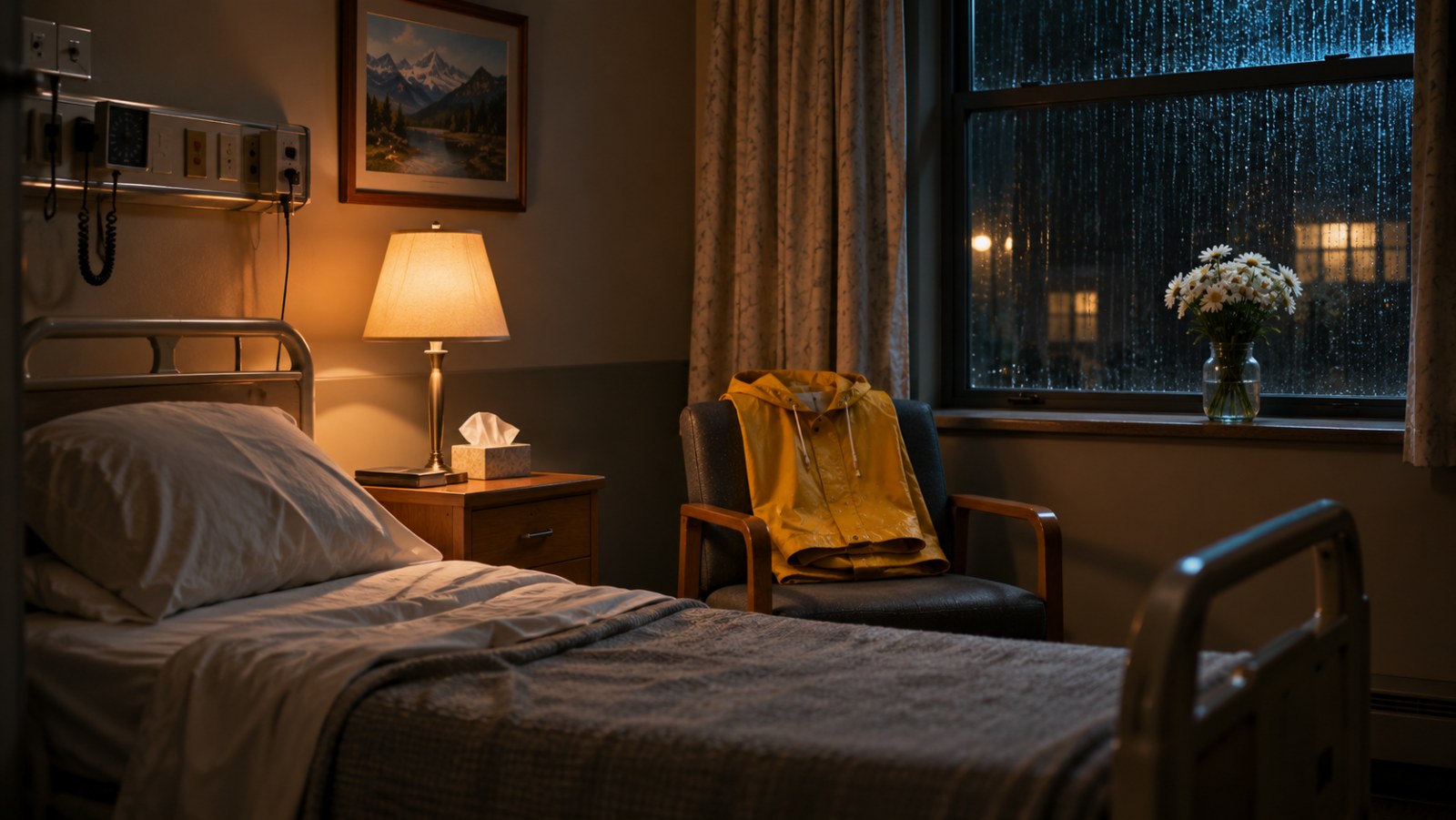
The bed was made, sheets tight. The lamp was off. The window was closed and locked.
But on the windowsill, in a plastic cup of water, were fresh daisies.
And on the chair beside the bed was a yellow raincoat, folded perfectly. Still wet.
I don’t remember walking back to the nurses’ station. I remember my hands shaking so hard I spilled my coffee.
Donna — the head nurse, thirty years on nights — just handed me a paper towel.
“I told you not to worry,” she said.
“Who is she?”
Donna finally looked up. Her eyes were kind, but tired. “Her name is Ruth. She comes when it rains in the fall. She’s been coming since before I started.”
“That’s impossible. Donna, there was nobody in that room.”
“I know, honey.”
“Then where did she go?”
Donna was quiet for a long moment. Then she said something that made the hair on my arms stand up.
“She’s still waiting for him to wake up.”
I didn’t sleep the next day.
I went to the county library instead and asked for old copies of the Big Timber Pioneer. The librarian found the microfilm for me. I started in 1998, because that’s the year Donna said Room 9 was closed.
It took me three hours.
October 14, 1998. A small article on page six.
“LOCAL RANCHER IN COMA AFTER HIGHWAY ACCIDENT.”
Earl Lindqvist, 61, had been driving home from Livingston in a storm when a semi crossed the center line. He was brought to Sweet Grass Memorial. Room 9.
His wife, Ruth, sat by his bed every single night for eleven weeks.
She brought daisies, because they were the flowers he’d picked for her on their first date in 1957.
On December 30, 1998, Earl Lindqvist died without ever opening his eyes.
Ruth died nineteen years later, in 2017.
There was a photo with her obituary.
Gray hair, pinned up. Kind face. And in the background, hanging on a hook by her front door — a bright yellow raincoat.
I almost quit.
I actually typed the resignation email. I sat in my car outside the hospital before my next shift with my thumb over the send button.
Then I thought about the daisies.
Who puts fresh flowers in water if they’re trying to scare you?
I went inside.
It rained again that Thursday. At 2:40 a.m., I heard the footsteps.
This time, I didn’t call out. I just walked to Room 9 and stood in the doorway.
The room was empty. The daisies were on the sill. The raincoat was on the chair.
And the bedside lamp, which had been off all night, was on.
I don’t know why I did what I did next. I pulled up the second chair. I sat down beside the empty bed. And I said, out loud, to nobody:
“Mrs. Lindqvist, I read about Earl. I’m so sorry.”
The lamp flickered. Just once.
I kept going back.
Every rainy night that fall, I took my break in Room 9. I didn’t feel scared anymore. I felt like I was keeping someone company.
Then, in November, something changed.
We got a patient. A young man named Tyler, nineteen, rolled his truck on the same stretch of highway outside Livingston. Head injury. Unresponsive. We had no other bed open.
So they put him in Room 9.
His mother sat with him all night, gripping his hand, whispering his name. She looked like she hadn’t eaten in days.
At 2:40 a.m., it started to rain.
I heard the footsteps.
I ran to Room 9.
Tyler’s mother was asleep in the chair, her head on the edge of the bed.
And on the windowsill, there were fresh daisies.
I swear to you, nobody had brought flowers. I’d checked his belongings myself.
I walked over to check Tyler’s vitals. That’s when I saw his hand.
His fingers were moving.
His eyes fluttered. Opened. He looked around the room, confused, and said in a dry whisper:
“Mom? Who’s the lady in the raincoat?”
His mother woke up screaming his name. I called the doctor. In the chaos, nobody heard what I heard.
Footsteps in the hall. Slow ones. Walking away.
Tyler went home three weeks later. Full recovery. The doctor called it “remarkable.”
On his last day, he asked me a strange question. “Is there an old lady who works nights here? She sat with me. She said her husband never got to wake up, so she wasn’t going to let me sleep through it.”
I didn’t know what to tell him. So I told him the truth.
“Her name is Ruth,” I said. “She’s been looking after this room for a long time.”
It’s been two years now.
It still rains in the fall. I still hear the footsteps sometimes, and I still find daisies on the windowsill of Room 9.
But the raincoat is gone.
The last time I found it on the chair, there was a second set of wet boot prints beside hers. Bigger. A man’s.
They walked out of the room together.
I think Earl finally woke up.
THE END.
Love doesn’t always leave when we do. Sometimes it stays to look after someone else. >> Would you have quit after that first night, or gone back into Room 9? Tell us in the comments.