For 3 Months, Packages Kept Arriving at My House for a Woman Named “Clara Wells.” I’ve Lived Here 9 Years. Clara Doesn’t Exist.
“Package for Clara Wells,” the delivery driver said, holding out a box.
“There’s no Clara here,” I told him. “You’ve got the wrong house.”
He checked his scanner. “1802 East Saguaro Lane?”
“That’s my address. But I’ve never heard of her.”
He shrugged, set the box on my porch, and left.
That was the first one.
My name is Dana Okafor. I’m 41, I’m an elementary school librarian, and I’ve lived in the same little stucco house in Scottsdale, Arizona, for nine years.
In those nine years, nobody named Clara Wells has ever lived here.
But in three months, Clara Wells received fourteen packages at my door.
The first box was a phone. The newest model. Still sealed.
I called the store’s customer service line. “I didn’t order this,” I said. “It’s addressed to someone named Clara Wells.”
“Ma’am, the order was placed with a valid card and shipped to that address. If you don’t know the recipient, you can refuse delivery.”
So I refused delivery.
A week later, a laptop came. Then a pair of $600 sneakers. Then wireless earbuds. Then a designer handbag. Then another phone.
Every time, I sent it back. Every time, two more arrived.
My neighbor, Mr. Harlan, joked about it over the fence. “Maybe you’ve got a secret roommate.”
I laughed. But I wasn’t sleeping well.
Then I noticed something strange.
Sometimes, packages arrived while I was at work. When I got home, they were gone.
At first, I assumed the delivery company had picked them back up. But the tracking always said the same thing: “Delivered. Left at front door.”
Delivered to my porch. And then they vanished.
Somebody was taking them.
I bought a doorbell camera that weekend.
It took nine days.
A Tuesday. I was at school, shelving picture books, when my phone buzzed with a motion alert.
I opened the app.
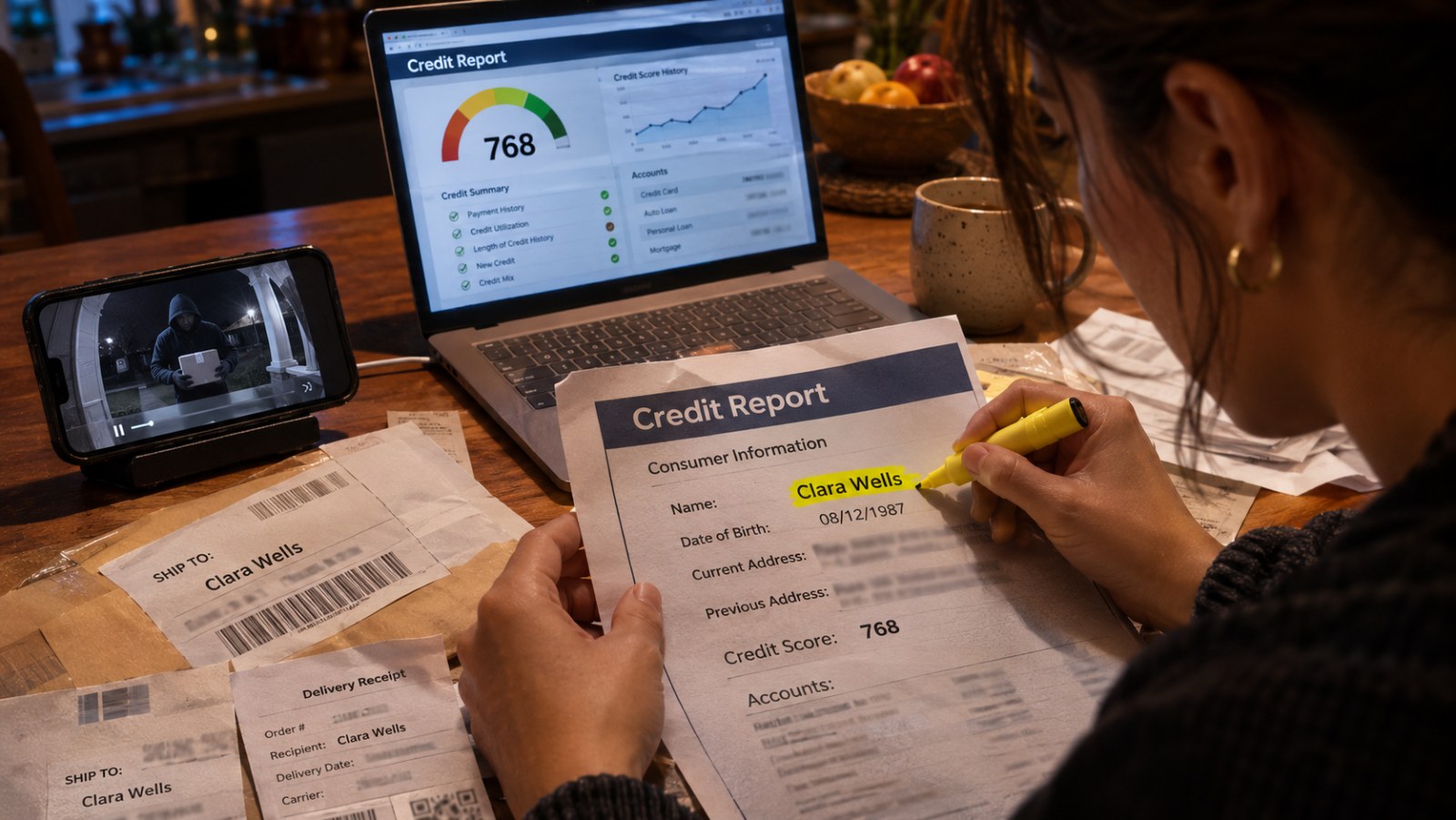
A woman was walking up my driveway. Mid-thirties, sunglasses, a baseball cap pulled low. She walked straight up to my porch like she owned it, picked up a box with “Clara Wells” on the label, and tucked it under her arm.
Then she looked directly at the camera.
She smiled. And waved.
I dropped my phone on the library carpet.
I called the police that afternoon. The officer who came out was kind but not hopeful.
“It’s a porch pirate situation,” he said. “Happens a lot.”
“She’s not stealing my packages,” I said. “She’s stealing packages that were sent to my house in a fake name. Doesn’t that seem worse?”
He wrote it down. He took the camera footage. He said a detective might follow up.
Nobody followed up.
So I did what librarians do.
I started researching.
I pulled my credit report that night. It took me ten minutes.
And there she was.
Clara Wells.
Not just packages. Credit cards. Four of them. Opened in the last five months. Every single one listed my address as the billing address.
Two store credit lines. A cell phone account. A furniture financing plan for $4,200.
But none of them were in my name. That’s what was so strange. My credit was fine. Clara Wells was a completely separate person — with her own Social Security number, her own date of birth, her own credit history going back two years.
A person who didn’t exist, living at my house.
My brother-in-law, Kevin, works fraud investigations for a bank in Phoenix. I called him in a panic.
He was quiet for a while. Then he said, “Dana, it’s called synthetic identity fraud. Someone combined a real Social Security number — probably stolen from a kid or someone who passed away — with a made-up name and a real address. Yours. They build up credit for a year or two, then max out everything and disappear.”
“Why my house?”
“Because it’s real. Because it’s quiet. Because the mail goes to a porch they can reach. And because nobody ever checks their porch at 2 p.m. on a Tuesday.”
“What do I do?”
“Freeze your credit. Report the address. And, Dana — whoever this is knows your schedule.”
That last part kept me up all night.
I didn’t stop.
I made a list of every package, every tracking number, every date and time. I matched it with the camera footage. Every pickup happened on a weekday between 1 and 3 p.m., while I was at school.
Same woman. Same cap.
On the third video, I noticed something I’d missed. When she bent down to pick up the box, the side of her car was visible at the end of my driveway.
A silver SUV. And on the back windshield, a parking permit sticker. Blue and white.
I zoomed in until it blurred. I could just make out the logo.
It was the parking permit for Desert Willow Elementary.
My school.
I sat in my car in the school parking lot the next morning, shaking.
At 7:40, a silver SUV pulled into the staff lot. The blue-and-white permit was on the back windshield.
The woman who stepped out was Shannon Greer. She worked in the front office. Attendance and records.
She’d been at Desert Willow for eight months.
She’d been the one who updated my emergency contact form in September. She knew my address. She knew my schedule down to the minute. She knew exactly when my house would be empty, because she was the one who printed the staff duty roster.
And she had access to the student records of every child in the district.
That’s when I stopped being scared and started being very, very careful.
I didn’t confront her. I didn’t tell anyone at school.
I put together a binder. Every tracking number. Every camera clip. The credit report. The parking permit, circled in red. Her photo from the staff directory, side by side with the doorbell footage.
Then I drove to the Scottsdale Police headquarters and asked for the financial crimes unit.
A detective named Ruiz flipped through the binder for ten minutes without saying a word.
Then she looked up at me. “Ms. Okafor, where did you learn to do this?”
“I’m a librarian,” I said. “Research is the job.”
It moved fast after that.
The detectives got a warrant for Shannon Greer’s home. They found boxes of electronics, still sealed, ready to resell. A notebook with seven fake identities. Seven different addresses around Scottsdale — all teachers and staff from three schools she’d worked at.
And the Social Security numbers?
They belonged to children. Students. Kindergarteners and first graders whose numbers she’d copied from enrollment files. Kids who wouldn’t check their credit for another fifteen years.
Clara Wells’s number belonged to a six-year-old boy in my school’s first-grade class.
Shannon Greer pleaded guilty to multiple counts of identity theft and fraud. The district notified more than forty families. Every one of those children had their records corrected before they were old enough to know anything had happened.
The detective sent me a letter of commendation. The school board gave me a plaque at a meeting. My principal hugged me in the hallway and said, “You saved forty kids from a nightmare they would have found out about at eighteen.”
The packages stopped coming in March.
But I still keep the doorbell camera.
And every once in a while, when I’m shelving books, a first grader comes up to the library desk to check out a mystery novel.
I always give them the good ones.
THE END.
Always check the little things that don’t add up. Sometimes they’re hiding something big. >> Would you have kept sending the packages back, or started investigating like Dana? Tell us in the comments.